
Trade Crypto Perpetuals: the complete perp trading guide
Perpetual futures (perps) are the most traded products in all of crypto. They let you go long or short on Bitcoin, Ethereum and hundreds of altcoins with leverage, without ever owning the underlying asset. This pillar guide explains what a perpetual really is, how the funding rate and liquidation work, where to trade perps (centralized exchanges versus decentralized perp DEXs), how to place your first trade, and the risk rules that keep you in the game.
Transparency: this guide contains affiliate links to platforms we cover. Our analysis stays honest: perps are high-risk instruments and we say so plainly.
What is a crypto perpetual?
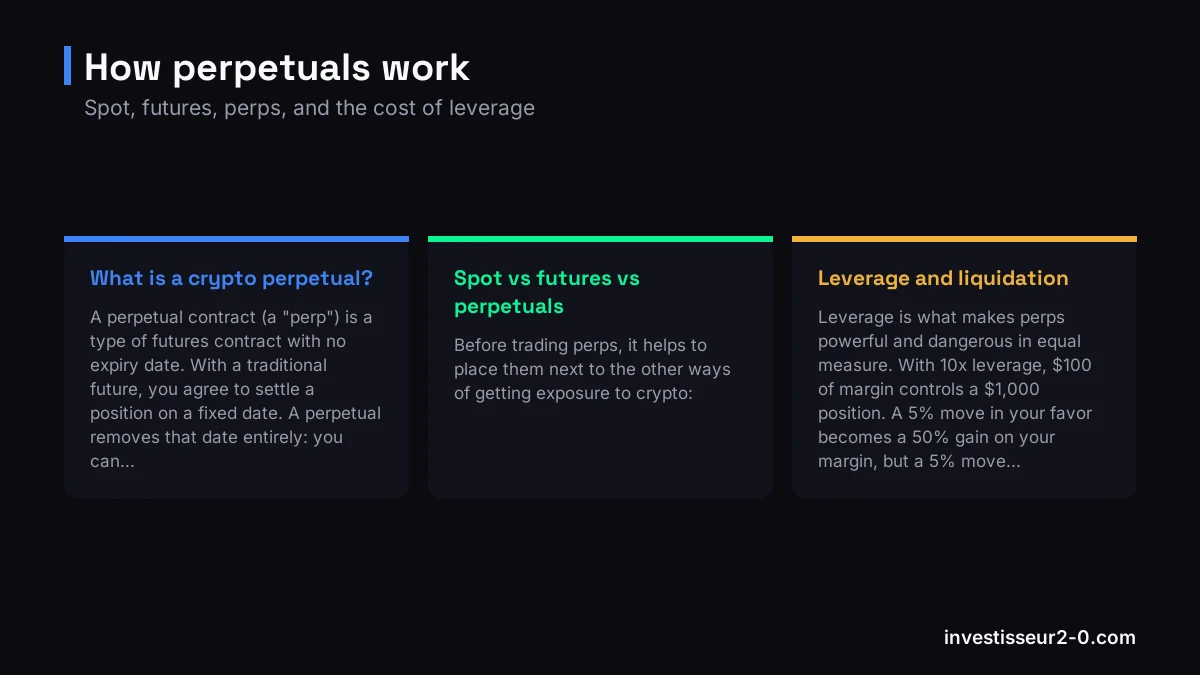
A perpetual contract (a "perp") is a type of futures contract with no expiry date. With a traditional future, you agree to settle a position on a fixed date. A perpetual removes that date entirely: you can hold the position indefinitely, as long as your margin can support it. That is the single feature that defines the product and makes it so popular for active traders.
Because there is no expiry to force the contract price back toward reality, perps rely on a clever mechanism, the funding rate, to keep their price anchored close to the spot price of the underlying asset. We come back to it below. The other defining trait of perps is that they are traded with leverage: you control a position much larger than the capital you put up, which magnifies both profits and losses.
Spot vs futures vs perpetuals
Before trading perps, it helps to place them next to the other ways of getting exposure to crypto:
- Spot: you buy the actual asset (1 BTC, 10 ETH) and own it. No leverage by default, no expiry, no funding. The simplest and safest starting point.
- Traditional futures: a contract to buy or sell at a fixed expiry date. The contract price converges to spot as that date approaches.
- Perpetuals: futures with no expiry. Instead of converging at a date, they use a recurring funding rate to stay close to spot, and they are almost always traded with leverage.
If you are still building the basics, our walkthrough on leverage and crypto futures is the right place to start before you ever open a perp.
Leverage and liquidation
Leverage is what makes perps powerful and dangerous in equal measure. With 10x leverage, $100 of margin controls a $1,000 position. A 5% move in your favor becomes a 50% gain on your margin, but a 5% move against you becomes a 50% loss, and at 10x a roughly 10% adverse move wipes you out entirely.
That wipeout has a name: liquidation. The exchange calculates a liquidation price the moment you open a position. If the market reaches it, your collateral can no longer cover the loss, and the position is automatically force-closed, and you lose your margin. The higher the leverage, the closer that liquidation price sits to your entry, which is why over-leverage is the number-one way new traders blow up an account. Read our deep dive on how liquidations work on crypto exchanges so the mechanic never surprises you.
The funding rate, briefly
The funding rate is the glue that keeps a perpetual tied to spot. Roughly every eight hours, longs and shorts exchange a small payment directly with each other, not with the exchange. When the perp trades above spot (crowd is bullish), longs pay shorts; when it trades below spot, shorts pay longs. This constant nudge pulls the perp price back toward the real market.
For a trader, funding is a recurring cost or income you must factor in, especially if you hold a position for days. Some traders even build strategies around it, and we cover that in our guide to the funding rate as a crypto strategy.
Where to trade perps: CEX vs DEX
There are two broad families of venues for perpetuals, and the choice shapes everything about your experience: custody, identity, fiat access and privacy.
Centralized exchanges (CEX) like Binance, Bybit and XT hold your funds for you, require KYC, and let you deposit fiat (EUR/USD) directly. They offer deep liquidity, polished apps and customer support. The trade-off is custody: the exchange controls your assets, and you must trust it.
Decentralized perp DEXs flip that model. On dYdX you trade from your own wallet, with no KYC and full self-custody, on an on-chain order book. See our full dYdX review for 2026. A newer hybrid is near.com, which routes its order flow into Hyperliquid behind a simple email or FaceID login. Read our near.com review for the details. The trade-off here is responsibility: lose your keys and no support team can help.
| Criterion | CEX (Binance / Bybit / XT) | Perp DEX (dYdX / near.com) |
|---|---|---|
| Custody | Custodial: exchange holds your funds | Non-custodial: your wallet, your keys |
| KYC | Mandatory identity verification | None on dYdX; minimal login on near.com |
| Fiat on-ramp | Yes: deposit EUR / USD directly | No: bridge or deposit crypto/USDC |
| Privacy | Lower: account tied to your identity | Higher: trade from a wallet |
| Fees | Low maker/taker, VIP tiers | Low maker/taker; add on-chain/bridge costs |
| Best for | Beginners, fiat users, deep liquidity | Self-custody, no-KYC, DeFi-native traders |
Placing your first perp trade
Once you have picked a venue, the workflow is broadly the same whether you are on a CEX or a DEX. Here is the path, step by step.
- Fund your account: deposit fiat and convert to a stablecoin on a CEX, or bridge/deposit USDC into your wallet for a DEX. This balance becomes your margin.
- Choose a market and direction: pick an asset (e.g. BTC-USDT), then decide long (you expect it to rise) or short (you expect it to fall).
- Set leverage and margin mode: start with the lowest leverage you can. Prefer isolated margin so a single bad trade cannot drain your whole account.
- Size the position and set a stop: define your position size from your risk budget, place a stop-loss immediately, and note your liquidation price.
- Monitor and manage: watch funding if you hold for long, move your stop to protect gains, and close the trade according to your plan, not your emotions.
If perpetuals still feel abstract, a regulated CEX is the gentlest on-ramp. For EU residents that means a MiCA-licensed venue: Bybit (licensed by the Austrian FMA) or OKX (licensed in Malta) both offer fiat deposits and full futures markets. Readers outside the EU can also create an account on XT (partner link; XT is not regulated in the EU and stopped accepting EU residents in July 2026, and leveraged trading can cost you your whole deposit). Or compare the major venues in our Binance vs XT vs Bybit comparison.
Risk management: the rules that keep you alive
Perps reward discipline and punish everything else. The traders who last are the ones who never let a single trade ruin them, not the ones who win big once. A few non-negotiable rules:
- The 1% rule: risk no more than 1% of your account on any single trade. With a stop in place, this caps the damage of being wrong.
- Always use a stop-loss: decide your exit before you enter. A trade without a stop is a gamble, not a plan.
- Never over-leverage: the temptation of 50x or 100x is how accounts vanish. Lower leverage gives the trade room to breathe.
- Keep dry powder: never put all your margin into one open position.
We dedicate a full guide to this because it matters more than any entry signal. Read our crypto trading risk-management framework and apply it from your very first trade.
Mistakes to avoid
- Trading perps before mastering spot: learn how markets move with your own money first.
- Chasing high leverage: it does not make you more right, it just makes you liquidated faster.
- Ignoring funding: holding the crowded side for days can quietly bleed your margin.
- No stop-loss: hoping a losing trade comes back is how small losses become liquidations.
- Revenge trading: doubling down after a loss to "get it back" usually doubles the loss.
- Over-sizing: a position so big you cannot sleep is a position that is too big.
Not sure which platform fits your level and country? Start with our shortlist of the best crypto exchanges in 2026.
Disclaimer
Trading crypto perpetuals is extremely risky. Leverage can liquidate your entire capital in seconds, and you can lose everything you deposit. Nothing in this guide is financial advice. Perpetual futures are complex products that are not suitable for most beginners. On a DEX, self-custody means you alone are responsible for the security of your wallet and funds. Always do your own research and only commit money you can afford to lose.
FAQ
What is a crypto perpetual (perp)?
A perpetual, or perp, is a futures contract with no expiry date. It lets you go long or short with leverage, and the funding rate keeps its price close to spot. You can hold a position for as long as your margin supports it.
What is the difference between spot, futures and perpetuals?
Spot means you own the actual asset. Traditional futures settle at a fixed expiry. Perpetuals are futures with no expiry: they use a recurring funding rate instead of a settlement date and almost always involve leverage.
What is the funding rate on perpetuals?
A small periodic payment exchanged directly between longs and shorts, usually every eight hours. When the perp is above spot, longs pay shorts; when below, shorts pay longs. It keeps the perp anchored to spot and is a cost, not an exchange fee.
How does liquidation work when trading perps?
Leverage gives you a liquidation price. If the market moves against you and your margin can no longer cover the loss, the position is force-closed and the margin is lost. Higher leverage moves the liquidation price closer to your entry.
Where can I trade crypto perpetuals?
On centralized exchanges such as Binance, Bybit or XT (KYC, fiat deposits), or on decentralized perp DEXs such as dYdX (non-custodial, no KYC) and near.com, which routes order flow into Hyperliquid behind a simple login.
Are crypto perpetuals risky for beginners?
Yes, they are among the riskiest instruments in crypto. Leverage amplifies losses and a sharp move can liquidate your margin in seconds. Learn spot first, start with the lowest leverage, always use a stop, and never risk money you cannot afford to lose.