
How much would you have earned?
Pick a top 50 crypto, a purchase year and an amount. The simulator instantly calculates what that investment would be worth today (May 2026), based on real CoinGecko prices.
Evolution of your $1,000 investment since 2017
"🚀 If I had invested $1,000 in Bitcoin (BTC) in 2017, I'd have $77,595 today (×77.6) 🤯 Try the Investisseur 2.0 simulator:"
Top 10 biggest historical multipliers (since launch)
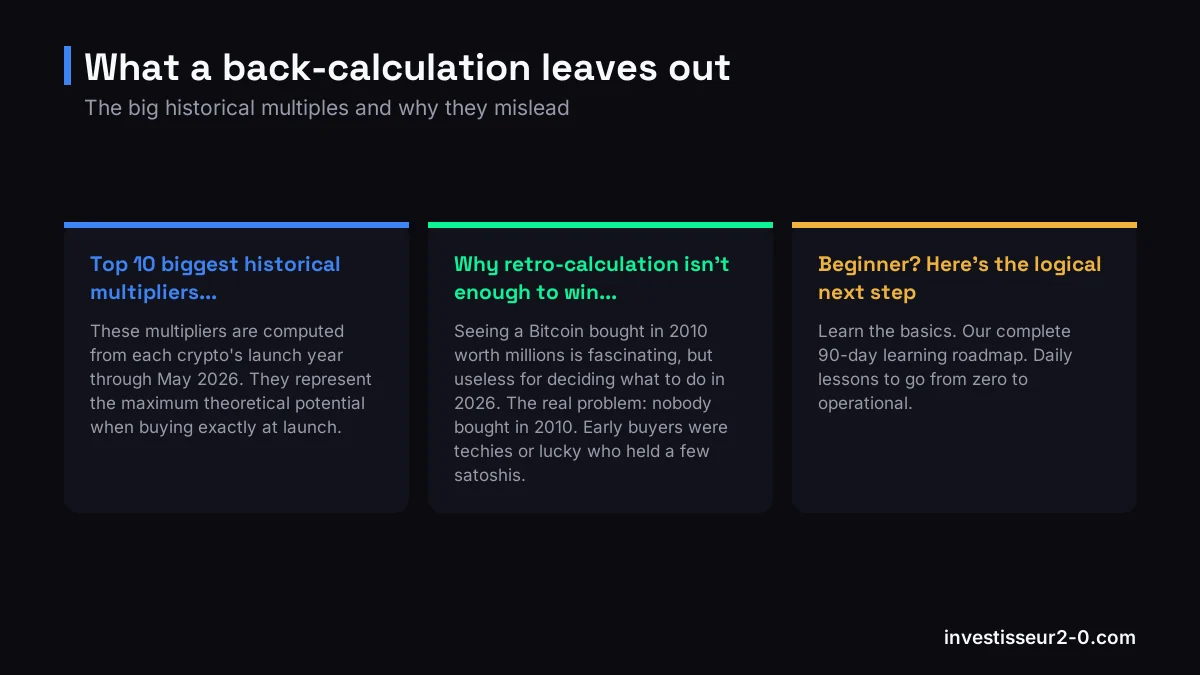
These multipliers are computed from each crypto's launch year through May 2026. They represent the maximum theoretical potential when buying exactly at launch.
| # | Crypto | Launch | Launch price | Price May 2026 | Multiplier |
|---|---|---|---|---|---|
| 1 | ₿ Bitcoin (BTC) | 2010 | $0.08 | $77,440 | ×968,000 |
| 2 | Shiba Inu (SHIB) | 2020 | $0 | $0.000005 | ×50,000 |
| 3 | Ξ Ethereum (ETH) | 2015 | $0.31 | $2,511 | ×8,100 |
| 4 | Binance Coin (BNB) | 2017 | $0.1 | $722.58 | ×7,226 |
| 5 | Litecoin (LTC) | 2013 | $0.07 | $54.12 | ×773.1 |
| 6 | Dogecoin (DOGE) | 2014 | $0.0002 | $0.084143 | ×420.7 |
| 7 | XRP (XRP) | 2013 | $0.005 | $1.38 | ×276.0 |
| 8 | Quant (QNT) | 2018 | $0.3 | $64 | ×213.3 |
| 9 | TRON (TRX) | 2017 | $0.0019 | $0.339358 | ×178.6 |
| 10 | Solana (SOL) | 2020 | $0.94 | $101.24 | ×107.7 |
Why retro-calculation isn't enough to win today
Seeing a Bitcoin bought in 2010 worth millions is fascinating, but useless for deciding what to do in 2026. The real problem: nobody bought in 2010. Early buyers were techies or lucky who held a few satoshis.
For 99% of traders, the question isn't "How much would I have earned if...?" but "How do I find the next x10 without losing all my capital?". This is exactly what the Smart Money Concepts (SMC) methodology teaches: spot institutional accumulation zones before explosions, manage risk by 1% capital, target a minimum 1:3 R:R.
The simulator above shows the magnitude of crypto's potential. Our methodology gives you the tools to capture it on the next opportunities, not regret the past ones.
Beginner? Here's the logical next step
- Learn the basics. Our complete 90-day learning roadmap. Daily lessons to go from zero to operational.
- Pick an exchange and make your first trade. Our comparison of recommended exchanges (OKX and Bybit for EU residents, Pionex via its EU entity, XT and BingX outside the EU) with sign-up bonuses.
- Calculate your risk correctly. Position sizing calculator.
- Learn SMC. Our 10,000-word pillar guide on the institutional methodology.
- Test with AI. Free AI SMC Analyzer that analyzes your charts in 10 seconds.
Frequently asked questions
How does the crypto gain simulator work?
The simulator calculates how much you would have earned if you had bought a certain amount of crypto in a given year. You select the cryptocurrency (top 50 by market cap), the amount in USD/EUR, and the purchase year. The calculator instantly shows the current value of that investment, the absolute gain and the multiplier (e.g. ×147 for Bitcoin bought in 2014). Prices used are January 1st quotes per CoinGecko historical data.
What is the biggest historical gain on a top 50 crypto?
Bitcoin bought in 2010 at $0.08 and held until May 2026 shows a multiplier of approximately ×937 500, meaning $1 became $937 500. On a more recent timeframe, Solana purchased at launch in 2020 at $0.94 trades around $195 today, that's ×207. Memecoins like SHIB (launched 2020) display dizzying multiples but on extremely short timeframes with extreme risk.
Why does the simulator not show big gains for some cryptos?
Not every crypto has appreciated since launch. Many crashed dramatically after their All-Time High (ATH). If you bought Cardano (ADA) at its 2021 ATH of $1.36, you'd be at around $0.85 today, that's -37%. The simulator reflects raw market reality, not cherry-picks. This is precisely why a methodology like SMC is useful: find the right entry points instead of buying at random.
Are the prices accurate?
Prices used are the January 1st quote of each crypto for each year, based on CoinGecko historical data. They are annual opening prices, not monthly or annual averages. For more precise calculations (specific week or day), check CoinGecko or TradingView directly. The simulator gives a representative estimate of what a long-term investment would have yielded.
How do I move from simulation to real crypto investment?
If you're a beginner: 1) Pick a licensed venue: in the EU that means MiCA-licensed exchanges like OKX or Bybit, or Pionex through its EU entity Pionew Ireland; outside the EU, XT or BingX are also options. 2) Create an account with KYC verification. 3) Deposit an amount you can afford to lose. 4) Buy a first position via DCA (spread over time). 5) Secure with a hardware wallet like Ledger once your amount is significant. Our 'My first crypto trade in 30 minutes' guide walks you through step by step.
What are Smart Money Concepts to go further?
Smart Money Concepts (SMC) is the methodology used by institutions to trade markets. Instead of buying at random, SMC identifies zones where institutions accumulate (Order Blocks) or break structure (BOS/CHoCH) to enter at the best points. This is exactly what our site teaches. Once you've taken your first positions, learning SMC can transform your win rate and R:R.
Capture the next x10s
The simulator shows the past. To grasp the future, you need a method. Investisseur 2.0 publishes daily BTC/ETH/SOL analyses with the Smart Money Concepts methodology used by institutionals.
- 📊 Daily BTC analyses (free)
- 🤖 AI SMC Analyzer: analyze your chart in 10 sec
- 📘 Complete SMC pillar guide (10,000 words)
- 🎯 90-day learning roadmap
⚠️ Past performance does not guarantee future results. Investing in crypto involves risks. Only risk what you can afford to lose.