
dYdX Review 2026: the decentralized perpetuals DEX
dYdX is one of the most established names in decentralized derivatives. It lets you trade perpetual futures with leverage directly from your own wallet, without ever handing custody of your funds to a company. In this review we break down how dYdX works, the dYdX Chain (v4), its fees, the DYDX token, and above all the real risks you need to understand before placing a single order.
Transparency: this article contains an affiliate link to dYdX. Our review stays objective: we present the platform with its strengths and its weaknesses, including the parts that can cost you money.
What is dYdX?
dYdX is a decentralized exchange (DEX) specialized in perpetual futures, contracts that track the price of an asset with no expiry date. Its defining trait is that it is non-custodial: you connect your own crypto wallet, your private keys never leave your control, and you keep ownership of your funds at every step. There is no central company holding your balance the way a bank or a centralized exchange does.
On the decentralized version of the protocol there is also no KYC: you do not upload an ID to start trading. That openness is a genuine feature for users who value self-sovereignty, but it shifts the entire responsibility of security onto your shoulders. Lose your seed phrase and no support team can recover your account.
dYdX Chain and dYdX v4
The big leap for the protocol came with dYdX v4, launched in late 2023. Earlier versions of dYdX ran on top of Ethereum layer-2 infrastructure. With v4, the team built a dedicated blockchain using the Cosmos SDK, commonly referred to as the dYdX Chain.
What makes this design distinctive is the central limit order book. Most DEXs rely on an automated market maker (AMM) where you swap against a liquidity pool. dYdX instead reproduces the order-book model you know from centralized exchanges (bids and asks, makers and takers) but with on-chain settlement and self-custody. The goal is to combine the fast, familiar trading experience of a CEX with the trustless guarantees of DeFi.
How it works: USDC, perpetuals and leverage
On dYdX you trade perpetual contracts collateralized in USDC. You deposit USDC as margin, then open long or short positions on the available markets. Many markets offer leverage up to around 20x, depending on the asset, with isolated or cross margin options. If you want the bigger picture first, our complete guide to trading crypto perpetuals walks through the whole workflow end to end.
- Collateral: USDC. There is no direct fiat on-ramp on the protocol itself, so you bridge USDC in.
- Perpetuals: no expiry; a funding rate periodically rebalances longs and shorts toward the spot price.
- Leverage: powerful but dangerous, since it magnifies gains and losses alike and brings the liquidation price closer.
- Margin modes: isolated margin caps risk per position; cross margin shares collateral across positions.
If leverage and perpetuals are new to you, read our explainer on leverage and crypto futures before going further. It is the single most common way new traders blow up an account.
Fees: a low maker/taker model
dYdX uses a classic maker/taker fee model with volume-based tiers. Makers (who add liquidity to the order book) often pay close to zero depending on the tier, while takers (who remove liquidity) pay a small percentage. We deliberately avoid quoting exact percentages here because tiers and schedules change, so always check the live fee schedule on the platform before sizing your strategy.
The takeaway: fees are competitive and structured to reward liquidity providers, which is attractive for active traders. But remember that fees compound across dozens of trades, and on leveraged positions they bite into a much larger notional than your actual capital.
The DYDX token: governance, staking and fee sharing
DYDX is the native token of dYdX Chain, and it plays several roles in the v4 ecosystem:
- Governance: holders can vote on protocol parameters and proposals.
- Staking: DYDX can be staked to help secure the chain, since dYdX Chain is a proof-of-stake network.
- Fee sharing: on v4, stakers earn a share of the protocol trading fees, distributed in USDC, on top of staking rewards.
This alignment, where those who secure the network earn a slice of real protocol revenue, is one of the more interesting tokenomics designs in the perp-DEX space. As always, staking carries its own risks (slashing, lock-up periods, token price volatility) and is not a guaranteed return.
Security and the real risks
Self-custody removes the counterparty risk of a centralized exchange going under, but it replaces it with a different set of risks you must own personally.
- Your keys, your responsibility: there is no password reset and no support line that can restore a lost seed phrase. If your wallet is compromised, your funds are gone.
- Smart-contract risk: any on-chain protocol can contain bugs or be exploited, despite audits.
- Liquidations: with leverage, an adverse move can wipe out your margin and close your position at a loss. See our guide to liquidations on crypto exchanges.
- Dangerous leverage: up to ~20x means a small percentage move against you can erase your entire position.
- No direct fiat on-ramp: you must bridge USDC in and out, which adds steps and on-chain fees.
- Geographic restriction: to be honest about it, the dYdX interface is geoblocked for US residents and some other jurisdictions for regulatory reasons.
None of this means dYdX is unsafe. It means the safety is in your hands. Pair it with disciplined position sizing from our crypto trading risk management guide.
dYdX vs CEX and vs other perp DEXs
How does dYdX stack up against a centralized exchange like Binance or Bybit, and against other decentralized perpetuals platforms such as GMX and Hyperliquid? The core trade-off is always custody and KYC versus convenience and fiat access. For a very different take on self-custodial perps, see near.com, another gateway into perps that routes its order flow into Hyperliquid behind an email or FaceID login.
| Criterion | dYdX | CEX (Binance / Bybit) | Other perp DEXs (GMX / Hyperliquid) |
|---|---|---|---|
| Custody | Non-custodial (your keys) | Custodial (exchange holds funds) | Non-custodial |
| KYC | None on the decentralized version | Mandatory KYC | None |
| Order model | On-chain central limit order book | Order book | AMM / pool or order book (varies) |
| Fees | Low maker/taker, tiered | Low, VIP tiers | Varies by protocol |
| Markets | Perpetuals only | Spot, futures, options, more | Perpetuals (catalog varies) |
| Fiat on-ramp | No (bridge USDC) | Yes (EUR/USD) | No (bridge in) |
| US access | Geoblocked | Restricted / regional entity | Often geoblocked |
How to get started on dYdX
Getting started is straightforward if you already understand wallets and USDC. Here is the path, step by step.
- Connect your wallet: head to dydx.trade and connect a compatible self-custody wallet. Confirm you are not in a restricted jurisdiction.
- Deposit USDC: bridge USDC onto dYdX Chain to fund your trading account. This USDC is your collateral.
- Pick a perpetual market: choose an asset, set your direction (long or short), leverage and margin mode.
- Manage your risk: size the position conservatively, set a stop, and keep an eye on your liquidation price.
Pros and cons
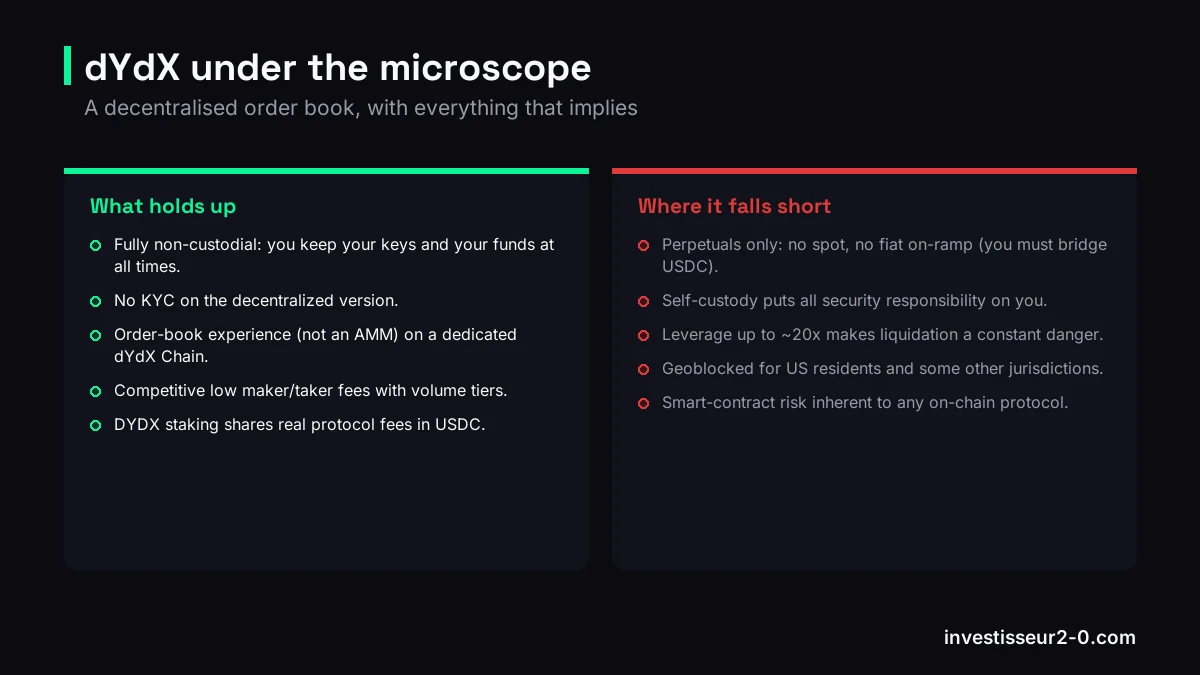
- + Fully non-custodial: you keep your keys and your funds at all times.
- + No KYC on the decentralized version.
- + Order-book experience (not an AMM) on a dedicated dYdX Chain.
- + Competitive low maker/taker fees with volume tiers.
- + DYDX staking shares real protocol fees in USDC.
- − Perpetuals only: no spot, no fiat on-ramp (you must bridge USDC).
- − Self-custody puts all security responsibility on you.
- − Leverage up to ~20x makes liquidation a constant danger.
- − Geoblocked for US residents and some other jurisdictions.
- − Smart-contract risk inherent to any on-chain protocol.
Who is dYdX for?
dYdX is best suited to experienced traders who are comfortable with wallets, USDC bridging and the mechanics of perpetual futures, and who specifically want self-custody and no KYC. It is a strong fit for DeFi-native users who want an order-book experience without trusting a centralized company with their funds.
It is not a good starting point for complete beginners, for anyone who needs a fiat on-ramp, or for US residents who cannot access it. If you are newer to the space or want EUR deposits, a regulated centralized exchange is a more natural first step. See our ranking of the best crypto exchanges in 2026.
Our verdict
One of the most credible decentralized perpetuals venues: an on-chain order book, low fees and real self-custody. We dock points for the missing fiat on-ramp, the geoblocking (notably the US) and a leveraged product best left to advanced traders.
dYdX is one of the most credible decentralized perpetuals platforms in 2026. The v4 architecture, a dedicated Cosmos-SDK chain with an on-chain order book and USDC fee sharing for stakers, is a genuinely thoughtful design that brings a CEX-grade trading experience to a self-custodial setting. If self-custody and no-KYC trading matter to you, it deserves a serious look. You can explore dYdX here.
Disclaimer
Trading perpetual futures is extremely risky. Leverage can liquidate your entire capital in seconds, and you can lose more than you intended if you are not careful with position sizing. Nothing in this article is financial advice. Self-custody means you are solely responsible for the security of your wallet and funds. Do your own research and only commit money you can afford to lose.
FAQ
What is dYdX and how is it different from Binance?
dYdX is a decentralized exchange specialized in perpetual futures. Unlike Binance, you trade directly from your own wallet and keep custody of your funds. There is no KYC on the decentralized version and settlement happens on-chain on the dYdX Chain.
Is dYdX non-custodial and does it require KYC?
Yes, dYdX is non-custodial: you connect your own wallet and your keys never leave your control. The decentralized version does not require KYC. That freedom comes with full personal responsibility for your wallet and seed phrase.
What is dYdX Chain (dYdX v4)?
dYdX v4, launched in late 2023, runs on its own blockchain built with the Cosmos SDK, called dYdX Chain. It uses a central limit order book rather than an AMM, with on-chain settlement.
What leverage and which collateral does dYdX use?
dYdX trades perpetuals collateralized in USDC, with leverage up to around 20x on many markets and isolated or cross margin. High leverage dramatically increases liquidation risk.
Is dYdX available in the United States?
No. For regulatory reasons the dYdX interface is geoblocked for US residents and several other restricted jurisdictions.
What is the DYDX token used for?
DYDX is used for governance and can be staked to help secure dYdX Chain. On v4, stakers earn a share of protocol trading fees, distributed in USDC, plus staking rewards.