
near.com Review 2026: the chain-abstraction super-app
near.com is the NEAR super-app that wants to make crypto feel like a normal app: you sign up with an email or FaceID, with no seed phrase and no manual bridging. Behind that simple login sits chain abstraction, perps powered by Hyperliquid, and a privacy layer called Confidential Mode. In this review we break down how near.com actually works, what is real, what is a trust assumption, and the risks you need to understand before you fund an account.
Transparency: this article contains an affiliate link to near.com. Our review stays objective. We present the platform with its strengths and its weaknesses, including the parts that can cost you money.
What is near.com?
near.com is the NEAR "super-app", launched in February 2026. Its headline idea is chain abstraction: instead of asking you to pick a network, manage a seed phrase and bridge assets by hand, it hides all of that plumbing behind a single account. You sign up with an email or a FaceID / passkey: there is no seed phrase to write down and no manual bridging to perform.
The piece that makes this possible is NEAR Intents. Rather than signing a low-level transaction on a specific chain, you express an intent ("deposit this," "swap that," "open this position") and the system handles the signatures and the cross-chain routing under the hood. Importantly, this is still self-custody: you keep control of your funds through a passkey and MPC (multi-party computation), rather than handing your assets to a company the way a centralized exchange does.
Perps on near.com: powered by Hyperliquid
This is the point worth stating plainly: near.com uses Hyperliquid for perps. The platform does not run its own perpetuals engine. When perps went live in June 2026, near.com integrated Hyperliquid rather than building a competing order book from scratch.
In practice, you deposit an asset from one of 35+ supported chains, and you get access to 50+ markets with up to 40x leverage, all inside Hyperliquid's unified order book. The strategic logic is interesting: near.com becomes a new entry point to the same Hyperliquid liquidity. Instead of splintering depth across yet another venue, it concentrates liquidity in one book, which tends to tighten spreads for everyone trading there.
New to this product entirely? Learn how to trade perps from start to finish before you fund an account with leverage.
If leverage and perpetuals are new to you, read our explainer on leverage and crypto futures before going anywhere near 40x. It is the single most common way new traders blow up an account.
Confidential Mode: private on-chain activity
The most distinctive feature is Confidential Mode, built on Confidential Intents. It lets you make private cross-chain transfers, deposits and swaps through a NEAR "private shard", a decentralized set of permissioned validators connected to the main network by a TEE-based bridge (Trusted Execution Environment).
You can freely switch between your main (public) account and your confidential account, depending on what you want visible on-chain. Crucially, there is no client-side zero-knowledge proof to generate: the user experience is the same as a normal public transaction, with none of the slow proving step that ZK systems usually impose.
- Hidden balances and strategies: your holdings and trades are not exposed for anyone to copy or target.
- Protection from MEV bots: confidential routing shields you from front-running and sandwich attacks.
- "Universal Send": confidential cross-chain payments from your confidential account.
- "Confidential perps": announced as the next step on the roadmap.
An honest nuance on the privacy model
This is where we want to be precise, because the marketing can blur it. Confidential Mode's privacy relies on a TEE (secure hardware) plus a set of permissioned validators. That is a hardware trust assumption: you are trusting that the secure enclave behaves correctly and that the permissioned validator set does not collude. It is not pure zero-knowledge privacy, where the guarantee comes from mathematics alone with no trusted party.
That is not a dealbreaker. TEE-based designs are a legitimate and widely used approach, and the payoff is a far smoother UX with no slow proof generation. But you should know what you are trusting: hardware and a permissioned set, rather than a math-only ZK proof.
NEAR Intelligence and AI agents
near.com also leans into AI through "NEAR Intelligence" and AI agents. One genuinely interesting angle is that Confidential Mode can route AI prompts through secure hardware (TEE), so the data you feed an agent can be processed with the same confidentiality assumptions as a confidential transaction. It is early, but it points at where the super-app wants to go: a single account that handles assets, trading, payments and AI under one privacy umbrella.
The NEAR token
NEAR is the native protocol token of the NEAR network. It is used to pay for gas and for staking that secures the proof-of-stake network. It is the underlying token of the infrastructure that near.com and NEAR Intents run on, distinct from the assets you might deposit from other chains to trade.
near.com vs CEX vs dYdX / Hyperliquid direct
How does near.com compare to a centralized exchange like Binance or Bybit, and to using a perp venue like dYdX or Hyperliquid directly? The honest answer is that near.com is a different kind of product, a chain-abstraction super-app, so it wins on onboarding and privacy but inherits the risks of the layers it sits on top of.
| Criterion | near.com | CEX (Binance / Bybit) | dYdX / Hyperliquid direct |
|---|---|---|---|
| Custody | Self-custody (passkey + MPC) | Custodial (exchange holds funds) | Self-custody (your wallet) |
| Onboarding | Email or FaceID, no seed phrase | Account + KYC | Wallet + manual setup |
| Chain abstraction | Yes (NEAR Intents, 35+ chains) | N/A (internal ledger) | No (you pick the chain) |
| Perps engine | Hyperliquid (integrated) | Own engine | Own engine |
| Privacy | Confidential Mode (TEE + private shard) | None (full visibility to exchange) | Public on-chain |
| KYC | Not required to start | Mandatory KYC | None on decentralized version |
| Fiat on-ramp | Deposit crypto from 35+ chains | Yes (EUR / USD) | No (bridge in) |
For a deeper look at a pure self-custodial order-book perp venue, see our dYdX review for 2026.
How to get started on near.com
Getting started is deliberately simple, and that is the whole point of chain abstraction. Here is the path, step by step.
- Sign up: go to near.com and create your account with an email or a FaceID / passkey. No seed phrase to write down.
- Deposit: send an asset from any of the 35+ supported chains. NEAR Intents handles the routing, with no manual bridging.
- Trade or transfer: open a perp on the Hyperliquid order book, swap, or send funds. Switch to your confidential account when you want privacy.
- Manage your risk: if you use leverage, size the position conservatively, set a stop, and watch your liquidation price closely.
Pros and cons
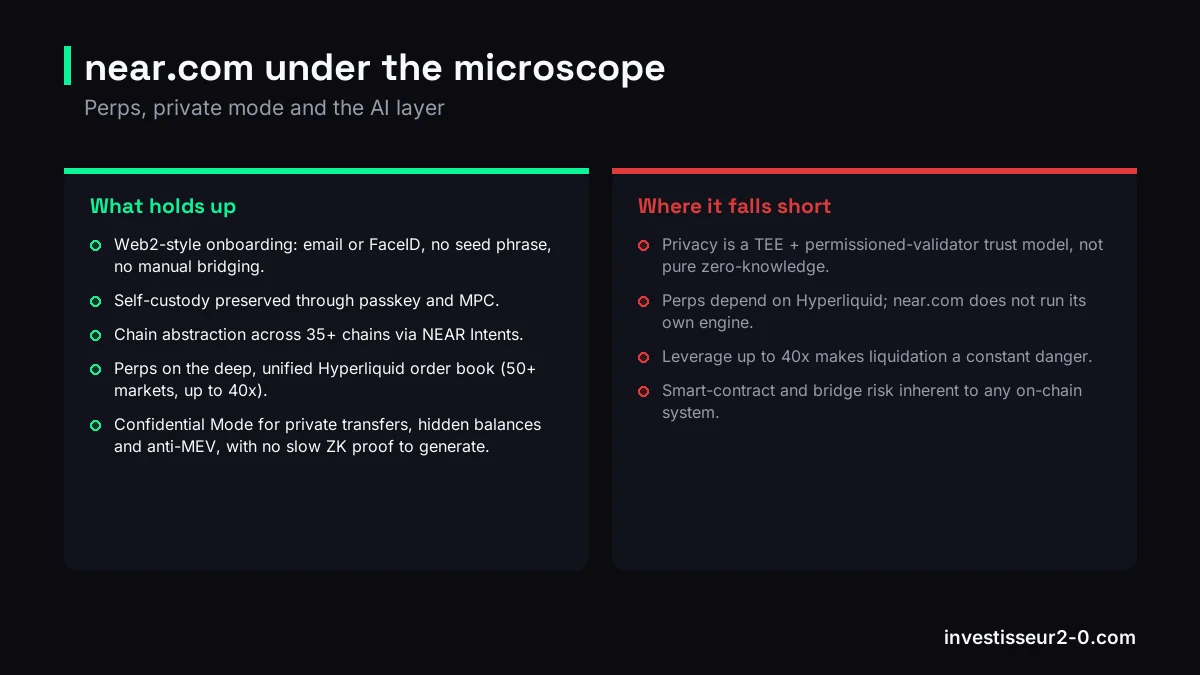
- + Web2-style onboarding: email or FaceID, no seed phrase, no manual bridging.
- + Self-custody preserved through passkey and MPC.
- + Chain abstraction across 35+ chains via NEAR Intents.
- + Perps on the deep, unified Hyperliquid order book (50+ markets, up to 40x).
- + Confidential Mode for private transfers, hidden balances and anti-MEV, with no slow ZK proof to generate.
- − Privacy is a TEE + permissioned-validator trust model, not pure zero-knowledge.
- − Perps depend on Hyperliquid; near.com does not run its own engine.
- − Leverage up to 40x makes liquidation a constant danger.
- − Smart-contract and bridge risk inherent to any on-chain system.
Who is near.com for?
near.com is a strong fit for users who want self-custody without the friction: people who are put off by seed phrases, manual bridging and chain-switching, but who do not want to hand their funds to a centralized exchange. It is also compelling for traders who value privacy (hidden balances, anti-MEV) and who want access to Hyperliquid liquidity through a smoother front door.
It is less suited to users who need a direct EUR/USD fiat on-ramp, or to privacy maximalists who will only accept pure zero-knowledge guarantees and not a hardware trust model. If you are brand new and want a regulated fiat entry point first, see our ranking of the best crypto exchanges in 2026.
Our verdict
One of the most ambitious super-apps of 2026: seed-phrase-free onboarding, preserved self-custody, shared Hyperliquid liquidity and a novel same-UX privacy layer. We dock points because privacy rests on a TEE trust assumption rather than zero-knowledge, the perps depend entirely on Hyperliquid, there is no fiat on-ramp and leverage stays an advanced product.
near.com is one of the more ambitious products of 2026. The combination of chain abstraction, self-custody, Hyperliquid-powered perps and a same-UX privacy layer is genuinely novel, and the onboarding is the smoothest we have seen for a self-custodial app. The honest caveats are real too: the privacy relies on a hardware trust assumption rather than zero-knowledge, the perps lean entirely on Hyperliquid, and leverage plus bridge risk are exactly as dangerous here as anywhere else. If the chain-abstraction super-app model appeals to you, it is well worth exploring. You can explore near.com here.
Disclaimer
Trading perpetual futures is extremely risky. Leverage of up to 40x can liquidate your entire capital in seconds, and you can lose money faster than you expect if you are careless with position sizing. Confidential Mode relies on a TEE and permissioned validators, a hardware trust assumption, not zero-knowledge. Self-custody means you are responsible for the security of your passkey and account. Nothing in this article is financial advice. Do your own research and only commit money you can afford to lose.
FAQ
What is near.com and how does it work?
near.com is the NEAR super-app launched in February 2026, built around chain abstraction. You sign up with an email or FaceID passkey, with no seed phrase and no manual bridging. NEAR Intents handles signatures and cross-chain routing under the hood, while you keep self-custody through a passkey and MPC.
Does near.com use Hyperliquid for perpetuals?
Yes. near.com does not run its own perps engine; for perps (live June 2026) it integrates Hyperliquid. You deposit from 35+ chains and trade 50+ markets with up to 40x leverage in Hyperliquid's unified order book. near.com is a new entry point to the same liquidity, which tightens spreads.
What is Confidential Mode on near.com?
Confidential Mode (Confidential Intents) enables private cross-chain transfers, deposits and swaps through a NEAR private shard, a set of permissioned validators linked to the main network by a TEE bridge. You switch freely between public and confidential accounts, with the same UX as a public tx and no client-side ZK proof. It hides balances and protects from MEV bots.
Is Confidential Mode the same as zero-knowledge privacy?
No. Confidential Mode relies on a Trusted Execution Environment (TEE) bridge and permissioned validators, a hardware trust assumption, not pure cryptographic zero-knowledge. It is convenient and fast, but you trust secure hardware and the validator set rather than a math-only ZK proof.
What is the NEAR token used for?
NEAR is the native protocol token of the NEAR network, used to pay for gas and for staking that secures the proof-of-stake network. It is the underlying token of the infrastructure that near.com and NEAR Intents are built on.
What are the main risks of using near.com?
Leverage on perps (liquidation), smart-contract and bridge risk, the TEE and permissioned-validator trust model behind Confidential Mode, and dependence on Hyperliquid for perps since near.com does not run its own engine. Trading perpetuals with leverage is extremely risky and is not financial advice.