
Crypto futures leverage, the capital efficiency angle
Leverage is not a risk multiplier. It's a capital efficiency tool. Trading $10 in x100 or $100 in x10 on BTC is the same trade: same notional exposed, same profit, same max loss. What liquidates you isn't the leverage, it's the margin you engage relative to your total capital. That's the real risk management pedagogy.
The lesson in one sentence: leverage multiplies your notional, not your risk. Your max risk per trade equals the margin you engage. Put $10 in x100 and you can lose $10 max (on liquidation). Put $100 in x10 and you can lose $100. Picked leverage is just the ratio that determines how much capital you immobilize to expose a given notional.
Same notional, same P&L. Leverage only pulls the liquidation price closer to entry, hence the formula max leverage ≈ 1 / (stop distance).
1. Operational definition of leverage
You deposit $100 of collateral on a futures exchange. You pick x10 leverage. The exchange lets you open a $1,000 notional BTC position. That position behaves as if you had actually bought $1,000 of BTC: if BTC rises 1 %, you gain $10. If BTC drops 1 %, you lose $10.
Leverage doesn't change your P&L per price tick: a 1 % move in BTC always returns 1 % of notional, regardless of leverage. What leverage changes is how much capital you must lock to open that position. Without leverage (spot) you'd lock $1,000. In x10 you lock $100. In x100, $10.
Three identical positions, same result
| Setup | Margin locked | Notional | BTC +2 % | BTC −2 % |
|---|---|---|---|---|
| Spot x1, $1,000 | $1,000 | $1,000 | +$20 | −$20 |
| Futures x10, $100 margin | $100 | $1,000 | +$20 | −$20 |
| Futures x100, $10 margin | $10 | $1,000 | +$20 | −$20 |
Same notional exposed, same P&L on the price move. Leverage doesn't change the trade outcome. It just frees up more or less capital.
2. Initial margin, maintenance margin, liquidation price
Initial margin is the minimum collateral to open the position. In x10 leverage on $1,000 notional, that's 1/10 = 10 %, so $100. In x100, 1 %, so $10. That's what shows as "required margin" when you open a position.
Maintenance margin is the threshold below which the exchange auto-liquidates you to avoid ending up with debt. It varies by exchange and position size, but on most platforms for BTC/ETH it sits around 0.4 to 0.5 % of notional for retail positions.
Liquidation price is the price at which your available total margin hits maintenance margin. But available margin differs between modes:
In isolated, only the locked initial margin protects the position. In cross, your entire account balance (initial margin + free balance) serves as buffer. Consequence: for a given notional, the higher your leverage in cross, the smaller the locked initial margin, the more free balance available as buffer, and therefore the FARTHER your liquidation. Counter-intuitive but that's the exact mechanics.
With BTC at $79,080, position notional $1,000, total capital $1,000, maintenance 0.5 % of notional, fees ignored:
| Leverage | Initial margin | Liquidation isolated | Liquidation cross ($1k balance) |
|---|---|---|---|
| x2 | $500 | −49.5 % | −49.5 % |
| x5 | $200 | −19.5 % | −79.5 % |
| x10 | $100 | −9.5 % | −89.5 % |
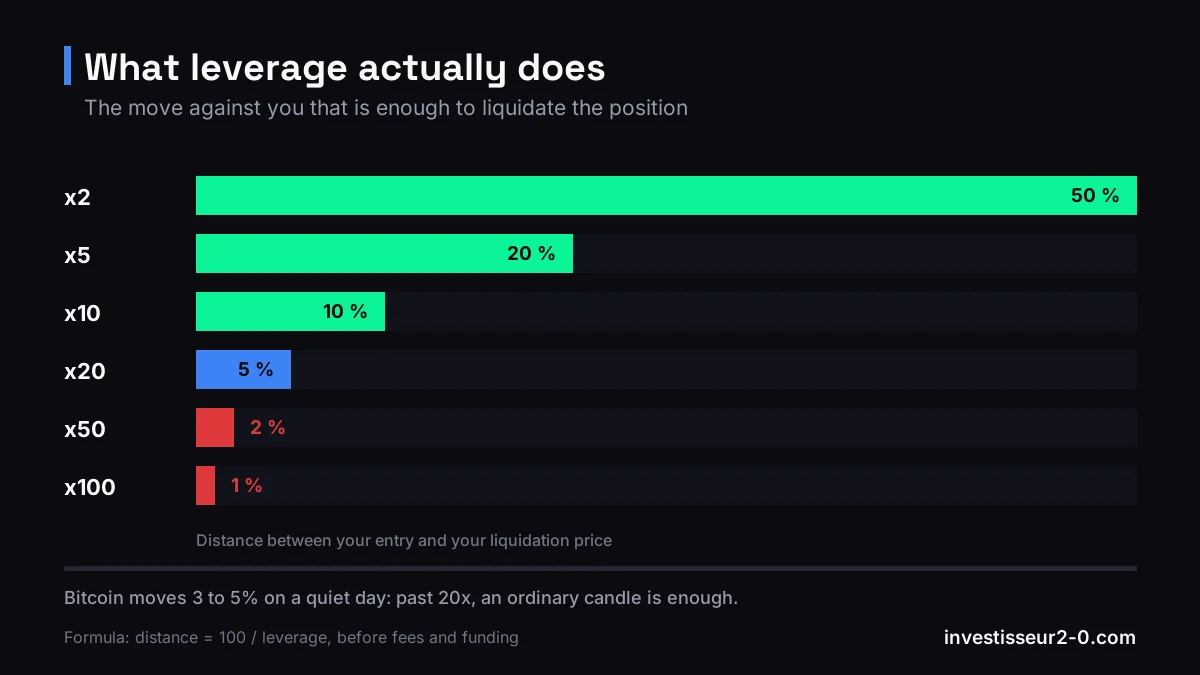
| x20 | $50 | −4.5 % | −94.5 % |
| x50 | $20 | −1.5 % | −97.5 % |
| x100 | $10 | −0.5 % | −98.5 % |
Read this: in isolated x100, a 0.5 % wick is enough to liquidate you, so a technical stop placed at -3 % under the OB will never execute. In the same setup in cross with $1,000 total capital, your theoretical liquidation sits at -98.5 %: your technical stop executes without issue.
Liquidation price ≠ your actual loss. Nobody waits for BTC to drop -98 % before exiting. The forced liquidation price is just the absolute worst case where the exchange closes your position to recover its loan. In cross with a technical stop, you'll almost always exit at your chart-based stop well before reaching that level.
Your real loss per trade = notional × stop_distance_%. It depends on where exactly you place your stop on the chart, not on leverage or the theoretical liquidation price. A single position can therefore generate any loss size depending on the stop. That's your call.
Two discipline dimensions never to confuse
For each trade, you're actually calibrating two different variables, often merged by mistake under the umbrella "1 % rule":
1. Engaged margin
The capital you lock to open the position. Determines your notional: notional = margin × leverage. It's an allocation choice, independent of max risk. Example house convention: 1 % of capital ($10 on $1,000).
2. Max accepted risk
What you accept to lose at most if the stop is hit. The classic "1 % rule" in SMC. Determines your stop and/or max notional: max_loss = notional × stop_distance. Serves to cap losses in case of a losing streak.
Both are independent. You can engage 1 % of capital as margin but accept a different max loss depending on the setup, or conversely cap your max loss at 1 % and adapt engaged margin to fit the technical stop.
Investisseur 2.0 convention in this lesson: we talk about engaged margin. The 1 % max loss rule is covered in the dedicated Crypto trading risk management lesson. The two are complementary, not interchangeable.
Concrete example, engaged margin angle. Total capital $1,000. You decide to engage 1 % as margin = $10. In cross x100, your notional becomes $10 × 100 = $1,000. The rest ($990) stays free, serves as cross buffer, and lets you open other positions in parallel.
Your loss if the stop is hit then depends solely on where you place it per the chart:
- Stop at -0.5 % (tight scalp) → loss = $1,000 × 0.5 % = $5 (0.5 % of capital, under 1 % rule)
- Stop at -1 % (intra-day) → loss = $1,000 × 1 % = $10 (1 % of capital, right on the 1 % rule)
- Stop at -3 % (swing under OB) → loss = $1,000 × 3 % = $30 (3 % of capital, exceeds 1 % rule)
- Stop at -5 % (wide swing) → loss = $1,000 × 5 % = $50 (5 % of capital, widely exceeds)
If you want to STRICTLY respect the 1 % max-loss rule on this $1,000 capital, you adapt your engaged margin: for a -3 % stop, you no longer engage $10 but $10/3 = $3.33 (notional $333 in x100). For a -5 % stop, you engage $2. Both disciplines coexist, so pick which one prevails based on your style.
Also worth noting: at low leverage (x2), isolated and cross give the same numbers. Initial margin consumes so much capital there's nothing left to free as buffer even in cross. The gap between the two modes only widens at high leverage, precisely because that's where smaller initial margin frees additional capital as protection.
Pedagogical takeaway. Leverage isn't viable beyond what your technical stop can absorb. If your stop is 2 %, your theoretical max leverage is x50 (liquidation at −2 %, right at the stop level, so premature liquidation risk on the wick). With a reasonable 0.5 % buffer, viable max leverage is ~x40. Above that, you're flipping coins with your full margin.
3. Cross margin vs isolated margin
Two margin management modes that radically change the meaning of your stop loss and therefore what kind of trading you're actually doing. The choice isn't trivial and is probably the most misunderstood decision beginners make.
Cross margin
Your full free balance serves as collateral for the position. Available margin to absorb losses isn't just initial margin anymore, it's your entire balance. Consequence: your forced liquidation price is pushed very far (often beyond -50% or -90% of entry depending on free balance).
Practical consequence: you can place your stop loss where the chart tells you to: under the Order Block, under the liquidity sweep, behind the last swing's wick. The technical stop executes before forced liquidation has anything to do. This is the mode that preserves coherence between your chart reading and the actual trade execution.
Isolated margin
Only the initial margin allocated to the position serves as collateral. The rest of the account is isolated. Consequence: your forced liquidation price is exactly at 1/leverage from entry (x50 → liquidation at -2%, x100 → liquidation at -1%).
Practical consequence: with high leverage, your technical stop placed per the chart (under the OB at -3%, under the swing at -5%) will never execute because forced liquidation triggers first. In isolated with high leverage, your effective "stop loss" IS the forced liquidation, and you lose 100% of engaged margin if the position moves against you by 1/leverage %. Mechanically, that's closer to a bet with a fixed budget than a technical trade with chart-based invalidation.
To make the right choice: ask yourself how you want your exit decided. If you want a chart-based level (SMC structure invalidation, lost sweep, return into a range) to determine your exit, you need your technical stop to actually execute, so cross, or isolated with a leverage low enough that liquidation sits behind your stop (max viable leverage formula in section 5). If you accept that forced liquidation IS your stop, meaning your max loss is fixed at engaged margin regardless of further movement, then isolated with high leverage is consistent. It's just a different kind of trading, closer to a budgeted bet.
The real danger of cross: opening 3-4correlated positions at once (longs on BTC + ETH + SOL + an alt). When the market plunges, all 4 positions pull from your global balance simultaneously and can cascade-liquidate you. Cross on a single position is coherent. Cross on multiple correlated positions is the classic mistake that turns a bad session into a wiped account.
4. Funding rate, the silent cost
Perpetual futures have no expiration. To keep their price pinned to spot, exchanges use a funding rate mechanism: a periodic exchange between longs and shorts, generally every 8 hours. Positive funding (typical in bull markets) → longs pay shorts. Negative funding (rarer) → reverse.
In normal bullish phases on BTC, funding hovers around 0.01 % per 8h. Three times a day, that's 0.03 % daily, or roughly 10.95 % per year. For a long position in x10 held 30 days, cumulative funding represents ~0.9 % of notional, or ~9 % of your engaged margin. Manageable.
In euphoric phases (retail FOMO), funding can climb to 0.1 % per 8h, or ~0.3 % daily, ~9 % per month. A long in x10 held 30 days then costs you ~9 % of notional, or 90 % of your margin. You pay nearly the full position cost to stay long while the market goes nowhere. That's why holding a leveraged long at cycle tops is statistically losing even if price doesn't drop.
The dedicated lesson: Crypto funding rate strategies details how to read funding in real time and how to use it to your advantage.
5. What leverage to choose: matrix by style
Viable leverage is derived from the technical stop, not the other way around. The rule:
With a 0.5 % buffer (to absorb wicks) and 0.05 % fees, here are viable max leverages by style:
| Style | Typical stop | Viable max leverage | Engaged margin |
|---|---|---|---|
| SMC swing (days-weeks) | 3 to 5 % | x18 to x28 | 0.5-1 % capital |
| Intra-day (hours) | 1 to 2 % | x40 to x65 | 0.5-1 % capital |
| Scalp (minutes) | 0.3 to 0.7 % | x80 to x125 | 0.5-1 % capital |
| No disciplined stop | - | x1 (= spot) | none valid |
Note: "engaged margin" stays at 0.5-1 % of total capital across styles. That's the 1 % rule applied to futures. Leverage just changes how much notional you deploy for the same margin.
The only real guardrail is ensuring your liquidation price sits behind your stop, with a 0.3-0.5 % buffer to absorb execution wicks. As long as that condition holds, x5 or x100 are equally safe.
6. The three errors that actually liquidate accounts
Error #1: Scaling margin with leverage
Beginner sees "x100 available" and engages $300 on a x100 position. Notional exposed = $30,000. A 1 % BTC move and the account is dead. Real cause: not the x100, it's the $300 engaged. With $3 margin on x100 ($300 notional), they'd have survived the same wick.
Rule: your engaged margin is dictated by your total capital and accepted risk (the 1 % rule), not by available leverage.
Error #2: Confusing technical stop with forced-liquidation stop
In isolated with high leverage, your "stop loss" placed per the chart (under the OB, under the sweep) has no chance to execute because forced liquidation triggers first. You think you're making a technical trade with chart-based invalidation, but you're actually just betting your engaged margin like a fixed budget: either the price holds at 1/leverage %, or it's lost. That isn't SMC trading, it's a wager.
Rule: if you want a chart level to determine your exit, either switch to cross on that position (technical stop executes, full balance protects), or lower the leverage so liquidation sits behind your stop (formula max_leverage = 1 / (stop + buffer + fees)). Otherwise accept that your effective stop IS the liquidation at 1/leverage %.
Error #3: Stop placed behind liquidation
x50 leverage, 2.5 % stop. Liquidation price at −2 % (1/50 = 2 %). When the market hits −2 %, liquidation triggers before the stop can execute. Result: you lose 100 % of engaged margin instead of the planned 2.5 %.
Rule: always verify your liquidation price is behind your stop, with a 0.3-0.5 % buffer.
7. Leverage in a real SMC method
In a Smart Money Concepts approach, every trade follows a rigorous protocol: entry zone (Order Block or FVG in discount), stop placed behind the liquidity sweep or last swing wick, targets in multiples of R. Risk per trade is calibrated at 1 % of total capital (the 1 % rule).
The full process:
- Total capital = $5,000. Risk per trade = 1 % = $50 max loss if stop hits.
- You identify a long SMC setup on BTC at $79,080. Technical stop under the OB at $76,700, or −3 % from entry.
- Max notional to respect risk = $50 / 3 % = $1,666 of BTC notional.
- You pick your leverage. In x20, engaged margin = $83. In x50, engaged margin = $33. In x100, engaged margin = $17. All three are valid as long as liquidation price stays behind the stop.
- Liquidation check: in x20, liquidation at −5 % (far from −3 % stop), good. In x50, liquidation at −2 % (in front of stop, danger). So max x33 on this trade.
- You take the trade. You only locked $83 ($50 risk + liquidation buffer), keeping 98 % of capital available for other opportunities.
That's capital efficiency. Leverage serves portfolio allocation, not bet multiplication. The lesson Crypto trading risk management details the 1 % rule in depth.
8. Choosing a futures exchange
The max leverage available doesn't matter as long as your margin is calibrated. Pick your exchange on fees, liquidity, regulation and partner bonus. The Investisseur 2.0 partner exchanges offering futures:
Regulatory note (July 2026): MEXC, BingX and XT stopped onboarding EU residents on 2026-07-01 because they hold no MiCA licence. If you live in the EU or France, use a MiCA-licensed venue such as Bybit (Austrian FMA licence, May 2025) or OKX (Malta MFSA, January 2025) instead. The bonus links below are affiliate links: we earn a commission on referred trading fees. Leveraged futures can wipe out your deposit; only trade money you can afford to lose.
| Exchange | Max leverage | Main strength | Inv 2.0 bonus |
|---|---|---|---|
| MEXC | x200 | 3,000+ tokens · 0 % maker spot | up to 10,000 USDT |
| BingX | x150 | External copy trading · accessible UI | −15 % fees |
| XT | x125 | Native copy trading · majors liquidity | −20 % fees |
| Pionex | x100 | Perpetual futures + integrated bots (Grid, DCA) | fee rebate |
| Bybit | x100 | MiCA licence (Austrian FMA, 2025) · open to EU residents | see our review |
| OKX | x100 | MiCA licence (Malta MFSA, 2025) · open to EU residents | see our review |
Reminder: max leverage displayed ≠ recommended leverage. On BTC/ETH with a swing stop at 3-5 %, x20-x30 is plenty. You never need x200 for a clean trade.
Prefer to keep custody of your collateral? You can also trade perps on a DEX instead of a centralized venue. The same margin and liquidation math applies, only settlement happens on-chain from your own wallet. For the full picture, see everything about trading crypto perpetual contracts.
To go beyond pure futures and directly copy the leveraged trade plans shared by Cedric & Julien, see Join VIP XT (native copy trading + analysis channel) or VIP Pionex (configured bots).
9. Next up: the liquidation mechanism
You now know what leverage is, how to calculate your liquidation price, and how to calibrate your margin. Next step: understand exactly how the exchange liquidates you: socialized losses, insurance fund, liquidation cascades on the order book, how market makers profit from it.
Next lesson: → Crypto exchange liquidations: how they work
Key takeaways
- Leverage doesn't define risk. Engaged margin relative to total capital does.
- Trade $10 in x100 or $100 in x10 on BTC = same notional exposed = same outcome.
- Liquidation price = entry_price × (1 − 1/leverage + maintenance%). Learn the formula.
- Cross margin = technical stop respected because the full balance protects. Isolated with high leverage = stop IS the forced liquidation at 1/leverage %, closer to a budgeted bet.
- For a chart-based stop to actually execute in isolated, leverage must be low: max_leverage = 1 / (stop_distance + buffer + fees).
- The danger of cross isn't the mode itself, it's running multiple correlated positions that all consume the same global balance.
- Funding rate can cost 9-90 % of your margin per month depending on market regime.
- The 1 % rule applies to engaged margin, not capital × leverage.
- Max leverage advertised by the exchange doesn't matter. Pick on fees, liquidity, partner bonus.
Want our live leveraged trade plans?
Free Telegram channel. SMC analyses, daily trade setups with entry/stop/target, and risk management debriefs. No paid signal, no PAMM. Just the method.
Join the channel