
Crypto Trading Risk Management: The Integral Guide
Why do 90% of crypto traders end up broke? Because they spend all their focus on entry signals instead of capital protection. The core of professional trading is strict, methodical risk management.
1. The foundational theorem: survive before winning
As traders specialized in Smart Money Concepts (SMC), our premise is simple: the market is a sophisticated machine designed to transfer wealth from the impatient to the patient. The institutional side has deep pockets, while the retail "Ape" trader uses leverage without a safety net.
It's pure math: if you suffer a 50% drawdown on your account, you will need a 100% performance just to get back to breakeven. If you cannot contain your losses, ruin is an arithmetic certainty.
💡 Go deeperRead our complete guide to mastering Maximum Drawdown.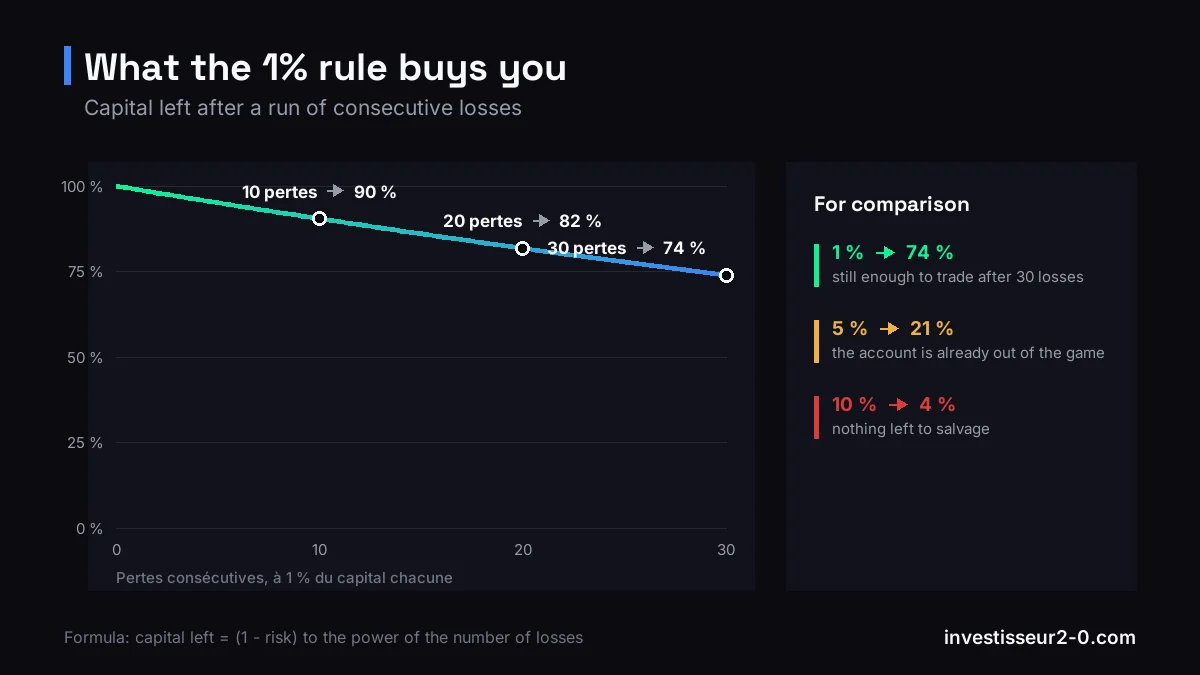
2. Sizing: The 1% rule
Placing a trade does not mean investing all your capital. "Sizing" (position size) is the mathematical process of computing the dollar amount allocated to a cryptocurrency so that a directional mistake never costs more than 1% (or 2% for higher risk tolerance) of your total equity.
That is why we built a dedicated tool: our Crypto Risk Calculator. It ingests the entry price, your maximum assumed loss and your account size, and instantly returns the exact lot size to use.
Don't confuse "max risk" with "engaged margin"
The 1% rule described here is the classic SMC convention: 1% = max accepted loss per trade. If the stop is hit, you lose 1% of total capital, never more. It's the discipline tool to survive losing streaks.
That's a different concept from "engaged margin" (the capital you lock to open the position). Engaged margin and max loss are two independent dimensions: a trader can engage 1% of capital as margin but accept a 3% max loss depending on the setup, or conversely cap max loss at 1% and adapt engaged margin to fit the technical stop.
For the full computation engaged margin → notional → liquidation price and the isolated vs cross comparison, see the dedicated Crypto futures leverage, capital efficiency lesson.
Download our Trading Journal (free resource)
Applying the 1% rule demands accounting rigor. We offer members our exclusive Excel Trading Journal and the Pre-Trade Checklist to scientifically record and review every single position.
Join the channel to receive the tools3. Dynamic Stop Loss: using the ATR
Many traders set their loss threshold arbitrarily ("I cut at -5% from entry!"). But a highly volatile asset like Solana does not breathe the same way as Bitcoin. You have to place your Stop Loss beyond the "noise" of the market.
We use the Average True Range indicator. A stop placed at (Entry - 1.5 ATR) gives the Market Structure its natural breathing room to develop.
💡 Go deeperLearn to compute and use the ATR in our dedicated article.4. Mastering leverage and Liquidation
Leverage is not your enemy. It is a capital-efficiency tool that allows you to open position sizes consistent with your risk management while locking only a fraction of your portfolio as margin.
The real danger lies in ignoring the liquidation math imposed by centralized exchanges (Binance, XT, Bybit). Whether you trade in Cross or Isolated margin, a high leverage (e.g., 100x) dangerously pushes your entry price towards the liquidation threshold, known as the Maintenance Margin Rate (MMR). The same discipline applies if you trade on a no-KYC perpetuals venue from your own wallet: self-custody does not soften the liquidation math. For the full walkthrough, read our A-to-Z guide on crypto perpetuals.
💡 Go deeperUnderstand how CEX liquidation engines actually work.5. Psychology, the irrational corollary of Risk Management
Do you have the right capital base? Trading with a $500 account amplifies the psychological need to "win fast" and to take oversized risks through over-leverage, while a properly capitalized account allows the patience to wait for the best SMC setups (such as an FVG fill aligned with a valid Order Block).
Peace of mind (a positive mathematical expectancy with a margin of error) is the hidden variable most traders miss. Read our thoughts on the right amount of capital to trade crypto in 2026.
Frequently Asked Questions on Risk
What is the 1% rule in trading?
The 1% rule states that a trader must never risk (difference between entry and stop loss) more than 1% of total capital on a single trade. If the stop loss is hit, you keep 99% of your capital for the next opportunity.
How do you avoid liquidation on Binance or XT?
Always place a guaranteed Stop-Loss (Hard Stop) systematically as soon as your entry is filled. Use our Calculator to make sure your Stop-Loss level sits BEFORE the liquidation price declared by the exchange engine.
What is the ATR in trading?
The Average True Range is a time series reflecting the absolute volatility of the asset. It matters because it lets you place stop losses outside the market's usual turbulence range.