
Funding rate in crypto: how to use it as a reversal signal
The funding rate is one of the few on-chain indicators that gives a direct reading of trader positioning on perpetual futures. When it reaches extremes, it signals that the market is ready to reverse. Understanding this mechanism changes how you read the market.
Prerequisite: The funding rate is a confirmation tool, not a standalone entry signal. Combine it with rigorous risk management and institutional structure reading.
Funding keeps the perpetual glued to spot: the over-crowded side pays the other every 8 hours.
Perpetual futures and the funding rate mechanism
Unlike traditional futures contracts that have an expiry date, perpetual futures (or perpetual swaps) never expire. A trader can hold a position indefinitely as long as they have enough margin. But without expiration, how does the contract price stay aligned with the spot price?
That is the role of the funding rate: a periodic payment (typically every 8 hours on Binance, Bybit, and OKX) between long and short traders. If the perpetual price is above spot, the funding rate is positive and longs pay shorts. If the perpetual is below spot, the funding rate is negative and shorts pay longs.
This mechanism creates a natural economic incentive: when too many traders are long, the cost of holding the position increases, discouraging excess leverage in one direction. This is what makes the funding rate so revealing of market sentiment.
If perpetuals themselves are still new to you, start with our guide to trading perpetual contracts before layering the funding rate on top.
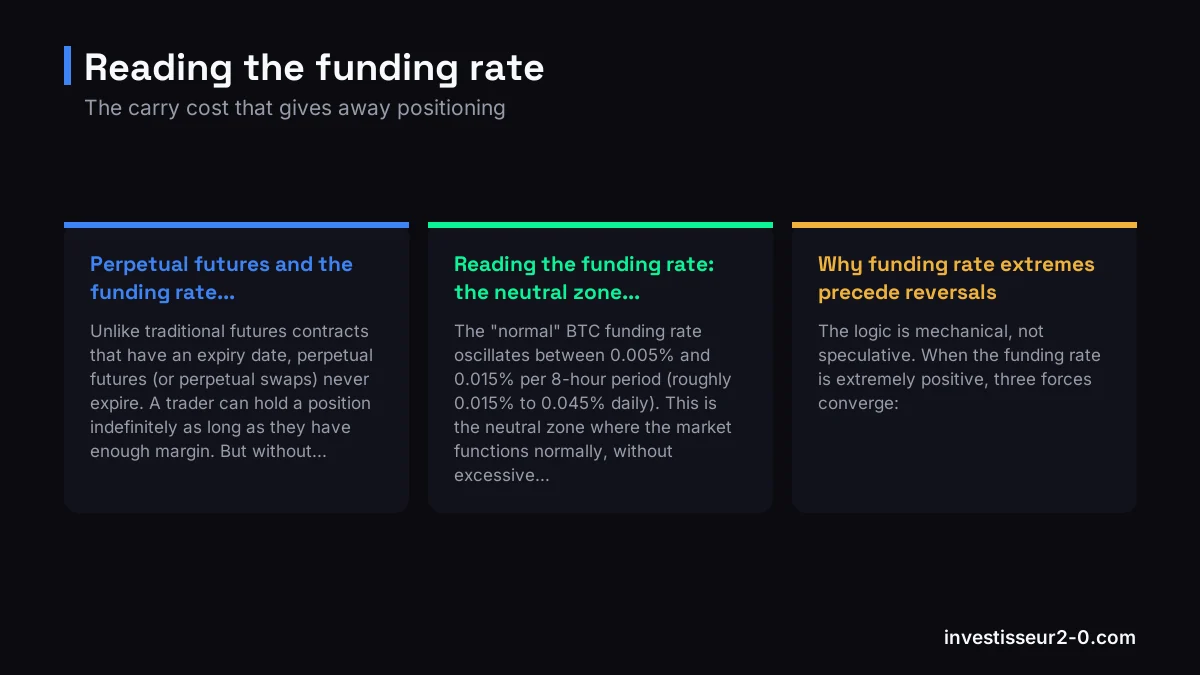
Reading the funding rate: the neutral zone and the extremes
The "normal" BTC funding rate oscillates between 0.005% and 0.015% per 8-hour period (roughly 0.015% to 0.045% daily). This is the neutral zone where the market functions normally, without excessive positioning in either direction.
Signals appear at the extremes:
- Highly positive funding rate (above 0.05% / 8h): the market is overloaded with long positions. Traders are paying dearly to hold their longs. This is a signal of excessive euphoria, the type of setup that often precedes a sharp correction or a liquidity sweep.
- Negative funding rate (below -0.03% / 8h): the market is dominated by shorts. Traders are paying to stay short, expecting further downside. This is often a capitulation signal and a bounce setup, especially if price is already sitting on an SMC demand zone.
ETH displays similar funding rate behaviors but often more amplified: during altcoin rallies, the ETH funding rate can climb to 0.1% / 8h or higher, reflecting the excessive leverage that accumulates faster on altcoins than on BTC.
Why funding rate extremes precede reversals
The logic is mechanical, not speculative. When the funding rate is extremely positive, three forces converge:
- The cost of holding long positions becomes unsustainable, so traders progressively close, creating sell pressure.
- Institutional players identify zones where long liquidations accumulate (visible on liquidation heatmaps) and engineer sweeps downward.
- The risk/reward ratio inverts: it becomes more profitable to be short (you get paid funding) than long (you pay to hold).
The inverse mechanism applies when the funding rate is extremely negative: shorts get squeezed, costs become prohibitive, and cascade liquidations of shorts trigger a rapid short squeeze.
Historical examples: the funding rate in action
Several market episodes illustrate the predictive value of the funding rate at extremes. Without citing specific performance numbers, the patterns are recurring:
- BTC local tops: intermediate cycle peaks on Bitcoin are regularly preceded by periods where the aggregate funding rate exceeds 0.08% / 8h for several consecutive days. This is the sign that long leverage has become unsustainable.
- Capitulation bottoms: major troughs (March 2020, June 2022, August 2023) were all accompanied by deeply negative funding rates for 3 to 7 days, a sign the market had exhausted its sellers.
- Altcoin season: during rotations into altcoins, the ETH and major alt funding rates often exceed BTC's. When this spread becomes extreme, it often signals that the altcoin season is approaching its peak.
Concrete strategies using the funding rate
1. Fade extreme funding rates
The most direct strategy: when the BTC funding rate exceeds 0.06% / 8h, start looking for short setups on your usual SMC tools (bearish order blocks, downside break of structure). When it drops below -0.04%, look for long setups. The funding rate does not give exact timing; it gives directional bias.
2. SMC confirmation with the funding rate
This is the most reliable use case. You have identified a demand order block on H4, price has swept the liquidity below the last low, and structure shows a CHoCH (Change of Character). If the funding rate is also negative or dropping sharply, the confluence is maximal. The funding rate confirms that market positioning is coherent with your SMC setup.
3. Funding rate monitoring as a risk filter
Before opening a leveraged long position, check the funding rate. If it is already extremely positive, you are entering an overloaded market, and the risk of liquidation is mechanically higher. It is not that your setup is bad; the environment is hostile. Reduce your size or wait for the funding to reset to neutral.
Where to track the funding rate in real time
Several platforms publish real-time funding rate data. Coinglass remains the reference for aggregated multi-exchange data (Binance, OKX, Bybit, Bitget). CryptoQuant offers historical views and configurable alerts. Most major exchanges also display the funding rate directly on their trading interface, and so do the on-chain perp venues, such as near.com and its Hyperliquid perps, where the same 8-hour funding mechanism is at play.
The key element is to look at the aggregated funding rate (weighted average across all exchanges), not that of a single exchange. An extreme funding rate on Binance but neutral on OKX and Bybit does not carry the same meaning as a generalized extreme across all platforms.
Funding rate limitations: when it does not work
The funding rate is not a magic indicator. Its main limitations:
- Neutral zone = noise. When the funding rate oscillates between 0.005% and 0.02%, it says nothing useful. Do not try to interpret micro-variations in this range.
- Strong trends ignore funding. During a powerful bull run, the funding rate can stay positive for weeks without a significant correction. The market can stay irrational longer than your margin can survive.
- Local manipulation. On low-volume exchanges, the funding rate can be influenced by a few large traders. This is why aggregated multi-exchange data is essential.
Funding rate and risk management: the fundamental rule
The funding rate is never a standalone entry signal. It is a context filter that tells you whether the environment is favorable or hostile to your directional bias. Use it in combination with your risk management framework: an extreme funding rate increases confidence in an already valid setup, but it does not replace the setup itself.
In summary: when the funding rate is extreme and your SMC setup is aligned, the probability of success is significantly higher. When the funding rate contradicts your setup, reduce your size or skip the trade. It is as much a discipline tool as it is an analytical one.