
Why Bitcoin is crashing in June 2026 (and what we are actually doing)
In one week, Bitcoin plunged roughly 16%, down to a low of $59,100 on June 5, before a technical bounce toward $62,000 on June 7. Over 30 days it is still -22%, more than 50% below its all-time high ($126,000). We have been getting the same message on a loop for 48 hours: "what do I do?". Here is our read, with a cool head, and what we apply. No magic prediction: order flow and discipline.
The numbers behind the drop, unfiltered
Before interpreting, let's lay out the facts. As of June 5-7, 2026:
- ~$62,000 on June 7 (bounce +2% over 24h), after a $59,100 low on June 5.
- -16% in 7 days, -22% over 30 days, the worst week of the year, more than 50% below the ATH ($126,000).
- $1.75 billion in liquidations over 24h, more than 350,000 traders liquidated.
- More than half of all BTC in unrealized loss, a marker that has accompanied every major bottom historically.
- Fear & Greed at 11 (extreme fear).
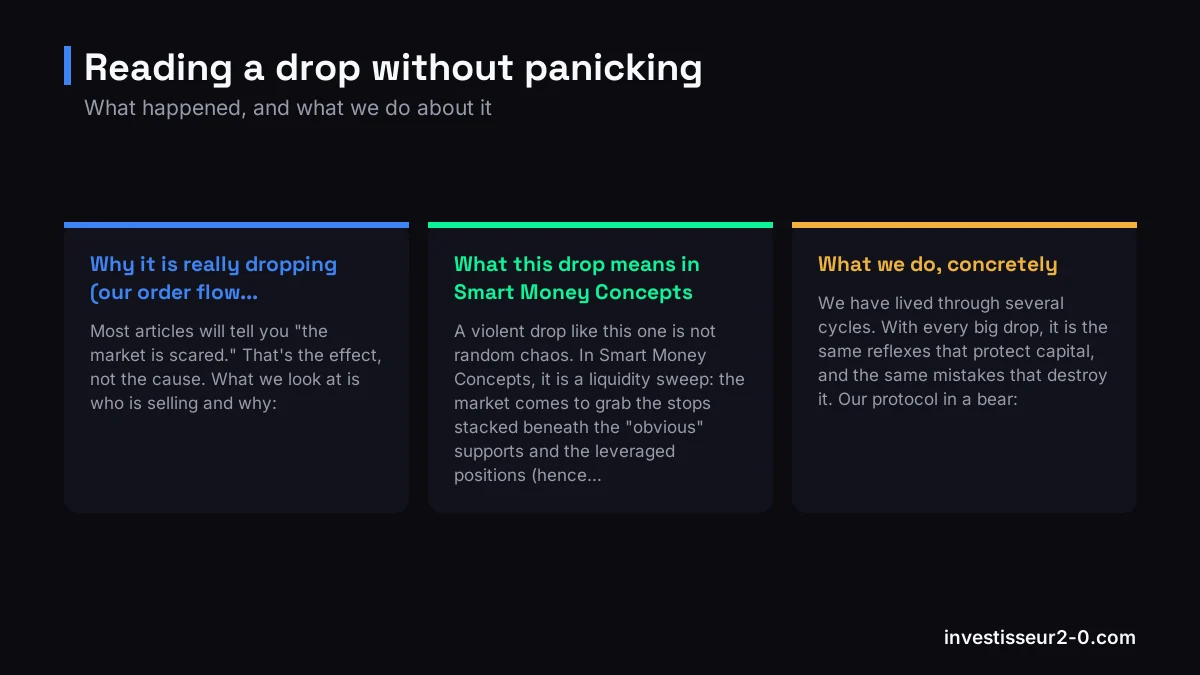
Why it is really dropping (our order flow read)
Most articles will tell you "the market is scared." That's the effect, not the cause. What we look at is who is selling and why:
1. Institutions are exiting. US spot Bitcoin ETFs recorded roughly 2.8 to 3.5 billion dollars in net outflows over about ten consecutive sessions. When the large flows that fueled the rally reverse, the fuel disappears. This is the most important signal, and it is measurable, not emotional.
2. Long-term holders are distributing. Part of the strong hands are selling into strength, which breaks the market structure (shift to Lower Highs / Lower Lows). As long as the structure is bearish, every bounce is a bounce to sell until proven otherwise.
3. Macro does the rest. Against a backdrop of US-Iran tensions, capital is fleeing risk assets. Crypto, in 2026, remains correlated to global risk: when geopolitical uncertainty rises, BTC takes the hit.
What this drop means in Smart Money Concepts
A violent drop like this one is not random chaos. In Smart Money Concepts, it is a liquidity sweep: the market comes to grab the stops stacked beneath the "obvious" supports and the leveraged positions (hence the $1.75B in liquidations). This is exactly the fuel large players need to accumulate. Extreme fear + majority unrealized loss + cascading liquidations = the classic signature of a capitulation zone, where coins move from weak hands to strong hands.
That does not mean "buy now with your eyes closed." It means we stop panicking and read the market for what it is: a redistribution.
What we do, concretely
We have lived through several cycles. With every big drop, it is the same reflexes that protect capital, and the same mistakes that destroy it. Our protocol in a bear:
- We do not sell in panic. Selling at F&G 11 is selling the bottom. The decision is made with a cool head, on a plan, not under emotion.
- We do not catch the knife. No buying "because it has dropped a lot." We wait for a structure shift (bullish BOS) before repositioning into a trade.
- The 1% rule, absolute. No position risks more than 1% of capital. That is what ensures a drop like this never takes you out of the game.
- For long-term investing, a capitulation zone is handled with disciplined DCA, not an emotional all-in, which is exactly why the question of whether it is too late to buy Bitcoin in 2026 matters less than the format of your buying.
- We map the liquidity zones below price: these are the levels the market may still come to grab. We share them live, with a defined invalidation.
The trap to avoid at all costs
Revenge trading. You take a loss, you want to "make it back," you size up a counter-trend position, and that is where accounts truly die, not in the drop itself. A market crash does not ruin a disciplined trader. Panic does.
In summary
Bitcoin is dropping in June 2026 because institutional flows reversed (ETF outflows), strong hands are distributing and macro is weighing in. It is measurable, not mystical. Extreme fear and massive liquidations are the signature of a capitulation zone: historically, not the time to panic, but the time to have a plan. Ours: risk 1%, no knife-catching, wait for the structure, read the liquidity.
We read the market live during the crash
Trade plans with a defined invalidation, liquidity zones below price, and our cool-headed reasoning, not signals to copy blindly. Free.
Join the free Telegram channelFrequently asked questions
Why is Bitcoin crashing in June 2026?
Three forces are combining. 1) Massive institutional outflows: US spot Bitcoin ETFs recorded roughly 2.8 to 3.5 billion dollars in net outflows over about ten sessions in late May / early June. 2) Long-term holders selling, which breaks the market structure. 3) A tense macro backdrop (US-Iran tensions) pushing capital out of risk assets. The result: a low of 59,100 dollars on June 5, about -16% in 7 days and -22% over 30 days, with 1.75 billion dollars of positions liquidated in 24 hours. As of June 7, BTC is bouncing technically around 62,000 dollars.
Should you sell your crypto during the crash?
Selling in panic, at the very moment the Fear & Greed index is at 11 (extreme fear), is statistically the worst decision: you sell the bottom. Our approach is not to predict the low but to manage risk: never risk more than 1% of capital per position, do not catch the falling knife, and wait for a structure shift (a bullish Break of Structure) before repositioning. This is not investment advice -- it is our discipline.
Is extreme fear a buy signal?
Historically, a Fear & Greed below 15 with more than half of all BTC in unrealized loss has coincided with capitulation zones near major bottoms. It is never a timing guarantee, but it is exactly the moment when the market transfers coins from weak hands (panic) to strong hands (accumulation). We treat it as a context signal, not a buy order.
How low can Bitcoin go?
Nobody predicts the future, and be wary of anyone who hands you a number with certainty. What we do is map the institutional liquidity zones below price: these are the levels where stops accumulate and that the market often comes to grab before reversing. That is what we share live on the channel, with a defined invalidation, rather than a baseless forecast.
What is the worst mistake to avoid during a crash?
Revenge trading. You take a loss, you want to make it back, you size up a counter-trend position -- and that is where accounts truly die, not in the drop itself. A market crash does not ruin a disciplined trader. Panic does.
⚠️ Strictly educational content, not investment advice. Crypto trading and investing carry a risk of capital loss. Never risk more than you can afford to lose.