Binance Review 2026: our full test
Binance remains, in 2026, the largest crypto exchange in the world by volume. But is it still the best choice for an active trader? We tested the platform in depth: fees, liquidity, security, regulatory compliance, mobile app and ecosystem. Here is our honest review, with its strengths and its limits.
Transparency: this article contains affiliate links. Investisseur 2.0 trades on OKX and Kraken in its daily practice and no longer links to Binance. Our review of Binance stays objective: we present it with its strengths and weaknesses, without bias.
Binance at a glance
Launched in 2017 by Changpeng Zhao, Binance established itself within a few years as the undisputed leader of the crypto market. The platform handles more daily volume than its three direct competitors combined, offers hundreds of cryptocurrencies, derivatives products, savings, staking and an entire ecosystem built around its native token, BNB.
For a trader, the question is therefore not whether Binance is a serious platform (it is) but rather in which cases it is the right tool. Our overall rating: 4.2/5 (revised July 15, 2026). Here is how it breaks down.
Trading fees: competitive but worth optimizing
Across dozens of monthly trades, fees make a real difference. Binance sits in the upper-middle range on spot, but becomes very competitive on futures and with BNB discounts.
- Spot: 0.10% maker / 0.10% taker. By paying fees in BNB, you get a 25% discount, which brings fees down to 0.075%.
- Futures: 0.02% maker / 0.05% taker at standard rates, among the lowest on the market.
- VIP discounts: VIP tiers (based on volume and BNB balance) reduce these rates further for high-volume traders.
Fee verdict: solid. Futures fees are excellent and the BNB discount is a genuine lever. The only downside: a beginner who does not hold BNB pays 0.10% on spot, which is higher than some competitors. For a complete breakdown, see our Binance fees explained guide, and to understand how fees compound with risk, our guide to crypto trading risk management.
Liquidity: the deepest on the market
This is arguably Binance's greatest strength. Its liquidity is the deepest in the entire crypto ecosystem. In practice, this means near-zero slippage at execution, even on large position sizes.
On major pairs such as BTC/USDT or ETH/USDT, the spread is tiny and the order book absorbs orders worth hundreds of thousands of dollars without flinching. For a trader who executes on majors with significant capital, no other platform does better. It is a decisive argument.
To see what this order book has to absorb day to day, our crypto market observatory tracks the volatility and correlations of BTC, ETH and SOL on real daily data.
Security: a battle-tested record
Security is non-negotiable: an exchange can offer the best fees in the world, but if your funds disappear, nothing else matters. Binance has a track record that inspires confidence precisely because it has been tested.
- 2019 hack: Binance's hot wallet was compromised for 7,000 BTC. Binance fully reimbursed the affected funds via its SAFU fund (Secure Asset Fund for Users), without a single user losing a cent.
- SAFU fund: this insurance fund, continuously topped up, serves as a safety net in case of an incident. It is one of the largest in the sector.
- Proof of Reserves: Binance publishes a verifiable proof of reserves via Merkle Tree, allowing anyone to confirm that the platform actually holds its customers' funds.
Security verdict: excellent. The SAFU fund and the reimbursement history make Binance the reference. That said, the golden rule still applies everywhere: never leave more capital on an exchange than you are prepared to lose. The rest goes to cold storage.
Regulatory compliance: the European retreat
With MiCA's progressive enforcement, compliance has become a survival criterion. On this front, Binance took the biggest hit of its history in 2026.
- PSAN registration with France's AMF: lapsed June 30, 2026, with no MiCA authorization on file at that date.
- MiCA compliance: not obtained by July 1, 2026; orderly wind-down running in France (no new spot orders, positions closed by October 1). Existing French accounts are limited to withdrawals.
- Outside the EU: Binance keeps operating under local licenses or registrations in dozens of jurisdictions; access and product range depend on where you live.
- Localized interface and support in most served markets.
Compliance verdict: weak in Europe, variable elsewhere. A European trader can no longer rely on Binance; a reader outside the EU should check the regulator register of their own country before funding an account.
Mobile app: complete but dense
The Binance app carries over the full set of desktop features: spot, futures, Earn, staking, conversion, P2P, advanced charting. This is both its strength and its weakness.
For an experienced trader, everything is there, accessible from a smartphone. For a beginner, the interface can feel intimidating at first: the density of information and the number of options require some adaptation time. Once the learning curve is behind you, the app is one of the most powerful on the market.
Ecosystem: far more than an exchange
Binance goes well beyond a trading platform: it is a universe in its own right. This is what sets it apart from most of its competitors.
- Binance Earn: flexible and locked savings, staking, yield products.
- Launchpad: early access to new projects.
- Binance Academy: free, high-quality educational resources, ideal for beginners.
- BNB token: fee discounts, ecosystem participation, utility on BNB Chain.
Ecosystem verdict: unmatched. No competitor offers such a rich set of integrated services.
Pros and cons
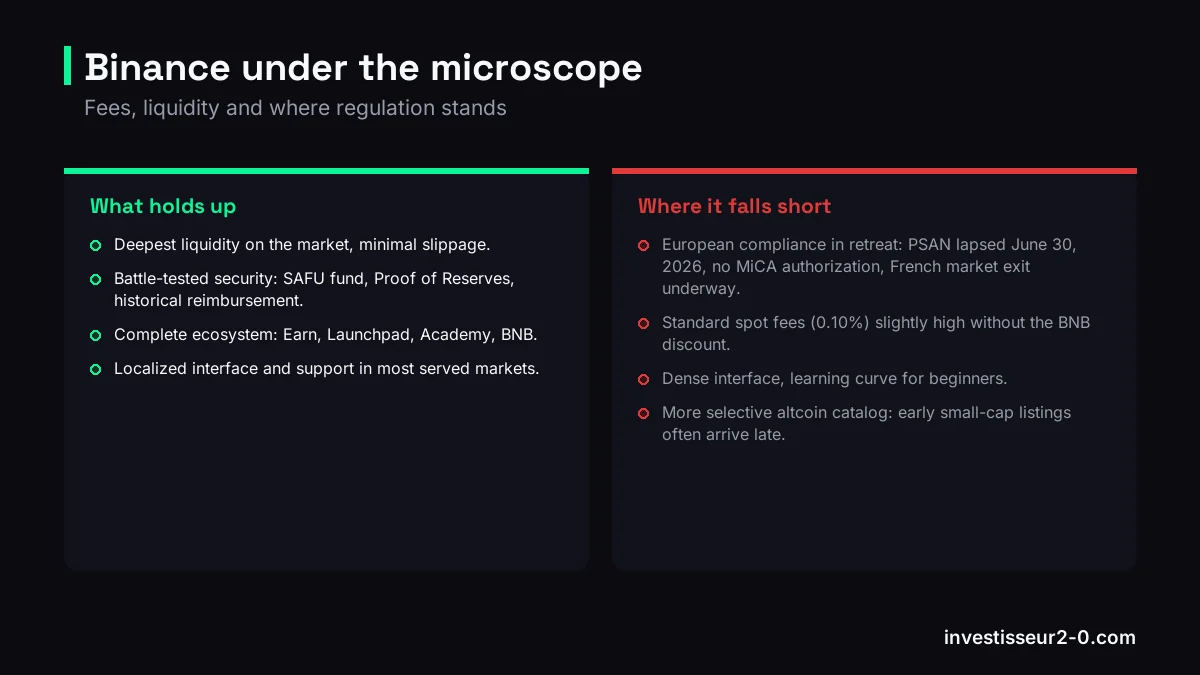
- + Deepest liquidity on the market, minimal slippage.
- + Battle-tested security: SAFU fund, Proof of Reserves, historical reimbursement.
- − European compliance in retreat: PSAN lapsed June 30, 2026, no MiCA authorization, French market exit underway.
- + Complete ecosystem: Earn, Launchpad, Academy, BNB.
- + Localized interface and support in most served markets.
- − Standard spot fees (0.10%) slightly high without the BNB discount.
- − Dense interface, learning curve for beginners.
- − More selective altcoin catalog: early small-cap listings often arrive late.
Ratings summary table
| Criterion | Rating | Comment |
|---|---|---|
| Trading fees | 4.5 / 5 | Excellent futures, spot worth optimizing via BNB |
| Liquidity | 5 / 5 | The deepest on the market |
| Security | 4.8 / 5 | SAFU + Proof of Reserves, battle-tested record |
| Compliance (EU/MiCA) | 1.5 / 5 | PSAN lapsed 06/30/2026, no MiCA, French wind-down |
| Mobile app | 4.3 / 5 | Very complete but dense |
| Ecosystem | 5 / 5 | Earn, Launchpad, Academy, BNB |
| Overall rating | 4.2 / 5 | Top-tier product, EU compliance in retreat |
Our pick at Investisseur 2.0
Binance remains an excellent exchange on the three things that made its name: liquidity, security and breadth. We still say so to anyone who can use it legally. What changed in 2026 is where it can be used. EU and French residents lost access on July 1, UK residents trade under the FCA promotions regime with a trimmed catalogue, and US residents never had the global platform. For the readers of this page, that leaves a narrower set of venues than the brand suggests, and it is why we removed our Binance link in October 2026.
Where we trade instead: OKX for most of our orders. The catalogue is close to Binance's, the entry fees are equivalent at 0.08% maker / 0.10% taker on spot, it is authorised under MiCA in Europe and serves UK residents, and since September it reimburses account takeovers up to EUR 100,000 through OKX Shield, something Binance does not offer. The full test is in our OKX review.
Kraken holds the part of our capital we want on an exchange with fifteen years and no intrusion on record, a MiCA authorisation from the Central Bank of Ireland, and a place on the FCA cryptoasset register. It is also the venue for our American readers. Its fees used to be the objection; the July 2026 Kraken Pro tiers now give the discount to what you hold, not only to what you trade.
We dropped XT and MEXC from our recommendations at the same time: no European licence, both on the FCA warning list, neither open to EU residents. Our older comparison pages still describe them for the record.
Where we trade instead of Binance
OKX for the catalogue, the fees and account protection (Europe and UK). Kraken for an FCA-registered, MiCA-authorised venue, and for US readers. Both are open today where Binance is not.
Affiliate links: we earn a share of trading fees, at no extra cost to you. OKX is not on the FCA cryptoasset register; UK customers are served under the financial promotions regime with a 24-hour cooling-off period and no FSCS cover. Crypto-assets are volatile and you may lose everything you commit. Reading from the UK? See which exchanges serve UK residents, and under what rules.
If you want the head-to-head numbers, our OKX vs Binance comparison puts fees, catalogue and licences side by side, and our best Binance alternatives widens the field. UK readers will find the register, the promotions regime and the venues that serve them in our guide to crypto exchanges for UK residents.
For a complete overview of all the platforms we recommend, check our ranking of the best crypto exchanges in 2026.
FAQ
Is Binance reliable and secure in 2026?
Yes. Despite the 2019 hot wallet hack (7,000 BTC), Binance fully reimbursed the funds via its SAFU fund and has since reinforced its architecture. The platform publishes a verifiable Proof of Reserves and remains the industry standard.
What are the trading fees on Binance?
0.10% maker/taker on spot, with a 25% discount when paying in BNB. On futures: 0.02% maker and 0.05% taker at standard rates, among the most competitive on the market.
Is Binance available in Europe in 2026?
Not in France since July 1, 2026: the PSAN lapsed on June 30 with no MiCA authorization on file, and French clients are in an orderly wind-down (no new spot orders, positions closed by October 1, 2026).
Is Binance suitable for beginners?
Yes, in countries where it operates legally: localized interface, maximum liquidity and Binance Academy for learning. EU and French residents can no longer sign up since July 1, 2026.
Where does Investisseur 2.0 trade instead of Binance?
On OKX for most orders: similar catalogue, equivalent entry fees (0.08% maker / 0.10% taker on spot), MiCA authorisation in Europe, open to UK residents, and OKX Shield reimbursing account takeovers up to EUR 100,000. On Kraken for the capital we want on an FCA-registered exchange with fifteen years and no intrusion on record. We stopped recommending XT and MEXC in October 2026.
What rating do you give Binance?
4.2/5, revised down on July 15, 2026. Liquidity, security and ecosystem remain the benchmark, but the loss of French access (PSAN lapsed June 30, no MiCA authorization) weighs on the score.
Is the Binance mobile app any good?
The app covers nearly everything desktop does: spot, futures, earn, alerts, portfolio. Dense at first; Lite mode strips it down. One of the most capable exchange apps for analysis on the go.
Is Binance good for futures trading?
One of the deepest futures markets in crypto: 0.02% maker / 0.05% taker standard, highest open interest on major pairs, less slippage on size. Leverage rules depend on jurisdiction and verification level.
What is Binance's reputation in 2026?
The world's largest exchange by volume since shortly after its 2017 launch. One major incident on record, the 2019 hot wallet hack (7,000 BTC), fully reimbursed through the SAFU fund. Verifiable Proof of Reserves; the French PSAN, however, lapsed on June 30, 2026 without a MiCA follow-up. We rate it 4.2/5.
Is Binance at risk of being banned in France or Europe?
The picture flipped on July 1, 2026. Binance's PSAN registration expired on June 30 without a MiCA authorization registered with the AMF, making unauthorized operation a criminal offence in France (up to two years in prison and a EUR 30,000 fine). French clients are in an orderly wind-down: no new spot orders since July 1, positions to be closed by October 1, 2026.
Binance or Coinbase: which one should you pick?
Coinbase wins for a first purchase: pared-down interface, NASDAQ-listed company, MiCA-authorized in the EU (CSSF Luxembourg, June 2025). Binance is structurally cheaper (0.10% on spot, versus fees that can exceed 1 to 2% per operation on Coinbase's simple interface) and offers around 400 spot pairs plus a deep futures market. Many traders use both.
What are the main alternatives to Binance?
OKX (MiCA-authorised, similar catalogue and fees, OKX Shield account protection), Kraken (FCA-registered, MiCA authorisation from the Central Bank of Ireland, best security record of the sector) and Bybit EU (MiCA-authorised in Austria, strong on derivatives). Spreading capital across several platforms also reduces counterparty risk.