
Is it too late to buy Bitcoin in 2026?
Bitcoin is hovering around $63,000 (~€54,800) on this June 16, 2026. And the question "is it too late?" comes up in exactly the same way it did at $100 in 2013, at $1,000 in 2017 and at $20,000 in 2020. The honest answer: no one knows, but the question is framed the wrong way.
The history of "too late"
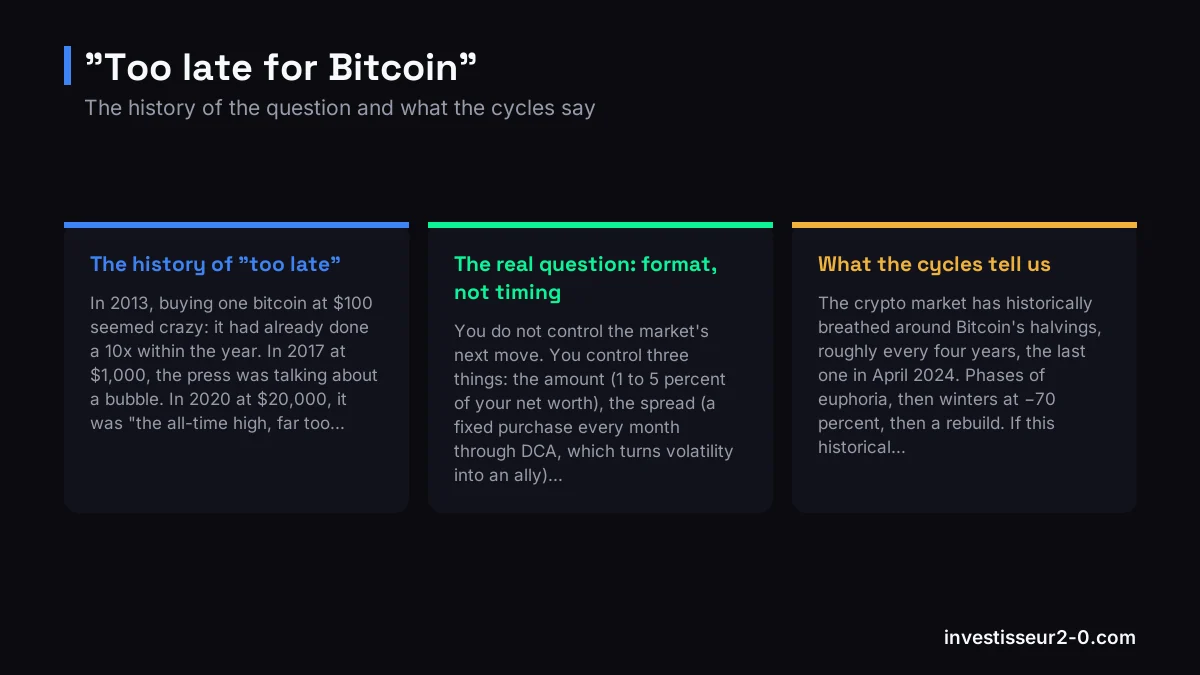
In 2013, buying one bitcoin at $100 seemed crazy: it had already done a 10x within the year. In 2017 at $1,000, the press was talking about a bubble. In 2020 at $20,000, it was "the all-time high, far too dangerous." Each of those moments later turned out, in hindsight, to be an entry point. And in between each of them, drops of 70 to 80 percent wiped out those who went all-in at the worst possible moment. Both facts are true at the same time, and that is the whole lesson: the problem was never the date, it was the format of the purchase.
The real question: format, not timing
You do not control the market's next move. You control three things: the amount (1 to 5 percent of your net worth), the spread (a fixed purchase every month through DCA, which turns volatility into an ally), and the horizon (nothing you cannot leave untouched for at least 3 years). With these three parameters set, the question "too late?" loses most of its power: you buy the market as it comes, at the top as well as at the bottom. If you trade alongside this, our guide to risk management covers how to size positions so a single entry never sinks you.
What the cycles tell us
The crypto market has historically breathed around Bitcoin's halvings, roughly every four years, the last one in April 2024. Phases of euphoria, then winters at −70 percent, then a rebuild. If this historical rhythm repeats, there will again be moments when everyone hails genius and moments when everyone swears it is over. None of those moments announces itself in advance, and that is precisely why DCA exists. To understand where we stand in the current cycle, our Bitcoin 2026 scenarios lay out the key levels without a crystal ball, and our breakdown of the 2024 halving and its cycle effects explains the four-year rhythm itself.
An honest conclusion
Too late for an easy 100x? Probably, that era belonged to the pioneers who took an immense risk. Too late to build a reasonable exposure to the best-performing asset of the decade? History suggests that patience has paid off far more often than timing. To put numbers on it, our analysis of Bitcoin reaching gold's market cap shows what the long-term thesis implies, and our crypto gain simulator lets you model a DCA plan. If you are looking for a place to actually buy and hold, start with our Binance review or our best crypto exchanges ranking for 2026, and keep one rule in mind: if a decision is driven by the fear of missing out, it is not a decision, it is FOMO.