ICT vs SMC: the real difference
People often confuse Inner Circle Trader (ICT) and Smart Money Concepts (SMC). In reality, one is the original framework, the other the popularized version. Here is what you need to know before choosing.
The 60-second version
- ICT = original framework created by Michael J. Huddleston as early as 2010. ~30-40 advanced concepts.
- SMC = educational subset of ICT popularized by YouTube since 2020. ~8-10 core concepts.
- SMC is more accessible to beginners. ICT delivers more advanced precision (timing, multi-layer confluence).
- Both describe the same institutional mechanics from different angles.
Origins: who created what?
ICT (Inner Circle Trader) is the work of Michael J. Huddleston, an American trader who has documented his methodology on YouTube and his private site since 2010. His "ICT Mentorship" series in 2016-2017 remains the canonical reference. ICT draws on the work of Richard Wyckoff (the market-phases method) and Larry Williams (volatility patterns).
SMC (Smart Money Concepts) emerged around 2019-2020 as a simplification of ICT, created mainly by French- and English-speaking YouTubers (TheInnerCircleTrader and then his students). The goal: make ICT concepts digestible in a few hours rather than months of study.
An important consequence: every SMC concept already exists in ICT, but the reverse is not true. An ICT trader knows all of SMC; an SMC trader typically ignores Killzone, Power of Three, Quarterly Theory, IPDA.
Comparison of concepts covered
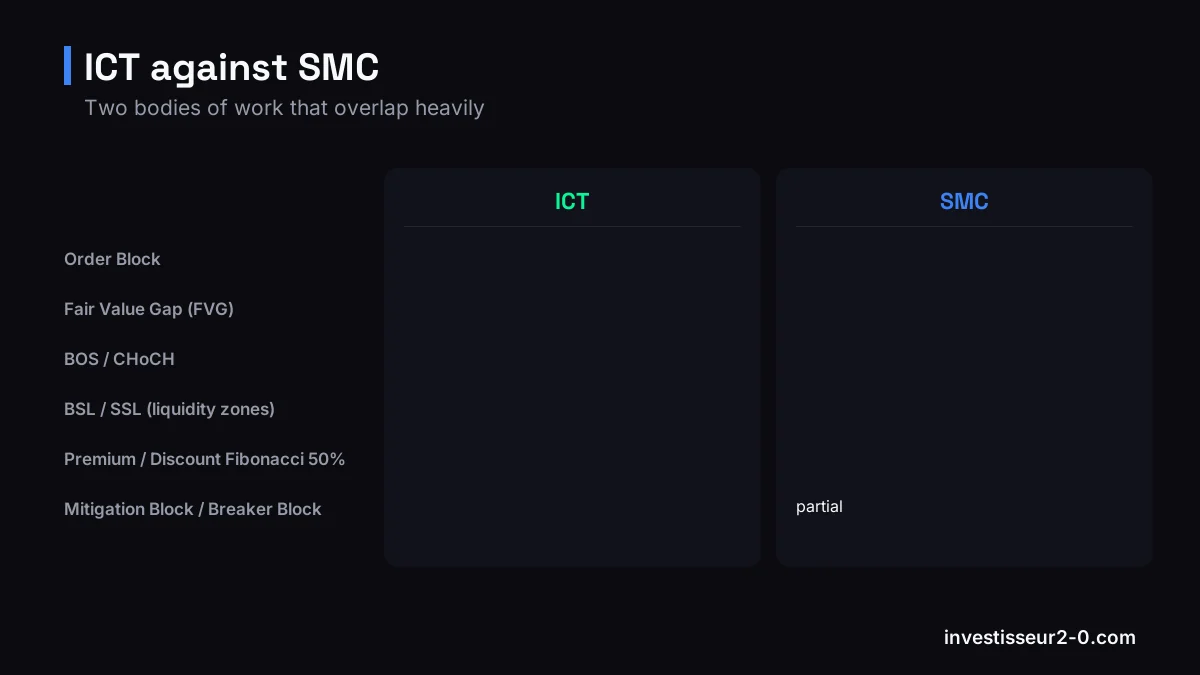
| Concept | ICT | SMC |
|---|---|---|
| Order Block | ✅ | ✅ |
| Fair Value Gap (FVG) | ✅ | ✅ |
| BOS / CHoCH | ✅ | ✅ |
| BSL / SSL (liquidity zones) | ✅ | ✅ |
| Premium / Discount Fibonacci 50% | ✅ | ✅ |
| Mitigation Block / Breaker Block | ✅ | ⚠️ partial |
| Killzone (Asia/London/NY) | ✅ | ❌ |
| OTE (62-79% Fibo) | ✅ | ⚠️ partial |
| Power of Three (PO3) | ✅ | ❌ |
| Judas Swing | ✅ | ❌ |
| Quarterly Theory | ✅ | ❌ |
| Silver Bullet Strategy | ✅ | ❌ |
| IPDA (delivery algorithm) | ✅ | ❌ |
Which one to choose in 2026?
If you are starting out in institutional trading
Start with SMC. Concretely:
- Learn to identify Order Blocks, FVG, BSL/SSL.
- Read market structure: higher highs/higher lows in a trend, BOS to confirm continuation, CHoCH to signal a reversal.
- Trade only in Higher Timeframe confluence (D1/H4 → entry H1/M15).
- Apply the 1% per trade rule without exception.
Our SMC pillar guide covers all of this in detail.
If you already master SMC after 6+ months
Expanding toward ICT adds the timing precision that SMC neglects:
- Killzones: trading only during institutional time windows (London Open 8am-11am CET and NY Open 2pm-5pm CET) significantly increases the win rate.
- Power of Three: an Accumulation → Manipulation → Distribution framework that applies to the daily, weekly and monthly cycle.
- OTE: the 62-79% retracement zone as the optimal entry, more restrictive than the simple "OB retest" in SMC.
The Investisseur 2.0 approach: SMC + key ICT concepts
Our 2026 methodology deliberately blends the two frameworks:
- SMC base for price-action reading: Order Blocks, FVG, BOS/CHoCH, BSL/SSL.
- ICT layer for timing: London/NY Killzones only, OTE for optimal entries, Mitigation Block for retests.
- Wyckoff discipline for context: identifying the market phase (accumulation/manipulation/distribution/markdown) on the higher timeframe. See how the two layer together in our Wyckoff vs SMC comparison.
This synthesis gives the best of both worlds: SMC's simplicity for reading, ICT's precision for execution. This is exactly what our free AI SMC Analyzer applies automatically when you upload a chart screenshot.
Frequently asked questions
Are ICT and SMC the same thing?
No. ICT (Inner Circle Trader) is the original framework created by Michael J. Huddleston since the early 2010s, which includes around thirty advanced concepts (Killzones, OTE, Mitigation Block, Breaker Block, Power of Three, Judas Swing, etc.). SMC (Smart Money Concepts) is the simplified, YouTube-popularized version that has emerged since 2020, retaining mainly Order Blocks, Fair Value Gaps, BOS/CHoCH and BSL/SSL liquidity zones. SMC is an educationally accessible subset of ICT.
Which approach should you choose between ICT and SMC to start in 2026?
For a beginner in institutional trading, starting with SMC is more efficient: fewer concepts, a gentler learning curve, more accessible resources. Once Order Blocks, FVG, BOS/CHoCH are mastered (typically 3 to 6 months of practice), expand toward ICT-specific concepts (Killzones, Power of Three, OTE) to gain entry precision.
Does ICT really include more concepts than SMC?
Yes. ICT covers roughly 30 to 40 concepts: Killzones, Power of Three, Judas Swing, OTE, Premium/Discount, Mitigation Block, Breaker Block, Liquidity Void, Quarterly Theory, Silver Bullet Strategy, IPDA, and numerous timing tools (HTF/LTF synchronization). SMC focuses on the 8 to 10 core concepts: Order Blocks, FVG, BSL/SSL, Liquidity Sweep, BOS, CHoCH, Premium/Discount, and multi-timeframe structure.
Is SMC less reliable than ICT?
No, reliability depends on application, not the framework. A disciplined SMC trader who respects the 1% rule and trades only in Higher Timeframe confluence can be more profitable than an ICT trader who overuses Killzones without context. Both frameworks describe the same institutional mechanics seen from different angles.
What is the practical difference when entering a trade?
In SMC, the typical entry is: retracement into an Order Block in confluence with an FVG, after BOS confirmation in the direction of the bias. In ICT, the entry adds the time dimension: wait for the Killzone (London or New York Open) AND the OTE zone (62-79% Fibonacci) AND a structure signal. ICT is more restrictive, so fewer signals but theoretically higher quality.
Going further
Three key Investisseur 2.0 resources to apply these concepts:
- 📘 SMC pillar guide (10,000 words). The entire SMC methodology applied to crypto.
- 📘 ICT crypto strategy. Killzones, OTE, Power of Three in detail.
- 🤖 AI SMC Analyzer (free). Upload a screenshot, the AI applies SMC + ICT in 10 sec.