
ICT (Inner Circle Trader): Applying Michael Huddleston's Method to Crypto Trading
The Smart Money Concepts everyone uses today did not appear out of thin air. They come from one man, Michael Huddleston, aka ICT (Inner Circle Trader). This guide breaks down the original ICT concepts and shows how to apply them concretely to crypto trading on BTC, ETH, and SOL.
Complete guide by Julien & Cedric of Investisseur 2.0: ICT vs SMC, Killzones, Optimal Trade Entry, Breaker Blocks, Mitigation Blocks, ICT Order Flow, concrete examples, and FAQ.
ICT trading, in one answer
ICT trading is the method of Michael Huddleston, the Inner Circle Trader. The premise: price is moved by institutions hunting liquidity, so you trade where and when they do it. In practice, four steps. Mark the liquidity resting above recent highs and below recent lows. Wait for the London or New York opening window, the Killzones, when volume arrives. Look for a sweep of that liquidity followed by a shift in structure, then enter on the retracement into a Fair Value Gap, an Order Block or the Optimal Trade Entry zone, between 62% and 79% of the move. Stop beyond the sweep, target the opposite pool. ICT is the source of what most people now call Smart Money Concepts; the rest of this guide takes each piece in turn, with crypto examples. Updated 19 October 2026.
What Is ICT (Inner Circle Trader)?
ICT is a trading methodology created by Michael Huddleston, an American trader who has studied financial markets since the 1990s. His core thesis: markets are not random. They are engineered by institutions (banks, funds, market makers) that manipulate price to accumulate and distribute positions at specific levels.
Unlike traditional technical analysis (RSI, MACD, moving averages), ICT ignores lagging indicators. The method focuses on three axes: where institutions place their orders (order blocks, breaker blocks, mitigation blocks), when they execute them (Killzones, the specific time windows), and how they manipulate price to obtain the liquidity they need (stop hunts, false breakouts, displacement).
Huddleston shared his method for free on YouTube through hundreds of videos called "ICT Mentorship." The community then simplified and popularized these concepts under the name Smart Money Concepts (SMC), but the original ICT version contains layers of analysis that the popular SMC version often omits.
ICT vs SMC: What Is the Difference?
This question comes up constantly. The answer is simple but important:
- ICT is the source. Michael Huddleston conceptualized the entire theoretical framework: order blocks, Fair Value Gaps, Killzones, OTE, Breaker Blocks, Mitigation Blocks, ICT Order Flow, Power of Three (accumulation, manipulation, distribution). Each concept has institutional order flow logic behind it.
- SMC is the popularized derivative. The trading community (Twitter, YouTube, Discord) adopted ICT concepts, renamed some of them, and simplified them for accessibility. The Smart Money Concepts you know (BOS, CHoCH, order blocks, FVG) are simplified versions of the original ICT teachings.
What SMC typically omits: Killzones (specific time windows), the Optimal Trade Entry (62-79% Fibonacci zone), Mitigation Blocks (institutional loss liquidation zones), and the Power of Three logic that structures each trading session. Mastering ICT means adding these layers to your existing SMC reading.
ICT Killzones: When to Trade Crypto
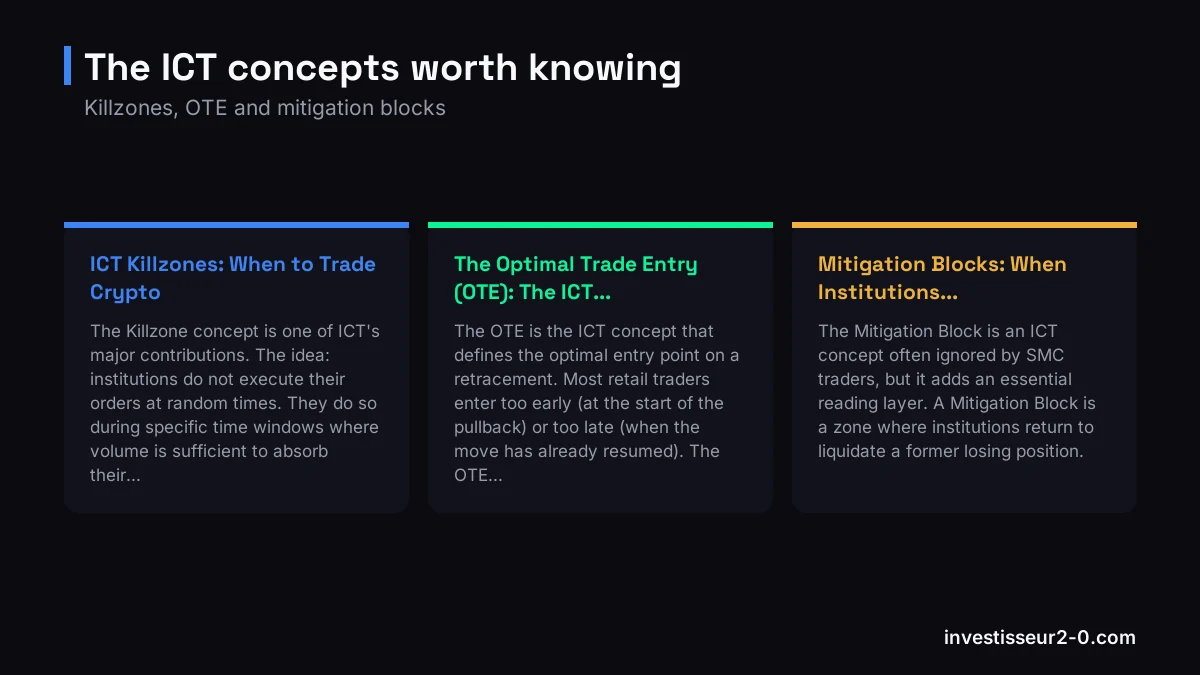
The Killzone concept is one of ICT's major contributions. The idea: institutions do not execute their orders at random times. They do so during specific time windows where volume is sufficient to absorb their positions without excessive price impact. Outside these windows, the market ranges or generates noise.
On traditional markets (forex, indices), Killzones correspond to session openings. In crypto, the market is open 24/7, but institutional volume still correlates with traditional market hours. Here are the three ICT Killzones adapted to crypto:
Asian Session Killzone (00:00 - 04:00 UTC)
This is the quietest session for BTC and ETH. Volume is low, ranges are tight. ICT teaches that the Asian session creates the liquidity that subsequent sessions will hunt. Concretely: the highs and lows of the Asian session become stop hunt targets for London and New York. Do not trade this session, analyze it.
Mapping the Asian range on BTC is an essential exercise: draw the high and low of the 00:00-04:00 UTC session, then observe how the London Open systematically breaks one of these levels before reversing in the opposite direction.
London Open Killzone (07:00 - 10:00 UTC)
This is the first high-volume Killzone. European desks open, market makers start moving price. On BTC and ETH, this is often when the first directional move of the day forms. The London Open has a strong tendency to sweep the liquidity created during the Asian session. Asian equal highs/lows are the preferred targets.
For crypto traders, the London Open is the "cleanest" Killzone: moves are directional, the Fair Value Gaps that form are often respected in the following hours, and the order blocks created have a high probability of reaction on the first retest.
New York AM Killzone (12:00 - 15:00 UTC)
This is the highest-volume session in crypto markets. The London/New York overlap (12:00-14:00 UTC) concentrates maximum liquidity, and this is when the most impulsive moves occur on BTC and ETH. ICT traders often look to enter during the pullback after the London move, entering during the New York AM with a confirmed bias.
The key: the New York AM confirms or invalidates the move initiated by London. If London broke the Asian high to the upside, the New York AM may either continue the move (continuation) or sweep London's low to invalidate the bias (reversal). This is what Huddleston calls the "Judas Swing": a false move designed to trap latecomers.
The Optimal Trade Entry (OTE): The ICT Entry Point
The OTE is the ICT concept that defines the optimal entry point on a retracement. Most retail traders enter too early (at the start of the pullback) or too late (when the move has already resumed). The OTE targets the precise zone where institutions reload their positions.
Technically, the OTE corresponds to the Fibonacci retracement zone between 62% and 79% of the last impulsive swing. This zone is not arbitrary. It corresponds to the point where price has retraced enough to offer institutions a good risk-to-reward ratio without invalidating the structure of the move.
Concrete example on BTC: Bitcoin forms a bullish swing from $92,000 to $98,000. The OTE sits between $94,260 (62% retracement) and $93,280 (79% retracement). If an order block or a FVG sits in this zone, the confluence is strong, and this is a high-probability ICT setup. Stop below the swing low, target on the previous high or beyond, typical R:R ratio 1:3 or better.
The OTE is not an indicator to use in isolation. It must be combined with an active Killzone, a clear directional bias (BOS on H4 minimum), and an institutional liquidity zone in confluence. Without these elements, the Fibonacci retracement alone has no predictive value.
Mitigation Blocks: When Institutions Liquidate Their Losses
The Mitigation Block is an ICT concept often ignored by SMC traders, but it adds an essential reading layer. A Mitigation Block is a zone where institutions return to liquidate a former losing position.
The logic: when an order block "fails," meaning price breaks through it instead of bouncing, institutions that had positions in that zone are in unrealized loss. They cannot cut immediately (position size too large, market impact too high). They wait for price to return to the zone to exit at breakeven or minimal loss. This exit zone is the Mitigation Block.
Example on ETH: a bullish order block forms at $3,200 on H4. Price breaks this level to the downside, invalidating the OB. Institutional buyers who had accumulated at $3,200 are in loss. When price rises back to $3,200 later, these institutions sell to mitigate their loss, and the zone becomes a temporary resistance (Mitigation Block). This is a high-probability short opportunity, because the institutional selling flow is predictable.
Breaker Blocks: The Institutional Reversal
The Breaker Block is the evolution of the Mitigation Block. When an order block is broken and market structure reverses, the former order block changes polarity: it becomes a reaction zone in the opposite direction.
Concretely: a bullish order block that gets broken to the downside becomes a bearish Breaker Block. When price returns to retest this zone from below, there is a high probability of bearish rejection, because institutions that were long in this zone are looking to exit, and new institutional sellers are placing shorts there.
The difference from a simple "support turned resistance": the Breaker Block has order flow logic behind it. It is not a visual observation; it is a zone where real institutional positions must be liquidated. This is why Breaker Blocks have a significantly higher reaction rate than simple technical level flips.
On crypto markets manipulated by market makers, Breaker Blocks are particularly useful after major stop hunts. When a market maker sweeps a significant low to trigger stops, then price recovers, the former broken support becomes a Breaker Block, and this is often where the real bullish move begins.
ICT Order Flow: Reading the Flow in Crypto
ICT Order Flow is the synthesis of all previous concepts. It is not a single indicator but a method for reading order flow that combines market structure, institutional zones, and timing.
The ICT Order Flow process for crypto follows a precise sequence:
- Step 1, Directional bias: identify the dominant flow direction on H4/Daily via BOS and CHoCH. This is the ICT "narrative," the framework within which you trade.
- Step 2, Zone mapping: draw order blocks, breaker blocks, mitigation blocks, and Fair Value Gaps on reference timeframes (H4, H1).
- Step 3, Timing: wait for an active Killzone to coincide with price returning to a high-probability zone (OTE + OB/Breaker confluence).
- Step 4, Confirmation: observe a displacement (impulsive candle) or a structure shift on a lower timeframe (M15, M5) confirming that institutions have committed flow in your direction.
- Step 5, Execution and management: entry with stop below/above the protected zone, target on the next liquidity pool (equal highs/lows, BSL/SSL). Minimum R:R ratio 1:3. Risk management in line with our protocol.
This process is more demanding than "basic" SMC trading (which often boils down to: "there is an OB, I buy"). But this rigor is precisely what filters setups and increases the win rate. In crypto, where volatility can quickly invalidate a zone, the timing filter of Killzones is particularly valuable.
Applying ICT to Crypto Trading: BTC, ETH, SOL Specifics
ICT was designed for forex and indices. Adapting it to crypto requires several essential adjustments:
- 24/7 market: Killzones remain valid but the Asian session is more active in crypto than in forex (on-chain volume, Asian exchange activity). Do not ignore it entirely. Use it to map liquidity, not to execute.
- Higher volatility: OTE retracements on crypto are often deeper than on forex. A 79% retracement that would be rare on EUR/USD is common on SOL or ETH. Adjust your stops accordingly. Our risk management guide details the method.
- Fragmented liquidity: unlike forex (effectively a centralized market), crypto liquidity is dispersed across multiple exchanges. The market makers exploit this fragmentation to create price dislocations. Abnormal wicks on certain exchanges are often artifacts of this fragmentation, not valid ICT signals.
- Active weekends: Sunday evening (UTC) is a low-liquidity period when crypto market makers often execute stop hunts. This is a time when Mitigation Blocks and Breaker Blocks are particularly useful for reading the real flow behind the wicks.
Complete ICT Setup Example on BTC/USDT
Here is a typical scenario combining all ICT elements:
BTC is in bullish structure on H4 (last bullish BOS confirmed). During the Asian session, price consolidates between $95,000 and $96,000, creating a range with liquidity on both sides (equal highs at $96,000, equal lows at $95,000).
At the London Open (07:00 UTC), price breaks the equal lows at $95,000. This is the stop hunt. Long traders' stops are triggered, institutions accumulate at a discount. Then price bounces aggressively, forming a bullish order block at $94,800 and a Fair Value Gap between $94,800 and $95,200.
This bullish OB at $94,800 sits in the OTE zone (62-79% retracement of the last H4 swing). The confluence is triple: OB + FVG + OTE. Entry is at $94,900, stop below the sweep low ($94,500), target on the equal highs at $96,000 then extension toward $97,500 if flow continues. R:R ratio: 1:2.75 minimum.
This setup does not appear every day, but when it does, it is one of the most reliable in crypto trading. The key is patience: waiting for all ICT elements to converge instead of forcing a trade on a single signal.
FAQ: ICT in Crypto Trading
What is ICT (Inner Circle Trader) in trading?
ICT is the trading methodology created by Michael Huddleston. It focuses on identifying zones where institutions execute their orders (order blocks, breaker blocks, mitigation blocks), high-volume time windows (Killzones), and optimal entry points (OTE). ICT is the origin of the Smart Money Concepts found everywhere today.
What is the difference between ICT and SMC?
ICT is the original source. SMC is the popularized, simplified version adopted by the trading community. ICT includes specific elements like Killzones, the Optimal Trade Entry, and Mitigation Blocks, which the SMC version often omits. Mastering ICT provides deeper understanding of institutional mechanics.
Do Killzones work in crypto?
Yes. Even though crypto trades 24/7, institutional volume follows traditional market hours. The London Open (07:00-10:00 UTC) and New York AM (12:00-15:00 UTC) produce the most directional moves on BTC and ETH. The Asian session creates the liquidity that subsequent sessions exploit.
How do you find the OTE on Bitcoin?
Draw a Fibonacci on the last impulsive swing. The OTE sits between 62% and 79% retracement. Look for confluence with an order block or FVG in this zone, during an active Killzone. This is the entry point where the risk-to-reward ratio is statistically most favorable.
What is a Breaker Block?
A Breaker Block is a former order block that failed: price broke through it. When price returns to retest this zone from the opposite side, it becomes a high-probability reversal zone. Breaker Blocks are particularly reliable after stop hunts on BTC and ETH.
Is ICT suitable for beginners?
No, it is an advanced methodology. Start with SMC basics (market structure, order blocks, FVG), then gradually integrate ICT concepts (Killzones, OTE, Breaker Blocks). Expect several months of serious study before being able to apply ICT coherently.
Summary
ICT is the original method behind Smart Money Concepts. Mastering its specific concepts (Killzones, OTE, Breaker Blocks, Mitigation Blocks, ICT Order Flow) adds analytical layers that the simplified SMC version does not cover. In crypto, these concepts adapt with adjustments related to volatility, fragmented liquidity, and the 24/7 market nature.
The key is not knowing each concept individually, but combining them in a structured analysis process: directional bias, zone mapping, Killzone timing, flow confirmation, and disciplined execution with rigorous risk management.
Disclaimer. This article is educational. Nothing we publish constitutes investment advice. Trading involves risk of capital loss. Learn the method, test it on a demo account, and never risk more than you can afford to lose.