
Fair Value Gap trading explained, TradingView indicator, BTC/ETH examples (SMC 2026)
The Fair Value Gap is one of the most used concepts in the Smart Money Concepts (SMC / ICT) framework. Behind the technical term lies a simple idea: when price moves too fast under institutional flow, it leaves holes in the market, and those holes act like magnets.
Complete guide by Julien & Cedric of Investisseur 2.0: rigorous definition, 3-candle detection method, FVG types, combination with order blocks, examples on Bitcoin and Ethereum, and FAQ at the end.
Definition of the Fair Value Gap
A Fair Value Gap (FVG), also called an imbalance, is a price zone where three consecutive candles form a gap: the low of the third candle does not overlap the high of the first candle (for a bullish FVG), leaving an untested price range.
In practical terms: buyers and sellers did not meet in that zone. The market passed through it so quickly (under the effect of an institutional move, a news event, or a cascade liquidation) that no real exchange occurred at those prices. This imbalance is what the market statistically seeks to "fill" by returning there to find an equilibrium value.
The concept originates from the ICT (Inner Circle Trader) theoretical framework and has spread widely across the SMC ecosystem. It describes a microstructural truth of the market: institutional flows leave footprints, and those footprints are exploitable.
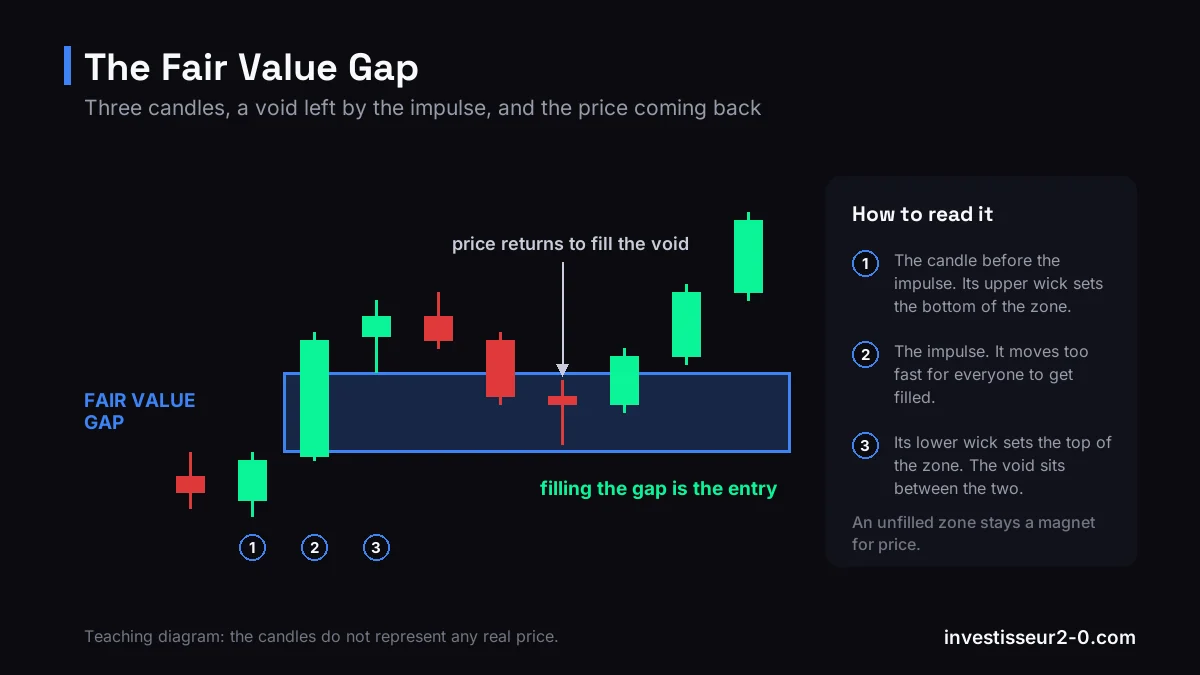
How to identify a FVG on your chart: the 3-candle rule
The method is systematic and leaves no room for interpretation:
- Spot three consecutive candles forming an impulsive move (bullish or bearish).
- For a bullish FVG: verify that the low of candle 3 is strictly above the high of candle 1. The zone between these two levels is your FVG.
- For a bearish FVG: verify that the high of candle 3 is strictly below the low of candle 1. The zone between these two levels is your FVG.
On TradingView, several community indicators (FVG, Imbalance, SMC Toolkit) draw these zones automatically. Use them to save time, but always manually verify structural validity, since an indicator also marks trivial FVGs without context.
FVG vs classical support/resistance
The fundamental difference between a FVG and a support/resistance is conceptual:
- Support/resistance: a zone where price has reacted multiple times. It's a memory of the past, known to everyone, and therefore potentially trapped by market makers who place stop hunts there.
- FVG: a zone where price was not exchanged. It's the footprint of a fast, typically institutional, move that the market is structurally pushed to revisit to rebalance order flow.
This difference is subtle but important for understanding the institutional mechanics of crypto markets. The FVG has an order-flow logic, not a psychological one.
The 3 types of FVG and their reliability
1. "Institutional" FVG (most reliable)
Forms on higher timeframes (Daily, H4) following a major macro news event (CPI, FOMC, ETF decision), a whale move, or a massive liquidation. The zone is wide, well-defined, and will be revisited with very high probability before continuation. These FVGs are the first we look at in our daily analysis on BTC and ETH.
2. Continuation FVG
Forms in the middle of a strong trend. Price makes an impulsive move, leaves a FVG, consolidates briefly, then continues in the same direction after partially (50% EQ) or fully filling the gap. This is the entry type we favor because the risk/reward ratio is excellent and the market context aligns the probability.
3. Reversal FVG
A FVG formed just after a liquidity sweep (institutions trapped longs or shorts by hunting stops). Combined with an order block below (or above for a short), this is often the signal of an upcoming trend reversal. Riskier because you're positioning against the immediate move, but potentially very rewarding when timing is right.
How to use the FVG as an entry zone
There are two schools, and your choice should depend on the level of confluence available:
- Fill the FVG to 50% (equilibrium / EQ level): enter when price retraces to the midpoint of the gap. This is often where institutions reload their position. This is our default entry point when the FVG is confluenced with an OB or liquidity zone.
- Fill the FVG to 100%: some traders wait for the FVG to be completely filled before entering. More certainty (you know the gap is filled), but often less reward since you enter later and closer to the stop.
The stop loss is placed just below the FVG low (bullish) or above the FVG high (bearish), with a margin calibrated to volatility. For this precise calculation we use the ATR. See our complete ATR guide.
Concrete example: FVG on Bitcoin H4
Imagine a frequent scenario on BTC/USDT on H4. Price consolidates around $66,000, then a positive news event (regulatory approval, ETF flow) triggers an impulsive move: three consecutive bullish candles carry price from $66,500 to $69,200. Candle 1 has a high at $67,100, candle 3 has a low at $67,800. The gap between $67,100 and $67,800 is your bullish FVG, EQ at $67,450.
When price retraces on the following pullback, two common scenarios:
- Return to $67,450 (EQ) then resumption: long entry, stop below $67,000, target at the last high at $69,200, typical R:R of 3:1 to 4:1.
- Full fill to $67,100 then continuation: conservative entry, tighter stop, better R:R but lower probability of execution.
Concrete example: FVG on Ethereum
On ETH/USDT, the mechanics are identical but volatility being higher than on BTC, FVGs are often wider and the wicks testing them are more aggressive. Practical consequence: it's wise to place the stop 1.5× the ATR below the FVG low rather than a pip under the zone, to avoid being taken out by a manipulation wick.
Another ETH specificity: FVGs are often formed around network upgrade announcements, major staking launches, or token unlocks. Crossing these dates with H4/Daily FVG zones allows anticipating price returns with a non-negligible statistical edge.
FVG + Order Block: the priority combined setup
This is the combination we look at with absolute priority. When a FVG and an order block overlap on the same price zone, the confluence is maximum:
- The OB indicates the institutional interest zone (where the big players have their positions).
- The FVG gives the precise entry level in that zone (the gap's EQ).
- The liquidity zone just above confirms the price target (the market will hunt that liquidity after reloading on the OB).
When all three elements align, it's a priority setup in our 2026 analysis protocol. We share it in real time on the Telegram channel.
The 3 most common mistakes with FVGs
The FVG is an entry tool, not a complete system. The mistakes we regularly observe among traders starting out:
- Entering a counter-trend FVG without confluence: a bullish FVG in a strong bearish structure (confirmed bearish BOS on H4 and Daily) can fill cleanly… then price continues to fall. The macro context always trumps the tactical zone.
- Confusing a FVG with a simple correction: not every price gap is a technical FVG. Apply the 3-candle rule rigorously: if the low of candle 3 touches or overlaps the high of candle 1 (even by one pip), there is no valid FVG.
- Neglecting risk management: even the best FVG doesn't justify risking more than 1% of capital per trade. See our article on the ATR for stop sizing.
FAQ: Fair Value Gap crypto
What is a Fair Value Gap in crypto trading?
It's a price zone where 3 consecutive candles form a gap: for a bullish FVG, the low of candle 3 is above the high of candle 1, leaving an untested range. It's the footprint of a fast institutional move that the market statistically revisits.
Is a FVG always filled?
No. FVGs formed in very strong macro trends can remain unfilled for weeks or even permanently. Statistically, H4/Daily FVGs have a high fill rate in the 1 to 10 sessions following formation, but there's always a distribution tail. A FVG alone is never a sufficient signal; it must be confluenced.
Should I enter at the FVG touch or wait for the fill?
By default in the Investisseur 2.0 methodology, we enter at 50% of the gap (EQ) when the FVG is confluenced with an order block or liquidity zone. Otherwise, we wait for more confirmation (rejection candle, BOS on lower timeframe).
FVG or Order Block: which takes priority?
They're complementary tools, not competitors. The OB defines the institutional interest zone (macro), the FVG gives the precise entry level (micro). The combination of both on the same zone is the most reliable setup in the SMC methodology.
Do FVGs work on altcoins?
Yes but with degraded reliability. On low-cap altcoins, liquidity is shallower and market makers can easily pass through or fill FVGs erratically. Practical rule: on altcoins, prefer H4 minimum FVGs and always confluence them with BTC structure.
Summary
The Fair Value Gap is the footprint of a fast institutional move, a zone where the market didn't have time to equilibrate. Statistically, these zones are revisited, making them high-quality entry zones when they align with other confluence elements: order block, liquidity sweep, market structure.
Integrated into a complete protocol (SMC): structure + liquidity + OB + FVG + ATR for the stop. It's one of the most precise tools we've added to our analysis since 2022. Not a magic recipe, but when the confluence is there, it's a real statistical edge.
Disclaimer. This article is educational. Nothing we publish constitutes investment advice. Trading involves a risk of capital loss. Learn the method, test it on a demo account, and never risk more than you can afford to lose.
Spotting an FVG is step one; filling it at low cost is what pays. Our free ecosystem bundles the venues we execute on and the channel where zones drop daily.
See the full setup