
How to invest in crypto as a beginner in 2026 without breaking the bank
The cautious Investisseur 2.0 method for getting started in crypto. How much to put in, how, where, and above all which mistakes to avoid so you don't lose your capital in 3 months like 80% of beginners.
Updated June 2026 · Julien & Cedric · 10 min read
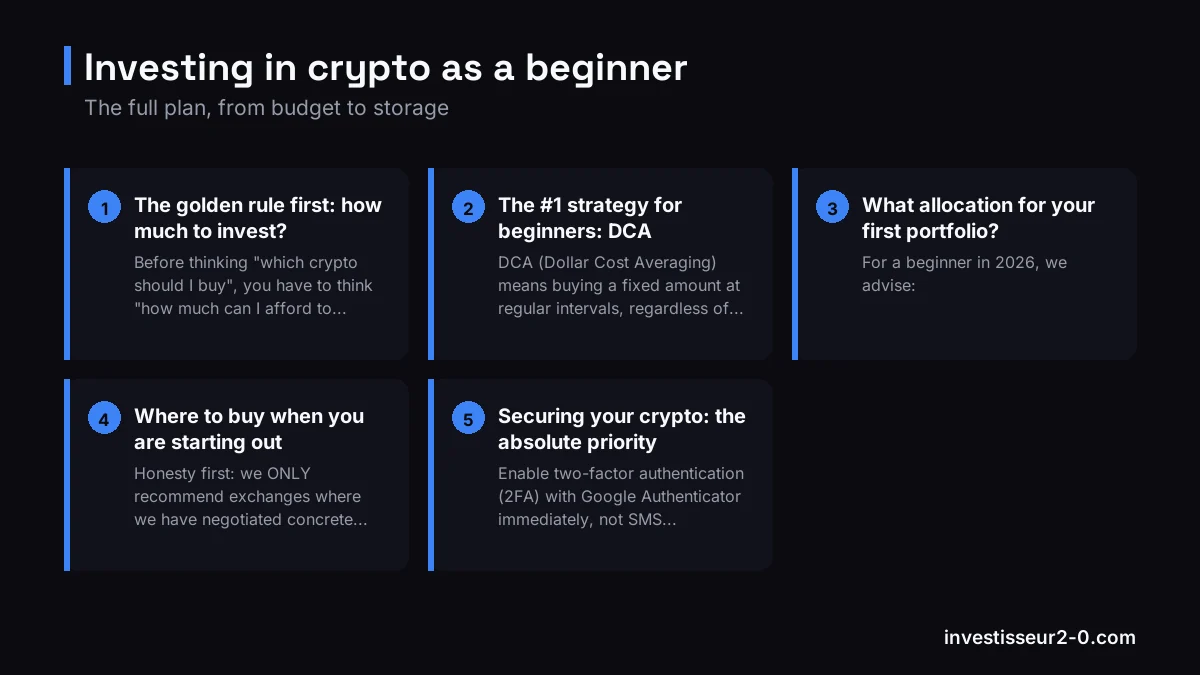
The order matters: budget and DCA come before the asset choice, and security comes before scaling up.
The golden rule first: how much to invest?
Before thinking "which crypto should I buy", you have to think "how much can I afford to lose entirely". That is THE question that separates the beginners who end up positive from the rest.
Our simple rule in 2026:
- A maximum of 5 to 10% of your wealth in crypto when you are starting out.
- Never rent money, grocery money, or your emergency fund (3-6 months of salary in cash).
- Start modest: $100 to $500 for 3-6 months, the time it takes to learn.
- Only increase once you have understood how the exchange works, how DCA works, and how to secure your funds.
The #1 strategy for beginners: DCA
DCA (Dollar Cost Averaging) means buying a fixed amount at regular intervals, regardless of the price. It is the most effective strategy for beginners.
A concrete example: you want to invest $1,200 over 12 months in Bitcoin.
- The wrong approach: put it all in at once on June 16, 2026. If BTC drops 30% in August, you watch your capital melt away.
- The right approach (DCA): $100 on the 1st of each month for 12 months. You sometimes buy expensive, sometimes cheap. In the end your average price smooths out the swings and you sleep at night.
DCA is the cornerstone of a beginner approach: automate it and let time do the work, instead of trying to time the market.
What allocation for your first portfolio?
For a beginner in 2026, we advise:
- 80% Bitcoin (BTC): the most stable base, what you will accumulate through DCA.
- 20% Ethereum (ETH): exposure to the smart contracts ecosystem.
- 0% altcoins, 0% memecoins before 6-12 months of experience.
Later, once you have it down, you can diversify with 10-15% across 2-3 major altcoins (Solana, Chainlink, Toncoin).
Where to buy when you are starting out
Honesty first: we ONLY recommend exchanges where we have negotiated concrete conditions for the Investisseur 2.0 community (reduced fees, deposit bonus, VIP channel). Otherwise it is just disguised advertising. One caveat before the list: if you live in the European Union, BingX and XT.com closed their doors to you on July 1, 2026 under MiCA (BingX has filed for an Austrian FMA licence and is waiting). EU readers should look at OKX or Bybit, both fully MiCA-licensed. For everyone else, three choices depending on your profile:
- For beginner simplicity (easy interface + copy trading): BingX via our partner link. A particularly accessible interface, fast KYC, external copy trading (follow other public traders), deposit bonus negotiated via Inv 2.0. Our #1 recommendation for non-EU beginners in 2026 (EU accounts closed since July 2026, FMA application in progress).
- For reduced fees + automated bots: Pionex via our partner link = 0.05% spot, 31 free bots including automatic DCA, Investisseur 2.0 VIP channel with our shared configurations. Ideal if you want to automate your DCA without thinking about it.
- For the lowest fees (volume + alts): XT.com via the Inv 2.0 VIP = 0.015% maker / 0.046% taker negotiated (vs 0.2% standard everywhere else). Massive savings as soon as you start doing volume. Not available to EU residents anymore. Partner links earn us a commission; your capital is at risk.
On mainstream platforms like Coinbase, Bitpanda or Revolut: they can do the job for a first $50 purchase, but their 1-2% fees eat into your returns over 5 years of DCA. And you often cannot withdraw your coins to a cold wallet (the case with Revolut, Trade Republic). We earn no commission on those, so we have no reason to push them on our community. We dig into the numbers in our detailed Coinbase review.
Securing your crypto: the absolute priority
3 non-negotiable rules:
- Enable two-factor authentication (2FA) with Google Authenticator immediately, not SMS (vulnerable to SIM swap).
- Above $1,000, move it off the exchange to a hardware cold wallet (Ledger Nano S Plus ~$80, Trezor Model One ~$75).
- NEVER give your seed phrase to anyone, not even exchange support. No legitimate support will ever ask for your seed.
Treat self-custody as a habit from day one, not an afterthought once your portfolio has grown.
Taxes on crypto for beginners
The basics, wherever you are based:
- Capital gains are usually taxable when you convert back to fiat (the rate depends on your country of residence).
- Many jurisdictions do not tax crypto-to-crypto swaps (BTC to ETH for example), but rules vary.
- Keep a clean record of every buy and sell so you can declare your annual gains correctly.
- Foreign exchange accounts (Pionex, XT, Binance, etc.) often have to be declared separately.
If you only HODL and never sell, there is usually nothing to declare on the capital-gains side. When in doubt, check your local tax rules or ask an accountant.
The 8 mistakes that ruin crypto beginners
- Investing emergency or rent money. If crypto drops 60%, you should not end up overdrawn.
- Putting it all in at once at the cycle top. Always spread it out with DCA.
- Buying memecoins without understanding them. 80% of memecoins go to zero in under a year.
- Using leverage before 12 months of experience. Futures and liquidations are not for beginners.
- Panic selling on a 30% drop. Crypto regularly drops 30% then recovers. Stick to your plan.
- Leaving your coins on the exchange forever. A hack or bankruptcy (FTX, Celsius) and you lose everything. Cold wallet from $1,000.
- Blindly following the "calls" of Twitter influencers. They are often paid. Do your own analysis.
- Forgetting about taxes. Tax authorities receive the data. Better to declare correctly from the start.
Why 90% of crypto traders lose and how to avoid the 5 big mistakes.
Frequently asked questions
How much do you need to start investing in crypto in 2026?
You can start with $50 on most exchanges. To genuinely learn and experiment without risk, $100 to $500 is a comfortable range. The golden rule: never invest more than you are willing to lose entirely. Investing $10,000 in one shot when you are just starting out is a classic mistake.
What is the best strategy for a crypto beginner?
DCA (Dollar Cost Averaging) is by far the simplest and most effective strategy for beginners: you buy a fixed amount (e.g. $100) every month in Bitcoin or Ethereum, regardless of the price. Over 3-5 years, it smooths your average entry price and protects you from timing mistakes.
What percentage of my wealth should I invest in crypto?
For a beginner in 2026, we rarely advise more than 5 to 10% of total wealth in crypto. More experienced investors sometimes go up to 20-25%, but it is more volatile. Crypto remains a high-volatility asset: never put in rent money or your emergency fund.
Should you buy Bitcoin or altcoins when starting out?
Bitcoin for 80-100% at the start. Ethereum as a complement for 20%. Altcoins (Solana, BNB, others) should be avoided before you have 6-12 months of experience. Many beginners lose big chasing altcoins that seem promising.
What are the best exchanges for a beginner?
EU-based beginners should open an account on a MiCA-licensed exchange first: Bybit (FMA Austria licence, passported across the EEA) or OKX (MFSA Malta). Since July 1, 2026, BingX and XT.com no longer accept EU residents (BingX is awaiting an Austrian FMA decision). Outside the EU, our partner conditions still apply: BingX (easy interface + copy trading + deposit bonus via our partner link), Pionex (0.05% fees + 31 free bots + Inv 2.0 VIP channel), XT.com (0.015% maker negotiated vs 0.2% standard + XT VIP access). Mainstream exchanges like Coinbase or Bitpanda can do the job for a first $50 purchase, but their 1-2% fees add up fast over 5 years of DCA.
What should you do if the price drops after you buy?
It is normal. Crypto is volatile, drops of 30 to 50% happen even on Bitcoin. If you are doing DCA, you keep buying at average prices. Never sell in panic. Only sell when you have a plan defined in advance (e.g. take 25% profit at +100%). Our risk management guide covers all of this.
How long does it take to become profitable in crypto?
If you invest in Bitcoin with monthly DCA and hold for 3-5 years, you statistically end up positive (based on the 2014-2024 cycles). If you trade actively, the majority of beginners lose during the first 6-12 months. The secret: start modest, learn before increasing the amounts, never use leverage at the start.
Ready to start your first crypto investment?
Our community shares the exact exchange setups, DCA configurations and risk rules we use ourselves, which is perfect for beginners who want a cautious, structured start.
Go further
- 🏆 Best crypto exchanges for 2026
- 🛡️ Crypto trading risk management: the complete guide
- 📈 DCA crypto strategy for beginners
- 🔎 Binance review 2026: fees, security and verdict
- 💶 How much should you invest in crypto as a beginner?
- 📋 How much do you need to trade crypto in 2026?
- ⚠️ Why 90% of crypto traders lose