
How much capital do you need to start trading crypto in 2026?
This is the question we get most often. The honest answer depends on what you want to achieve. It's not the same answer for someone looking to learn, someone after supplemental income, and someone who wants to live off trading.
Capital shrinks at each step: only 1% is truly at stake on any given trade.
The rule that changes everything: 1% per trade
Before talking about amounts, you need to understand the fundamental risk management rule we apply: never risk more than 1% of your capital on a single trade.
This rule, combined with stop-loss calibration via the ATR, mechanically determines the minimum capital size needed to trade seriously. If your stop is $500 away from current price and you only want to risk 1%, you need at least $50,000 of capital to take a one-bitcoin position... or you adapt your position size to your capital.
This is where small capital is disadvantaged: not by a lack of opportunities, but because transaction fees and exchange minimum lot sizes represent a larger share of capital.
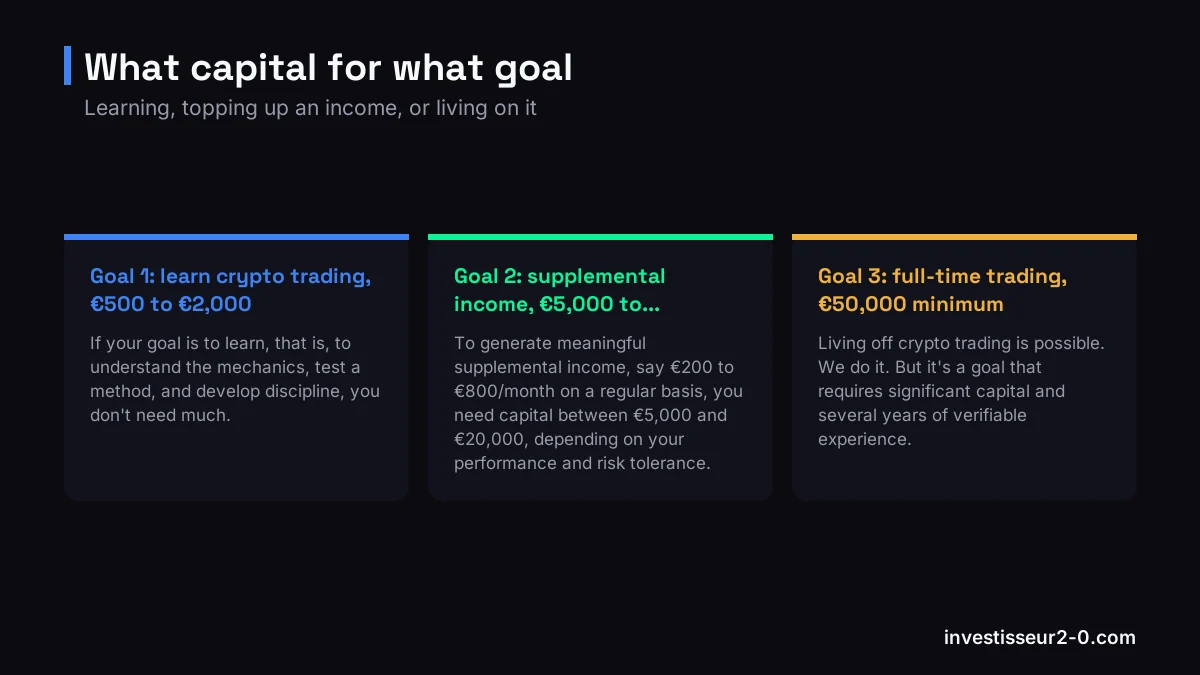
Goal 1: learn crypto trading, €500 to €2,000
If your goal is to learn, that is, to understand the mechanics, test a method, and develop discipline, you don't need much.
Between €500 and €2,000, you can:
- Trade spot positions on BTC/ETH with controlled risk
- Test perps with small leverage (2x max at the start)
- Learn to place stops and targets without excessive emotional pressure
- Make mistakes, and there will be some, without ruining your financial situation
Absolute rule: never put into the market money you need. This capital must be money you psychologically accept losing entirely. It's the only way to learn without destructive emotional pressure. One of the 7 classic mistakes is precisely trading with money you need.
At this stage, absolute euro gains will be small. That's not the goal. The goal is to build the right reflexes, keep a trading journal, and validate your method on real data.
Goal 2: supplemental income, €5,000 to €20,000
To generate meaningful supplemental income, say €200 to €800/month on a regular basis, you need capital between €5,000 and €20,000, depending on your performance and risk tolerance.
The math is simple. With a net monthly performance of 3-5% (realistic for a disciplined trader in a bull market, ambitious but achievable):
- €5,000 × 4% = €200/month
- €10,000 × 4% = €400/month
- €20,000 × 4% = €800/month
These numbers assume rigorous risk management (1% per trade, stops calibrated on ATR), a solid method based on institutional liquidity and order blocks, and iron discipline on losses (no revenge trading).
They also assume negative months, and there will be some. Over 12 months, aim for an annual performance of 30-60% at this capital level, with drawdowns contained under 15%.
Goal 3: full-time trading, €50,000 minimum
Living off crypto trading is possible. We do it. But it's a goal that requires significant capital and several years of verifiable experience.
The realistic minimum to replace an average salary (€2,000-€3,000/month net) with a 4-5% monthly performance: €50,000 to €75,000.
But capital alone isn't enough. You also need:
- At least 2 years of active trading with a documented performance journal
- A historical maximum drawdown below 20%
- Proven psychology: months at -10% happen, and they must not push you into bad decisions
- A "runway" of 12 months of personal expenses outside of trading, so you're never forced to trade out of financial necessity
Claiming you can live off trading with €5,000 would be lying to you. Some make it with extreme leverage, but studies show that 99% of high-leverage traders lose their capital in less than 12 months.
And leverage in all this?
Leverage lets you take larger positions than your actual capital. With 10x leverage on €1,000, you control €10,000 of position. In theory, this lets you "compensate" for small capital.
In practice, leverage amplifies mistakes as much as gains. With 10x, a 10% move against you = capital to zero. Stop losses that are too tight combined with high leverage means guaranteed liquidation.
Our recommendation: no leverage above 3x before 6 months of documented trading. Even with experience, we rarely use more than 5-10x on perps, and only on high-confluence setups.
The truth about "small accounts"
Many beginners try to grow a small account quickly to "reach the required capital". That's a reasoning error. A trader who takes too much risk with €1,000 to turn it into €10,000 takes the same destructive risks with €10,000. The problem isn't the capital; it's the method and the discipline.
The right approach: start with a modest learning capital, validate a method over 6 to 12 months, then scale up progressively. Join a community like ours to shorten the learning curve, not to get shortcuts, but to avoid the costly mistakes we've already made.
In summary: the tiers to remember
- €500-€2,000: learning phase. Goal: build the method, not the gains.
- €5,000-€20,000: supplemental income of €200-€800/month possible with a 4% monthly performance.
- €50,000+: full-time trading becomes conceivable, with a minimum of 2 years of documented experience.
Whatever your tier, method trumps capital. A good trader with €2,000 progresses faster than a bad trader with €20,000.