
Why 90% of crypto traders lose money (real data)
This number gets quoted everywhere, but rarely accompanied by a serious analysis of why. After six years of active trading and observing thousands of traders in our community, here is our no-holds-barred diagnosis.
By Julien & Cedric of Investisseur 2.0.
The data first
Several academic studies and exchange reports confirm the figure:
- A University of California study on day traders in equities shows that 97% lose money over 300 active trading days.
- ESMA (European regulator) data on crypto CFDs shows that 74 to 89% of retail accounts lose, and brokers are legally required to display this figure.
- A Chainalysis analysis of on-chain BTC data shows that during bear markets, fewer than 13% of active addresses are in net profit over their complete history.
The "90%" figure is therefore conservative. The reality on certain markets is worse. But what interests us is not the number. It's why.
Reason #1: the mathematics of loss are asymmetric
Here's something most traders never calculate. If you lose 50% of your capital, you don't need to gain 50% to get back to where you started. You need 100%.
- Loss of 20% → need +25% to recover
- Loss of 33% → need +50% to recover
- Loss of 50% → need +100% to recover
- Loss of 75% → need +300% to recover
This mathematical asymmetry means that a trader who alternates gains and losses of the same percentage always loses money over time. This is the fundamental reason why limiting losses, via stops calibrated on the ATR and the 1% rule, is more important than maximizing gains.
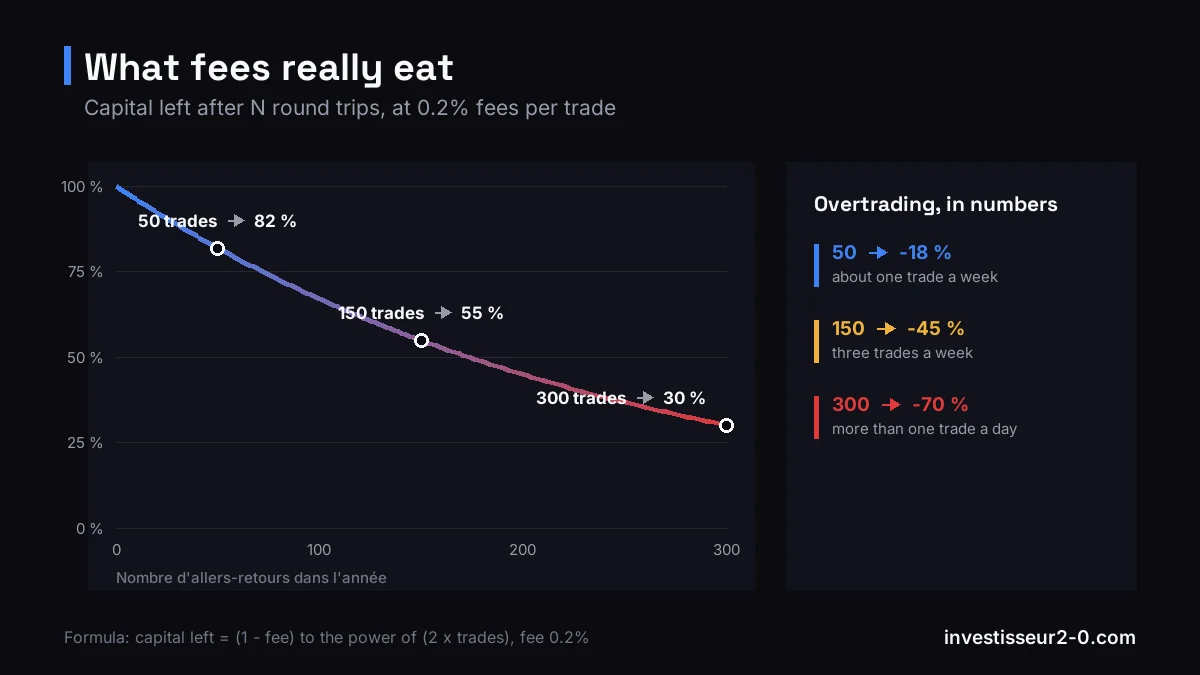
Reason #2: fees and spread eat small gains
A trader doing 5 trades per day at 0.06% fees per trade (standard taker fee) pays 0.3% per day of their capital in fees. Over 20 trading days per month, that's 6% of capital in fees, before generating a single dollar of profit.
To be profitable, this trader must therefore generate more than 6% per month just to cover fees. That's a very high threshold. Exchanges have built a perfect business model: the more you trade, the more they earn, regardless of your performance.
The solution: trade less, but better. The profitable traders we know make between 5 and 20 trades per month, not per day. Overtrading is one of the classic mistakes we document in detail in our methodology.
Reason #3: cognitive biases are wired to make you lose
The human brain is optimized for survival on the African savanna, not for crypto trading. Several fundamental cognitive biases work against you:
Loss aversion
Kahneman and Tversky showed that the pain of a loss is psychologically twice as intense as the pleasure of an equivalent gain. Direct consequence: traders tend to cut their profits too early ("already +5%, I'm taking it") and let their losses run ("it'll come back"). The mathematical result is disastrous.
Confirmation bias
Once you're in a position, you unconsciously seek information that confirms your thesis and ignore what contradicts it. A bearish signal appears when you're long? "It's temporary." Market structure reverses? "It's a short squeeze trap." This bias is devastating, and the only remedy is a clearly defined invalidation process set before entering a trade.
FOMO (Fear Of Missing Out)
BTC just made +15% in 4 hours. Telegram groups are exploding. Most traders enter at the peak, precisely when institutions are distributing. The institutional liquidity hunt exploits exactly this bias: driving price up to attract latecomers, then selling into their liquidity.
Reason #4: no reproducible method
The majority of traders have a vague trading "style": a mix of RSI, intuitively drawn trend lines, forum reads, and "I feel like it's going up." That is not a method.
A reproducible method has clear rules, defined in advance, applicable the same way every day regardless of the trader's mood. It specifies: which setups to look for, on which timeframes, with which minimum confluences, what stop, what target, what position size.
This is what we describe in our 2026 methodology: liquidity + structure + order block + FVG. Without this framework, each trade is an ad hoc decision, and ad hoc decisions under stress are never the best ones.
Reason #5: leverage without calibrated engaged margin
The trap isn't leverage itself but the engaged margin relative to total capital. A beginner sees "x100 available" and engages 30% of capital on it → monstrous notional, the slightest 1% wick liquidates. With the same $300 risk budget, a pro would have engaged $3 on x100 (notional equivalent to a $30 spot trade) and stayed calm. The chosen leverage doesn't define risk; the engaged margin does.
Most beginners start with perpetuals because they're "more exciting" and exchanges push x50 or x100 in their face from the first session. Without having learned to calibrate sizing, they scale margin with leverage instead of calibrating it against total capital. Result: repeated liquidations before touching the fundamentals.
The real rule: apply the 1% rule on engaged margin, not on capital × leverage. The chosen leverage is just the capital efficiency tool: it frees up capital without changing your risk. The Crypto futures leverage, capital efficiency lesson details exact formulas and the viable max leverage matrix per stop.
Reason #6: the market is structurally designed to take retail money
This is the truth nobody wants to hear. Exchanges earn on fees regardless of the outcome. Market makers earn by exploiting retail's liquidity. Whales and funds have information and tools (on-chain data, institutional order flow, OTC access) that retail doesn't.
This isn't a reason not to trade. It's a reason to understand these mechanics and use them to your advantage rather than being their victim. This is exactly what we teach: how to read the footprints of big capital, how to identify liquidity hunt zones, how to place your stops out of market makers' reach.
What the 10% who win do differently
Observing thousands of traders in our community since 2020, the common traits of long-term profitable traders are always the same:
- They have a written method and follow it. No exceptions of "this time it's different."
- They manage risk before thinking about gains. The question "how much can I lose?" always precedes "how much can I gain?".
- They keep a trading journal. Every trade, winning or losing, is documented and analyzed.
- They've accepted that losing is part of the game. A 50-55% win rate with a 2:1 R:R ratio is more profitable than an 80% win rate with a 0.5:1 R:R.
- They learn continuously. Markets evolve, strategies must adapt. Complacency is the profitable trader's enemy.
- They belong to a serious community. Not to copy signals, but to stress-test their analysis, identify blind spots, and stay disciplined through difficult periods.
The good news
The good news is that all these reasons are avoidable. Not easily and not quickly, but avoidable. The mathematical asymmetry of losses is managed with good risk management. Cognitive biases are compensated with a written process. The absence of method is solved with time and a solid learning framework.
That's why we've existed since 2020.
FAQ: Why 90% of crypto traders lose
Is it really true that 90% of crypto traders lose?
Yes, and the actual figure is often worse. ESMA data shows 74 to 89% of retail accounts on crypto CFDs lose. The "90%" is a conservative estimate across asset classes.
What is the main mathematical reason?
The asymmetry of losses: losing 50% requires +100% to recover, not +50%. A trader alternating equal gains and losses always loses on net. This is why limiting losses via proper risk management matters more than chasing large gains.
Which cognitive bias hurts traders the most?
Loss aversion is the most destructive: cutting winners too early and letting losers run. Combined with FOMO, which pushes entry at peaks, it creates a pattern of small gains and large losses that is impossible to be profitable with long-term.
What do successful traders do differently?
They follow a written, rules-based method. They put risk management first. They journal every trade. They accept losses as part of the game and think in terms of R:R ratios, not win rates alone.
Disclaimer. This article is educational. Nothing we publish constitutes investment advice. Trading involves a risk of capital loss. Learn the method, test it on a demo account, and never risk more than you can afford to lose.