
ICT Silver Bullet crypto: the time-based strategy that fits in one hour
The Silver Bullet is one of the rare ICT strategies that is both simple to state and hard to execute: a single time window, a single type of setup, nothing else. Designed by Michael Huddleston (ICT) for forex and indices, its mechanics work just as well on crypto, which trades 24/7.
What the Silver Bullet is
The Silver Bullet is a setup that plays out within a precise one-hour window, where you look for one thing only: an entry on a Fair Value Gap that forms after a liquidity grab. ICT's idea is that at certain hours, institutional algorithms leave recurring, exploitable imbalances. Rather than watching the market all day, you focus on that hour, take the setup if it appears, and turn off the screen if it does not.
Three windows exist originally (New York time): 3-4am, 10-11am and 2-3pm. In crypto, it is mainly the windows aligned with the London and New York killzones that produce the cleanest moves, because that is where institutional volume is present.
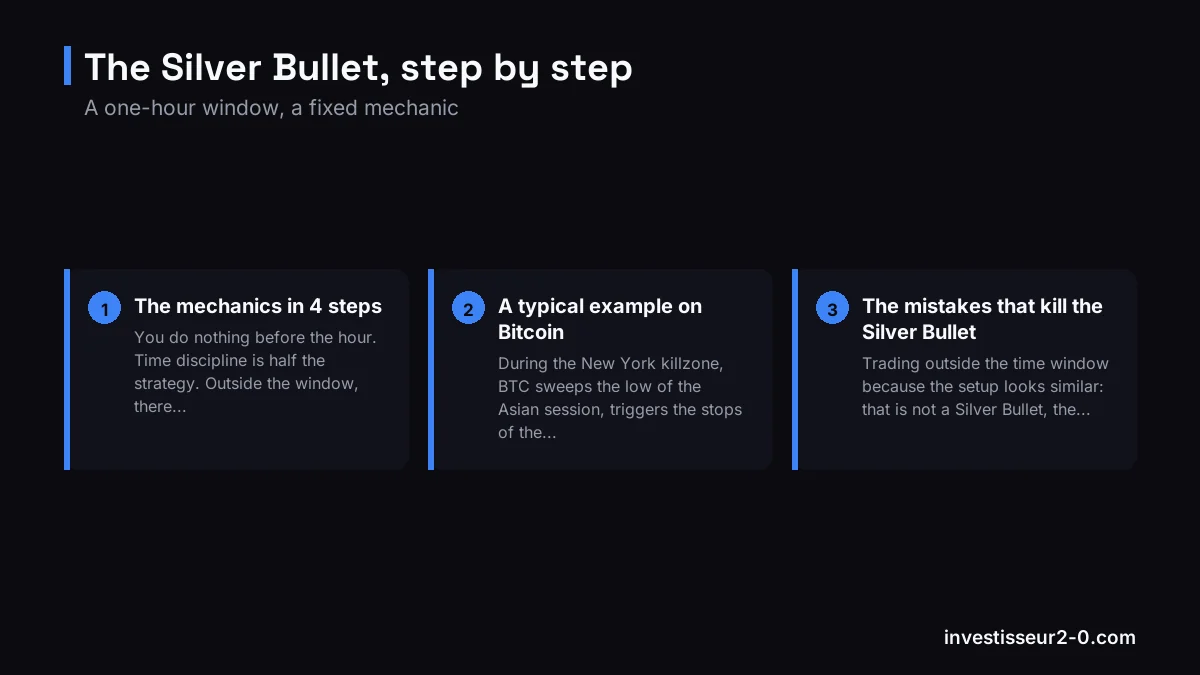
The mechanics in 4 steps
1. Wait for the window
You do nothing before the hour. Time discipline is half the strategy. Outside the window, there is no Silver Bullet, even if the chart looks tempting.
2. Spot the liquidity grab
Just before or at the start of the window, price often reaches for an obvious high or low (the stops piled above a high or below a low). That is the liquidity sweep. It signals that the market has taken the fuel it needed to head the other way.
3. Enter on the Fair Value Gap
After the sweep, price moves off and leaves an FVG, a three-candle imbalance. The entry is on the return into that FVG, in the direction of the post-sweep move. No FVG, no trade. That is what makes the setup objective. For an even tighter entry, refine the return with the OTE 62-79% zone when an Order Block sits inside it.
4. Stop and targets
The stop goes beyond the swept liquidity point (above the high for a short, below the low for a long). The targets: the next opposing liquidity pool, often with a first objective at a 1:2 ratio. The window lasts one hour, so the move you are after is fast.
A typical example on Bitcoin
During the New York killzone, BTC sweeps the low of the Asian session, triggers the stops of the longs, then turns back up leaving an FVG on the recovery move. You enter long on the return into that FVG, stop below the swept low, target the previous intraday high. If price does not come back into the FVG within the window, you do not force it: you wait for the next session.
The mistakes that kill the Silver Bullet
Trading outside the time window because the setup looks similar: that is not a Silver Bullet, the hour is part of the definition. Entering without a prior sweep: with no liquidity grab you do not have the institutional fuel, just a random FVG. Widening the stop when the trade goes against you: the stop beyond the sweep is the logical invalidation of the thesis, and if it gets hit the thesis is dead. And forgetting risk management: keep your 1% per trade rule, size your position with a risk calculator before entering.
The Silver Bullet and the rest of the ICT method
The Silver Bullet is only one setup within the ICT / Smart Money Concepts arsenal. It works because it combines three concepts you find everywhere: liquidity, imbalance (FVG) and timing (killzone). If you master these three building blocks, the Silver Bullet becomes obvious. If you are unsure how ICT relates to the simplified version, see our ICT vs SMC comparison.
To train yourself to spot the FVG and the structure quickly on your own screenshots, the SMC AI Analyzer marks the imbalances and the structure in a few seconds: useful to check your reading during the window, when time is short.
FAQ
What time does the Silver Bullet play out in crypto?
The original windows are 3-4am, 10-11am and 2-3pm New York time. In crypto, the most reliable ones are those aligned with the London and New York killzones. Adapt to your own time zone.
Does the Silver Bullet work on altcoins?
On highly liquid alts, yes. On small caps it is less reliable: less institutional volume, so messier imbalances.
What is the difference between the Silver Bullet and a simple FVG trade?
The Silver Bullet adds two constraints: the precise time window and the prior liquidity grab. These filters reduce the number of trades but increase their quality.
Do you need a paid indicator to trade the Silver Bullet?
No. Killzone, sweep and FVG are visible on a naked chart. A tool can speed up the reading, but nothing is required.
Disclaimer. This article is educational. Nothing we publish constitutes investment advice. Trading carries a risk of capital loss.