
How to trade crypto in 2026: the complete beginner-to-expert guide
Everything you need to know to start crypto trading with a professional approach. Choosing an exchange, reading a chart, institutional methodologies, risk management, building a trade plan. No promises of profit, no 1500 EUR course.
- Why trade crypto in 2026
- Choosing a reliable crypto exchange
- Which assets to trade (BTC, ETH, alts)
- Learning to read a chart
- The 3 institutional methodologies
- Complete risk management
- Building a trade plan
- Typical beginner mistakes
- How much capital to start
- Recommended tools and platforms
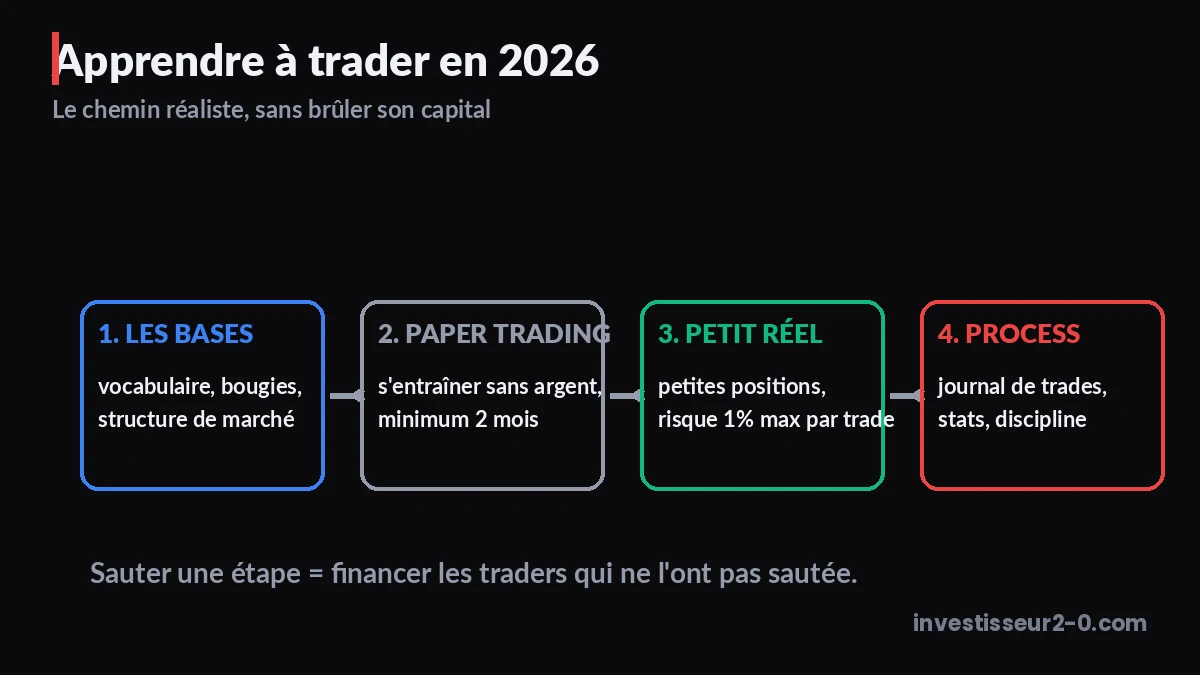
- The realistic progression path
- FAQ
1. Why trade crypto in 2026
In 2026, the crypto market has reached an institutional maturity that did not exist in 2017 or even in 2021. Spot Bitcoin ETFs have been approved in the United States, BlackRock and Fidelity actively allocate to BTC in their portfolios, and daily volumes on major exchanges exceed those of Forex on certain pairs. The crypto market is no longer a niche for geeks; it is an asset class in its own right.
This maturity radically changes the opportunities for the retail trader:
- Massive liquidity on BTC, ETH and the top 30 altcoins. Spreads have tightened, slippage is limited, execution is fast.
- Readable institutional behavior: fund flows leave clear footprints on charts, identifiable with the right methodologies (SMC, ICT, Wyckoff).
- 24/7 market, unlike traditional equities, giving unique flexibility to traders who have a main activity on the side.
- Accessible pro tools: TradingView, exchanges with advanced features, AI analysis, risk calculators, sophisticated indicators.
In return, crypto trading remains extremely risky. More than 90% of retail traders lose money according to the most recent studies. This article aims to give you the tools to be part of the 10% who survive and perform.
2. Choosing a reliable crypto exchange
The choice of exchange is more important than most beginners think. A bad exchange means fees that eat into your gains, slippage that ruins your entries, and support that vanishes when you need it.
Criteria for a good exchange in 2026
- High daily volumes on your target pairs (minimum 500M USD on BTC/USDT for an exchange to be usable seriously).
- Credible regulation: MSB license, FinCEN, or equivalent in the EU/Asia. Avoid exchanges without any identifiable regulator.
- Competitive fees: maker 0.02-0.05%, taker 0.05-0.1% on spot. Beyond that, your performance gets devoured by fees.
- Stable interface: an exchange that freezes during pumps (Binance in May 2021, FTX before its crash) is unusable for an active trader.
- Security: mandatory 2FA, withdrawal address whitelist, cold storage for the majority of client funds.
Our 2026 recommendation: partner exchanges
At Investisseur 2.0, we work with exchanges that all meet the criteria above and each offer a specific advantage:
- Bybit: MiCA-licensed (Austrian FMA, May 2025), on the AMF white list, copy trading included. Our first pick for EU and French residents. See our Bybit review.
- OKX: MiCA-licensed (Malta MFSA, January 2025), deep liquidity and strong tooling. The other EU-compatible choice. See our OKX review.
- XT.com: native copy trading, top 20 global liquidity, reduced fees up to -20% via our link. Offshore registration only, no EU licence: closed to new EU residents since 2026-07-01.
- Pionex: 31 integrated trading bots (Grid, DCA, Smart Trade), free bots, ideal for passive mode. In the EU, only its Irish entity Pionew serves residents since December 2025.
- BingX: very accessible interface, external copy trading. Offshore registration, EU onboarding paused since 2026-07-01 while its MiCA application with the Austrian FMA is pending.
These are affiliate partnerships: signing up through our links earns us a share of your trading fees at no extra cost to you. Trading crypto exposes your entire stake; most retail traders lose money.
For the complete details, see our best crypto exchanges 2026 comparison and, if you are weighing the giant, our best Binance alternatives. If you would rather skip the KYC step entirely and keep your own keys, our dYdX review covers the leading decentralized way to trade perps.
Mistakes to avoid when choosing an exchange
- Signing up on 5 exchanges at once. Maximum 1 or 2 at the start. Master the interface before expanding.
- Choosing solely on fees. An exchange with 0% fees but 0.3% spread costs more than an exchange with 0.05% fees and 0.05% spread.
- Keeping your crypto on the exchange long term. "Not your keys, not your coins." For active trading yes, for long-term HODL, use a personal wallet (Ledger, Trezor).
3. Which assets to trade (BTC, ETH, altcoins)
Asset selection is the underrated lever of crypto trading. Trading 50 pairs in parallel means no trade can work well. Trading 2-3 pairs with mastery is the foundation of durable profitability.
Bitcoin (BTC): the mandatory pillar
BTC is the most liquid, most institutional, most technically readable crypto asset. Every beginner should start with BTC. SMC patterns are clean there, liquidity sweeps are visible, market structures are clear. Altcoins generally follow BTC with an amplified beta, so mastering BTC already gives you 70% of the reading of the overall market.
Ethereum (ETH): the complement
ETH is the second pair to add, after 2-3 months of practice on BTC. Its correlation with BTC is strong (typically 0.85-0.95) but its technical behavior has nuances: higher volatility, specific narratives (DeFi, staking, protocol upgrades), sensitivity to Layer 2 flows.
Top 30 large-cap altcoins: for intermediate traders
Solana, Avalanche, BNB, XRP, etc. Sufficient liquidity for SMC, but already more noise than on BTC. To be integrated gradually after 6 months of practice on BTC + ETH.
Memecoins and small caps: to avoid at the start
DOGE, SHIB, PEPE and other memes: very volatile, illiquid, chaotic technical behavior. These assets are nearly impossible to trade properly with an SMC or ICT methodology. The only ones who profit from them are either whales who pump and dump, or the lucky ones who are right one time in ten. Not a playground for the learning phase.
4. Learning to read a crypto chart
Chart reading is the fundamental skill that separates the 10% who survive from the 90% who never progress. Mastering this skill takes 3-6 months of serious practice and there is no shortcut.
Japanese candlesticks: the basics
A candle represents the price over a given period (1 minute, 1 hour, 1 day). It has 4 key pieces of information: open, high, low, close. The body represents the open-close zone, the wicks represent the high and low extensions.
A green (bullish) candle means close > open. A red (bearish) candle means close < open. But the pattern matters more than the color: a long lower wick on a green candle (rejection of a low level) tells the same story as a classic reversal candle.
Volume: the critical overlooked element
Volume is the most important indicator that 90% of retail traders underestimate. A price move on low volume is suspect (often a trap for stops). A move on high volume confirms the direction. Before each SMC setup, check the volume context on the identified zone.
Timeframes: the structure
In crypto, the relevant timeframes are weekly, daily, 4H, 1H, 15M. The rule: you read the structure on the HTF (higher timeframe), you take the entry on the LTF (lower timeframe). A trade that contradicts the HTF is statistically losing 70% of the time. To pick your sessions well, see our guide on the best time to trade crypto.
5. The 3 institutional methodologies
Once chart reading is mastered, you need to choose a coherent framework. Three major methodologies dominate professional trading in 2026:
Smart Money Concepts (SMC)
SMC maps institutional behavior on the chart. Key concepts: order blocks, fair value gaps, liquidity sweeps, break of structure, change of character. It is our main methodology at Investisseur 2.0. Dive deeper in our Smart Money Concepts pillar guide.
Inner Circle Trader (ICT)
ICT is the original methodology that SMC draws from. More complex, deeper, with additional concepts (silver bullet, killzones, asian range, Optimal Trade Entry).
Wyckoff
A century-old methodology (Richard Wyckoff, 1920s) that breaks the market into 4 phases: accumulation, markup, distribution, markdown. Very useful for framing the macro context before applying SMC or ICT on the LTF.
Which methodology should you start with?
Our recommendation: SMC first. More accessible, more operational, better suited to crypto than the historical equity/forex methodologies. Once SMC is mastered (6-12 months), you can integrate ICT to refine and Wyckoff to frame the macro.
6. Complete risk management
The analysis methodology gives you the setups. Risk management determines whether you survive over the long term. More traders have died from bad risk management than from bad analysis.
The absolute 1% rule
Maximum risk per trade = 1% of the account's total capital. Not the engaged capital, not the capital "allocated to trading." The total capital. This rule protects against the inevitable losing streaks. See our crypto trading risk management guide for the mathematical detail.
Position sizing via ATR
Position size is calculated from the distance between the entry and the stop-loss, a distance itself calibrated on the ATR (Average True Range). Without ATR, you place your stop arbitrarily and the market comes to hit it through normal noise. With ATR, your stop respects the real volatility of the instrument.
Maximum accepted drawdown
A drawdown of 15-20% is manageable; a drawdown of 50% requires a 100% performance to recover. Define your maximum accepted drawdown before the first trade. At that threshold, you stop trading for at least 7 days to reassess.
The 5 iron rules of risk management
- Max risk 1% per trade calculated on total capital.
- No more than 3 simultaneous trades in the same direction (correlation = hidden exposure).
- No revenge trading: 24h minimum after a loss before the next.
- No trading during major macro news (FOMC, CPI, NFP).
- Systematic stop loss from the opening of the position, never a "mental stop".
7. Building a trade plan
A trade plan written in advance is the difference between a professional and a reactive retail trader. The plan is built BEFORE the session opens, never live.
The 7 elements of a complete trade plan
- Pair: traded asset (e.g. BTC/USDT)
- Directional bias: long or short, based on HTF structure
- Entry zone: precise level or range (e.g. OB 78400-79200)
- Stop loss: technical invalidation level (e.g. 77800, below the OB)
- Take profit 1 and 2: partial exit levels (e.g. TP1 81500 R:R 1:2, TP2 84000 R:R 1:5)
- Risk: percentage of engaged capital (1% max)
- Pre-entry invalidation conditions: events that cancel the plan before entry
Example of a complete plan on BTC
Pair: BTC/USDT.
Bias: long based on intact daily bullish structure.
Setup: retest of bullish 4H OB between 78400-79200 after a liquidity sweep below 77000.
Entry: limit order 78800 on LTF MSS confirmation (15M).
Stop: 77800 (below the OB + 1.5x ATR M15).
TP1: 81500 (50% exit, next liquidity pool).
TP2: 84200 (30% exit, recent ATH).
Runner: 20% left for a macro push.
Risk: 1% capital.
Pre-entry invalidation: if BTC breaks 76500 before entry, plan cancelled.
This level of detail eliminates 90% of emotional trades. If everything is not aligned before the open, you do not trade. No "by instinct", no "feeling".
8. Typical beginner mistakes
Knowing the mistakes in advance means gaining 6-12 months of learning. Here are the most frequent ones we have seen since 2020:
Mistake 1: trading without a plan
"Let's see how it goes." 95% chance of being in the red at the end of the month. No plan = no discipline = no measurable progression.
Mistake 2: sizing at 5-10% per trade
"If I win, I win big." And if you lose, you lose the account. 5 consecutive losing trades at 10% = -41% of capital, which requires +69% to recover. Mathematically unsustainable.
Mistake 3: no stop loss
"I'll watch it." At 3am during the March 2020 flash crash, your "watching" will not have saved you from liquidation. Systematic stop loss, never negotiable.
Mistake 4: changing methodology every week
Monday SMC, Tuesday RSI, Wednesday Wyckoff, Thursday Elliott Waves. No methodology works 100% of the time; the only way to know whether yours works is to test it over 100+ trades. Changing every week = you will never know.
Mistake 5: revenge trading
Loss → "I have to recover now" → impulsive trade → bigger loss. The classic spiral that zeroes the account. The 24h post-loss rule is non-negotiable.
Mistake 6: following paid signals without understanding
You pay 50 EUR/month for signals you cannot evaluate. When the signaler blows up, you blow up with them. You learn nothing. You stay dependent. Learn the methodology first; signals become superfluous.
Mistake 7: trading with the rent money
Risk capital only. If losing your trading capital changes your quality of life, you are psychologically over-exposed and every trade becomes emotional. Trade with "extra" capital you can lose without putting yourself in difficulty.
9. How much capital to start
The most asked question by beginners. Our honest answer, based on 10 years of practice:
Under 500 USD: paper trading only
Mathematically, below 500 USD the 1% rule gives 5 USD of risk per trade. On major pairs with fees and spread, that is below the average execution cost. You are trading noise. Paper trading is more relevant at this level.
1000-2000 USD: live start possible
At this level, positions become manageable (10-20 USD of risk per trade). Fees and slippage remain significant but the learning experience is real.
5000-10000 USD: comfortable level
The capital where the 1% rule (50-100 USD of risk) allows clean execution, liquid positions, and statistically interpretable results after 50-100 trades.
20000 USD+: pro level
At this level, you can diversify across several pairs, manage multiple timeframes in parallel, and generate significant monthly income if the methodology is solid.
Living off crypto trading full time
Living off trading typically requires 100k USD+ of capital, documented profitability over at least 2 years, and a cash reserve of 12 months of expenses. Below that, it is an illusion.
10. Recommended tools and platforms
TradingView (free or Pro)
The industry standard for chart reading. The free version is enough to start. The Pro version at 15 USD/month adds the number of alerts, multiple simultaneous charts, and more indicators.
Crypto risk calculator (free)
Our crypto risk calculator automatically computes the optimal position size based on capital, accepted risk, and distance to the stop-loss. Essential for avoiding poor sizing.
AI SMC analyzer (free, exclusive)
Investisseur 2.0's AI SMC analyzer reads any chart screenshot in 10 seconds using the SMC framework. 3 analyses per day free, 10 after Telegram verification. A valuable complement to your manual reading.
SM Radar Pine Script indicator (free, open source)
Our Pine Script indicator published for free on TradingView: SM Radar, Smart Money Concepts indicator for crypto. Automatic detection of Order Blocks, Fair Value Gaps, liquidity zones and structure changes (BOS / CHoCH). Open source code, accessible to everyone from any free TradingView account. No registration on Investisseur 2.0 required to use it.
Trading journal
Notion, Excel, or a dedicated tool (Edgewonk, Tradezella). What matters is consistency, not the tool. Document every trade: entry, exit, technical reason, lesson. Without a journal, no progression.
11. The realistic progression path
Here is what an honest progression over 24 months looks like:
Months 1-2: study
- Read 2-3 long articles per week on SMC, ICT, risk management
- Take 100 chart screenshots to train the eye
- No live trades, no paper trades
Months 3-4: systematic paper trading
- 50-100 documented paper trades on BTC/ETH
- Keeping a journal for every trade
- Identifying success and failure patterns
Months 5-8: live start with 0.25% sizing
- First real capital (1000-2000 USD)
- 0.25% risk per trade (very conservative)
- Objective: not to lose, not to win
- 50-80 live trades minimum
Months 9-12: scaling to 0.5% if profitable
- Increase sizing only if win rate > 50% and positive expectancy
- Adding a 2nd pair (ETH after BTC)
- First real return on investment (but modest)
Months 13-24: maturity 1% sizing
- 1% risk per trade if solid profitability is demonstrated
- Expanding to 3-5 pairs
- Reproducible performance across different cycles
- Capital at 5000-15000 USD ideally
Critical point: 80% of traders quit between month 4 and month 8. Not because they cannot trade, but because they expected fast results. The learning curve is flat at the start; the return on effort comes after 12-18 months minimum. Patience and method.
12. FAQ: frequent beginner questions
How much capital do you need to start trading crypto?
Mathematically, below 500-1000 USD of capital, the 1% rule produces positions too small to be manageable. Our practical threshold: 1000-2000 USD minimum to start trading live. Below that, paper trading only.
What is the best crypto exchange for beginners in 2026?
It depends on the profile, and on your country. In the EU, go with a MiCA-licensed exchange: Bybit (Austrian FMA, 2025) or OKX (Malta MFSA, 2025). Outside the EU: XT.com for active traders with native copy trading, Pionex for those who want to automate via bots, BingX for an accessible interface (all three closed to new EU residents since 2026-07-01). Our detailed comparison here.
Should you trade crypto spot or futures?
For beginners, spot is strongly recommended. Futures introduce complex mechanisms (leverage, funding rate, mark price) that amplify losses during the learning phase. Move to futures only after 6-12 months of proven profitability on spot.
How long does it take to become profitable in crypto trading?
Honestly: 1 to 3 years of serious practice for most traders. This period typically includes 3-6 months of understanding the concepts, 3-6 months of paper trading, 6-12 months of first live trading with conservative sizing, then the gradual establishment of reproducible profitability.
Should you pay for trading signals?
No. Paid signals at 50-100 EUR/month are rarely profitable once you deduct fees and real performance. If a provider really had an edge of +30% per month, they would monetize via a managed fund. Investisseur 2.0 shares its signals for free, funded by exchange commissions.
Which timeframe is best for beginners?
Daily and 4H. Enough signals per month to practice without overwhelming yourself. Lower timeframes (15M, 5M) generate noise that makes reading difficult before hundreds of hours of practice.
Which cryptocurrencies should you trade first?
BTC and ETH. Maximum liquidity, clean technical behavior, followed macro context. Once comfortable, expand to large-cap altcoins (top 30). Avoid memecoins and small caps at the start of learning.
Do you need a mentor to learn crypto trading?
Not mandatory but useful to accelerate. A good mentor (or good community) shortens the curve by 12-18 months. A bad mentor (sells dreams, shows only gains) = worse than no mentor. Our public Telegram channel lets you observe the quality before committing.
Conclusion: crypto trading, a marathon not a sprint
Crypto trading in 2026 offers opportunities that no other asset class provides. Massive liquidity, exploitable volatility, a 24/7 market, accessible tools, proven institutional methodologies.
But trading remains statistically unfavorable: 90% of traders lose. Being part of the 10% who survive requires a rare combination: a coherent methodology, strict risk management, a regular journal, patience over 12-24 months minimum, risk capital only, and ideally a community that calibrates the eye daily.
Investisseur 2.0 provides the necessary tools for free: long guides on each concept, an AI analyzer, a risk calculator, a Pine Script indicator, a Telegram channel with daily analyses, a VIP community for active traders with a minimum deposit of 100 USD at a partner.
Everything above stays theory until an order actually fills. The member page has the venues, the fee cuts and the same daily plans we trade ourselves.
Start with the member setup