
How to secure your crypto in 2026
In crypto, you are the bank. There is no support line to call if you get hacked. Here are the 5 rules that separate you from the 30% of beginners who lose their crypto in the first year.
The 5 essential security rules
- 1.2FA everywhere (never SMS, always Google Authenticator / Authy)
- 2.Hardware wallet as soon as you exceed $1,000 in crypto
- 3.Seed phrase on paper, never as a photo, never on the cloud
- 4.Dedicated email for your exchanges, never the same as your personal email
- 5.Scam vigilance: no support team will ever ask for your seed
Why it matters
Statistically, 1 in 3 beginners loses part or all of their crypto within the first 12 months, not because of the market, but because of poor security. Phishing, SIM swap, a badly stored seed phrase, a reused password… These mistakes are free to avoid and would cost you everything. This lesson takes 14 minutes. Skipping these 14 minutes costs several thousand dollars on average. New to the topic? Brush up on the terms in our crypto vocabulary for beginners before you read on.
The 5 rules that separate you from the 1-in-3 beginners who lose crypto in year one.
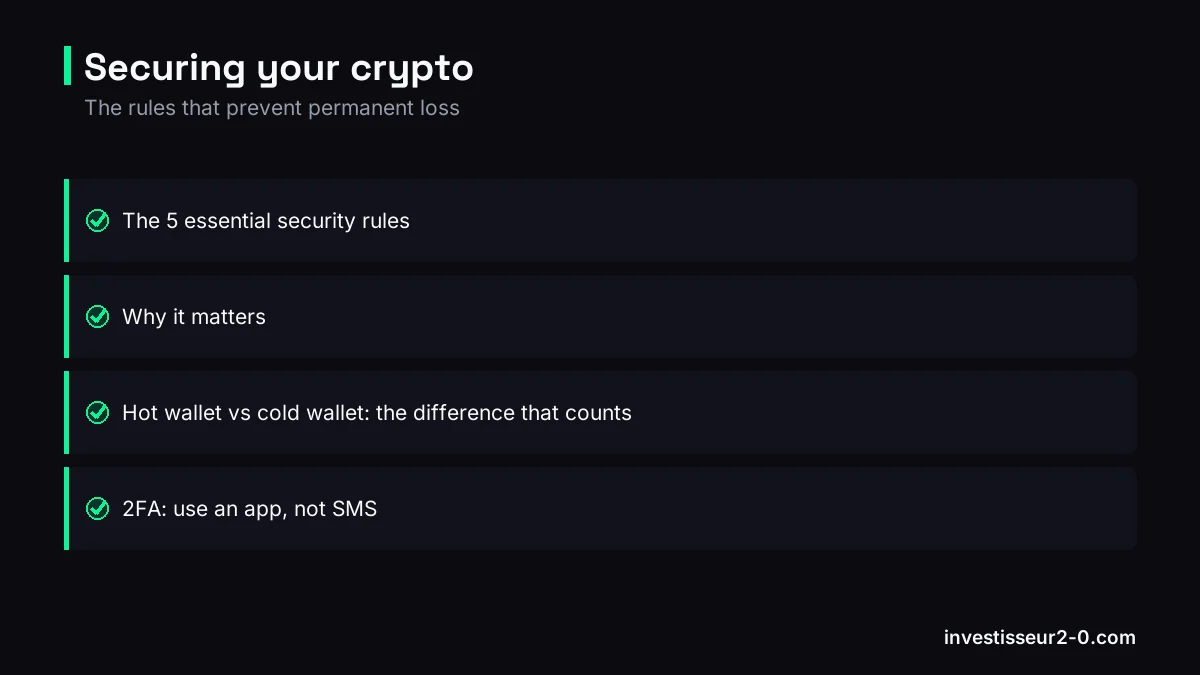
Hot wallet vs cold wallet: the difference that counts
A "wallet" (crypto wallet) is simply software that stores the cryptographic keys allowing you to prove that you own a given crypto. There are 2 main families:
"Hot" wallet (internet-connected)
Lives on your phone, your browser or an exchange. Convenient for frequent transactions, but vulnerable to malware, phishing and hacks.
Examples:
- Metamask, Phantom, Trust Wallet
- Exchanges (Binance, XT, Pionex...)
- Mobile apps like Crypto.com
Best for: < $500, active trading
"Cold" wallet (offline)
Physical device that signs transactions without ever exposing the keys to the internet. Immune to 99% of attacks. The standard for serious investors.
Examples:
- Ledger Nano S Plus ($79)
- Ledger Nano X ($149)
- Trezor Safe 3 ($79)
- Coldcard Mk4 ($157)
Best for: > $1,000, long-term holding
Pragmatic rule: keeping funds on an exchange = OK for trading. Keeping them on a hardware wallet = OK for holding. NEVER leave more than 6 months of salary on an exchange. History has shown enough collapses (FTX, Mt. Gox, Celsius...).
2FA: use an app, not SMS
2FA (two-factor authentication) adds a second verification step to every login: a 6-digit code that changes every 30 seconds. Without 2FA, a stolen password = an emptied account.
SMS-based 2FA: absolutely avoid
SIM swap (an attacker convinces your carrier to transfer your number to their SIM card) is the most profitable crypto attack. Tens of thousands of victims a year, including celebrities like Vitalik Buterin. If your exchange only offers SMS, change exchange.
App-based 2FA: the standard
Download Google Authenticator, Authy, or Aegis (open-source). Scan the QR code in the security settings of each exchange. The codes are generated locally, impossible to intercept remotely.
YubiKey: pro level
Physical USB key (~$50) that must be plugged in to validate the login. Unbeatable. Recommended for accounts with > $10,000 in crypto.
Concrete action: before you even buy your first crypto, open your exchanges, go to "Security" and enable app-based authenticator 2FA. 3 minutes per exchange. Store the recovery codes on paper.
The seed phrase: what you must NEVER do
When you create a wallet, you are given a "seed phrase": 12 or 24 words in a precise order. These words = full access to your wallet. If anyone sees them, they can empty your account from the other side of the world, without even knowing your password.
NEVER DO THIS
- • Photograph the seed phrase
- • Email it to yourself
- • Store it on Google Drive, Dropbox, iCloud
- • Type it into a Word/Notes document
- • Screenshot the wallet at creation
- • Say it out loud next to a smartphone (Siri, Alexa are listening)
- • Give it to a "support" team (no official support asks for the seed)
DO THIS
- • Write it on paper, legible handwriting
- • Verify by re-reading (1 misspelled word = total loss)
- • Store in a dry place, away from fire
- • Ideally 2 copies in 2 different locations
- • Engraved metal plate (Cryptosteel, Billfodl) if > $10,000
- • Test recovery on a test wallet
- • NEVER tell it to anyone, even family
Real-world test: before putting > $100 on your wallet, run a test. Wipe the wallet, restore it with your seed phrase, verify that you recover your funds. If you do not know how to do this, you are not ready to store large amounts.
The 7 most common crypto scams in 2026
Fake Telegram support
Someone replies to you in DM pretending to be Binance/Pionex/etc. support. They ask for your credentials or seed phrase to 'fix your problem'. NO official support operates via Telegram DM.
Fake Elon Musk / Vitalik giveaway
Sponsored tweet announcing 'send 1 BTC, we send back 2 BTC for the launch'. You send, you get nothing. No celebrity ever runs a crypto giveaway where you have to send first.
Cloned exchange site
You search 'binance' on Google and click the sponsored result at the top. The site looks pixel-perfect like Binance. You enter your credentials, they steal your account. ALWAYS check the exact URL in the address bar.
Telegram pump-and-dump
Private group announcing 'we pump this altcoin at 2pm sharp'. The organizers have already bought beforehand. When the naive buyers pile in, they sell. The coin collapses 80%. You lose everything.
Romance scam (pig butchering)
A 'beautiful woman' / 'handsome man' contacts you on LinkedIn/WhatsApp, talks nicely for weeks, then steers you toward an 'exceptional crypto investment platform'. It is fake. Your deposits vanish.
Wallet drainer (malicious signature)
A DeFi site asks you to sign a transaction to 'connect your wallet'. Without realizing it, you sign a permission that gives the site the right to withdraw all your tokens. ALWAYS read what you sign.
SIM swap (SIM card theft)
An attacker calls your carrier, pretends to be you, transfers your number to their SIM card. Receives your 2FA SMS. Empties your accounts. Solution: enable a port-out PIN with your carrier + use app-based 2FA, never SMS.
Which exchange should you start on (safely)?
An exchange's security depends on 4 criteria: regulation, Proof of Reserves audits, a hack-free track record, and mandatory app-based 2FA. Here are the 2 exchanges that Cedric and Julien have used personally since 2022:
Pionex
Regulated by FinCEN (USA) + FSA Japan. No security incident since 2019. 16+ free bots. App-based 2FA mandatory at signup. Free VIP account with bot configurations.
XT.com
Top 20 worldwide by liquidity. Audited Proof of Reserves. Native copy trading to avoid beginner mistakes. Reduced fees via our link (affiliate).
Note that since July 2026 XT no longer signs up EU residents (it holds no MiCA licence). EU readers who want the same regulation criterion ticked can look at Bybit, licensed under MiCA by the Austrian FMA in 2025.
Important security reminder: whatever exchange you choose, never leave more than 3-6 months of salary on it. Above that, transfer to a hardware wallet. History (FTX, Mt. Gox, Celsius) shows that no exchange is invincible. See our best crypto exchanges ranking.
Your security checklist before your first purchase
- Dedicated crypto email created (Gmail/Proton), different from your personal email
- Strong unique password per exchange (password manager like 1Password or Bitwarden)
- Google Authenticator installed on mobile
- 2FA enabled on each exchange (not SMS!)
- 2FA recovery codes stored on paper
- Account PIN and port-out lock enabled with your mobile carrier
- Read the common beginner crypto mistakes
- Hardware wallet purchased (only from the official Ledger/Trezor site, NEVER Amazon)
- Seed phrase copied on paper, verified, stored in 2 dry locations
- Wallet recovery test performed before adding any funds
Ready for the next step?
Key takeaways
- Hot wallet (exchange, mobile app) = convenient but internet-connected. Cold wallet (Ledger, Trezor) = offline, infinitely safer. Above $1,000-2,000, switch to cold.
- Enable Google Authenticator 2FA on every exchange account. Never SMS-based 2FA (SIM swap = account emptied in 5 minutes).
- The seed phrase = 12 or 24 words. It is the master key. Stored offline, never photographed, never typed into a website. Nobody legitimately needs to ask you for it.
- The 7 classic scams share 3 signs: artificial urgency, spontaneous contact (Telegram/Insta DM), a request for your seed/key. If any of the 3 appears → it is a scam, period.
- Golden rule: "Not your keys, not your coins". If you do not control the private keys, you do not really own the crypto. True for exchanges too (see FTX 2022).