
Crypto vocabulary for beginners, 48 essential terms
The glossary to bookmark. 48 terms defined simply, organized into 6 categories. If you see a word you don't know in another article on the site, it's here.
Pourquoi cette leçon est importante
From the basics to Smart Money Concepts: jump straight to the family you need.
Quick navigation
The basics(9 terms)
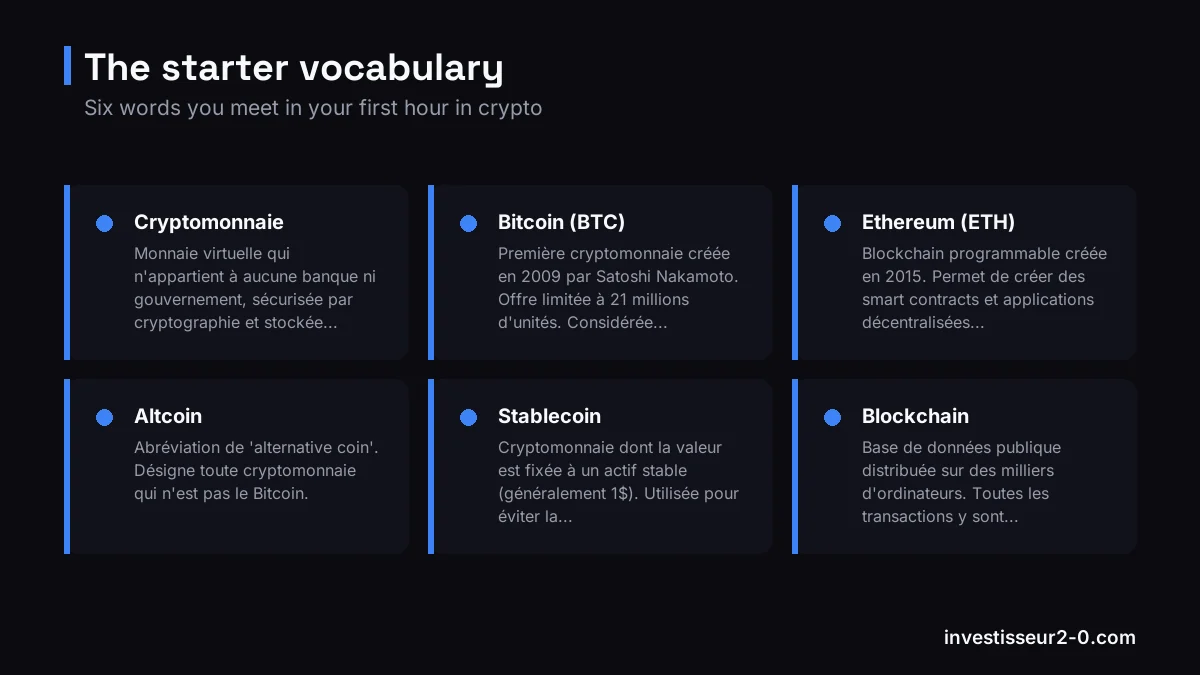
CryptocurrencyDigital money
Virtual money that belongs to no bank or government, secured by cryptography and stored on a blockchain.
Example: Bitcoin, Ethereum, Solana.
Bitcoin (BTC)The first crypto
The first cryptocurrency, created in 2009 by Satoshi Nakamoto. Supply capped at 21 million units. Considered digital gold.
Example: 1 BTC = roughly $110,000 in May 2026.
Ethereum (ETH)Blockchain platform
Programmable blockchain created in 2015. Enables smart contracts and decentralized applications (DeFi, NFTs).
Example: 1 ETH = roughly $4,200 in May 2026.
AltcoinAny crypto other than BTC
Short for 'alternative coin'. Refers to any cryptocurrency that is not Bitcoin.
Example: ETH, SOL, ADA, XRP are altcoins.
StablecoinPrice-stable crypto
A cryptocurrency whose value is pegged to a stable asset (usually $1). Used to avoid volatility.
Example: USDT (Tether), USDC, DAI.
BlockchainPublic ledger
A public database distributed across thousands of computers. Every transaction is recorded permanently and verifiably.
Example: Bitcoin runs on the Bitcoin blockchain, Ethereum on its own.
TokenDigital unit
A digital representation of an asset or a right, created on an existing blockchain (often Ethereum). Different from a coin, which has its own blockchain.
Example: USDT is an ERC-20 token on Ethereum.
MemecoinJoke crypto
A cryptocurrency created for humorous or speculative purposes, with no real technical utility. 99% end up at zero.
Example: DOGE, SHIB, PEPE.
NFTNon-fungible token
Non-Fungible Token. Represents ownership of a unique digital item (image, video, certificate, game item).
Example: Bored Ape Yacht Club, CryptoPunks.
Wallet and security(8 terms)
WalletCrypto wallet
Software or a device that stores the cryptographic keys proving ownership of cryptos. It does NOT store the cryptos themselves (those live on the blockchain).
Example: Metamask, Phantom, Ledger.
Hot walletOnline wallet
A wallet connected to the internet (mobile, browser, exchange). Convenient for transactions but vulnerable to hacks.
Example: Metamask, Trust Wallet, Binance apps.
Cold walletOffline wallet
A physical offline wallet (hardware wallet). Far more secure. Recommended for storing more than $1,000.
Example: Ledger Nano S Plus, Trezor Safe 3.
Seed phraseRecovery phrase
A list of 12 or 24 words that restores a wallet. WARNING: whoever owns the seed owns the funds. Keep it absolutely safe.
Example: Never a photo, never on the cloud, paper only.
Private keyCrypto password
A secret cryptographic code that proves ownership of a wallet. Derived from the seed phrase. NEVER share it.
Example: Long hexadecimal format, e.g. a1b2c3...
Public keyWallet address
The public cryptographic code matching your private key. It is the address others use to send you crypto. Can be shared safely.
Example: bc1q... for Bitcoin, 0x... for Ethereum.
2FATwo-factor authentication
Two-Factor Authentication. An extra security layer requiring a 6-digit code on top of the password. Use it on ALL exchanges.
Example: Google Authenticator, Authy. NEVER via SMS.
SIM swapSIM card theft
An attack where a scammer convinces the telecom carrier to transfer your number to their SIM, intercepting your 2FA SMS. This is why SMS 2FA is banned for crypto.
Example: Vitalik Buterin was a SIM swap victim in 2020.
Exchange and trading(9 terms)
ExchangeTrading platform
A site that lets you buy and sell cryptos against euros, dollars or other cryptos. Centralized (CEX) or decentralized (DEX).
Example: CEX: Binance, XT, Pionex. DEX: Uniswap.
CEX vs DEXCentralized vs Decentralized
CEX = Centralized Exchange (a company runs it). DEX = Decentralized Exchange (smart contracts, no central entity). CEX is simpler, DEX is freer.
Example: Binance (CEX) vs Uniswap (DEX).
KYCKnow Your Customer
The mandatory identity verification process on regulated exchanges. ID card + selfie + proof of address.
Example: Required on Binance, Coinbase, Kraken to withdraw.
Spot tradingClassic trading
Immediate buying/selling of cryptos. You pay, you receive the crypto, you truly own it.
Example: Buying 0.01 BTC by paying USDT.
Futures / PerpLeveraged trading
Contracts that let you bet on a rise or fall with leverage (up to 125x). Huge risk: you can lose more than your investment.
Example: Long BTC 10x = you gain/lose 10x the moves.
LiquidationForced loss
When a futures trader loses enough that their position is closed automatically. The entire margin is lost.
Example: Long BTC 10x at $110K liquidated if BTC drops to $99K.
Order BookOrder ledger
The list of all pending buy and sell orders on an exchange. Visualizes supply and demand in real time.
Example: Visible on Binance Pro, Bybit, Coinbase Advanced.
Maker / TakerFee types
Maker = you place an order at a specific price (limit). Taker = you take an existing order at market. Maker is often cheaper (0.02% vs 0.05%).
Example: Limit order = maker. Market order = taker.
SlippagePrice slippage
The difference between the expected price and the price actually obtained on a trade. The bigger the order, the larger the slippage.
Example: Buying $100,000 of an illiquid altcoin = 5-10% slippage.
Analysis and strategy(8 terms)
DCADollar Cost Averaging
A strategy of buying the same amount at regular intervals, regardless of price. Smooths out volatility.
Example: $100 of BTC on the 1st of every month.
HODLHold (iconic typo)
Holding your cryptos long term without selling, regardless of volatility. Comes from a 2013 typo of 'hold'.
Example: HODLing BTC since 2020.
FOMOFear Of Missing Out
Fear of missing an opportunity. Pushes you to buy in a panic when the price pumps. The beginner's worst enemy.
Example: Buying BTC at $110K in a bull market for fear of missing out.
FUDFear, Uncertainty, Doubt
Negative communication tactics to push a price down. Can be organized (manipulation) or organic (negative news).
Example: An anti-crypto article that dumps the market 5%.
Technical analysis (TA)Reading the charts
Studying price charts to predict future moves. Uses candles, indicators and patterns.
Example: Spotting an Order Block, an FVG, a trend.
Fundamental analysis (FA)Evaluating a project
Studying the crypto project itself: team, technology, adoption, tokenomics. To decide whether it is worth holding.
Example: Evaluating Ethereum on its on-chain metrics and adoption.
Support / ResistanceKey levels
Support = a price where the market tends to bounce. Resistance = a price where the market tends to pull back. Important psychological levels.
Example: BTC support at $100K, resistance at $120K.
Bull market / Bear marketRising / falling market
Bull = an extended upward trend (months/years). Bear = an extended downward trend. The crypto cycle is roughly 4 years.
Example: Bull 2024-2025, Bear expected 2026 (halving + 18 months).
Smart Money Concepts(7 terms)
Smart Money Concepts (SMC)Pro methodology
A methodology that analyzes institutional moves to anticipate prices. Includes Order Blocks, FVG, BOS, liquidity.
Example: Our core Investisseur 2.0 methodology.
Order Block (OB)Institutional zone
The last candle of opposite direction before an impulsive move that breaks structure. A zone where institutions placed their orders.
Example: Bullish OB = retest = probable bounce.
Fair Value Gap (FVG)Price imbalance
A price gap left by a vertical institutional move. Price almost always returns to partially fill it.
Example: 3 consecutive candles with no overlap = FVG.
BOS / CHoCHStructure break
BOS = Break of Structure (trend continuation). CHoCH = Change of Character (trend reversal). A key read of structure.
Example: Bullish BOS = new high. CHoCH = reversal signal.
Liquidity (BSL/SSL)Stop-loss zones
BSL = Buy Side Liquidity (above the highs). SSL = Sell Side Liquidity (below the lows). Price almost always sweeps these zones.
Example: Equal highs = BSL targeted by institutions.
ICTInner Circle Trader
A methodology created by Michael J. Huddleston. An advanced evolution of SMC with concepts like Killzones, OTE, Mitigation Block.
Example: Killzones London 7-10am UTC, NY 12-3pm UTC.
WyckoffCyclical method
Richard Wyckoff's methodology (1929). Identifies 4 phases: accumulation, manipulation, expansion, distribution. The theoretical basis of SMC.
Example: Accumulation phase = institutions buying quietly.
DeFi and advanced(7 terms)
DeFiDecentralized finance
Decentralized Finance. Financial applications on blockchain without an intermediary (bank). Lending, saving, swapping, derivatives.
Example: Uniswap (swap), Aave (lending), MakerDAO (stablecoin).
Gas / Network feesCost of a transaction
Fees paid to validators to execute a transaction on the blockchain. Varies with network congestion.
Example: Ethereum gas: $0.5-50 depending on congestion.
Yield farmingDeFi yield
A strategy of lending your cryptos to earn a return in interest or additional tokens.
Example: Stake ETH on Aave for 3-8% APY.
StakingLocking up cryptos
Locking cryptos on a Proof-of-Stake network to help secure it and earn rewards.
Example: Stake ETH = ~4% APY, Stake SOL = ~7% APY.
Liquidity PoolLiquidity reserve
A pool of cryptos deposited by users that allows DEXs to function. You deposit, you earn a share of the fees.
Example: USDC/ETH pool on Uniswap V3.
Impermanent LossUnrealized loss
A theoretical loss when you provide liquidity and the relative prices of the 2 assets diverge.
Example: ETH/USDC pool during an ETH pump = IL.
Smart contractBlockchain program
Computer code that executes automatically on a blockchain when certain conditions are met.
Example: The Uniswap smart contract that swaps token A for B.
From theory to practice
Now that you've got the vocabulary down, here is where to start concretely. If a term still feels abstract, read what is cryptocurrency for the big picture, then how to buy your first crypto and lock in the basics with how to secure your crypto:
Pionex (recommended for beginners)
Ideal for automating a DCA. 31 free bots, 0.05% fees. VIP account with shared configurations.
Join the Pionex VIPXT.com
Native copy trading (you copy the pros). -20% fees via partner link (we earn a commission). 2 VIP channels included. Heads up: XT stopped accepting EU residents on July 1, 2026; readers in the EU can turn to MiCA-licensed OKX or Bybit instead. Capital at risk.
Join the XT VIPArticles related to the glossary
- 📊 Crypto trading risk management: the complete guide to protecting your capital
- 📖 Advanced SMC glossary: 50+ Smart Money Concepts terms for the advanced level
- 🏆 Best crypto exchanges 2026: where to buy and trade safely
À retenir de cette leçon
- 1You don't need to memorize all the terms. Use this page as a bookmark: come back whenever a word escapes you while reading another article.
- 2The 9 vital terms before your first purchase: Wallet, Seed phrase, 2FA, Exchange, Spot, Market vs Limit order, KYC, Fees, Slippage. Without these 9, you will lose money foolishly.
- 3SMC vocabulary (Order Block, FVG, BOS, CHoCH) = advanced level. No need to tackle it if you haven't bought your first crypto yet.
- 4In DeFi (Uniswap, etc.) the vocabulary is different: gas, slippage, impermanent loss, LP. Only relevant once you leave centralized exchanges.
Une question sur cette leçon ?
Rejoins notre Telegram gratuit. On répond aux questions des élèves de l'académie en moins de 30 min.
Rejoindre le Telegram