
How to Buy Ethereum in 2026: the complete beginner guide (no traps)
Ethereum is the second crypto by market cap and the dominant smart contract ecosystem. If you want to buy your first ETH in 2026 without getting burned on fees or panicking over taxes, here are the six concrete steps we have followed since 2017.
Transparency: some links below are partner links. We only recommend platforms we use ourselves and where we negotiated concrete conditions for our community. This costs you nothing and helps keep our resources free.
Before you buy: 3 truths to internalize
1. Ethereum is volatile. Over the past decade, ETH has gone through several corrections of 50 to 80%. That is the norm for this asset, not the exception. Only invest what you can afford to see cut in half without losing sleep.
2. Taxes are real and vary by country. In most places, a capital gain is taxed only when you convert crypto to fiat, while crypto-to-crypto trades are not taxed until you cash out. Reporting rules differ by jurisdiction, and we cover more on this below.
3. Security is your responsibility. There is no "crypto bank" that refunds you if you get hacked. A secure wallet, clean 2FA, and a cold wallet for larger amounts are non-negotiable.
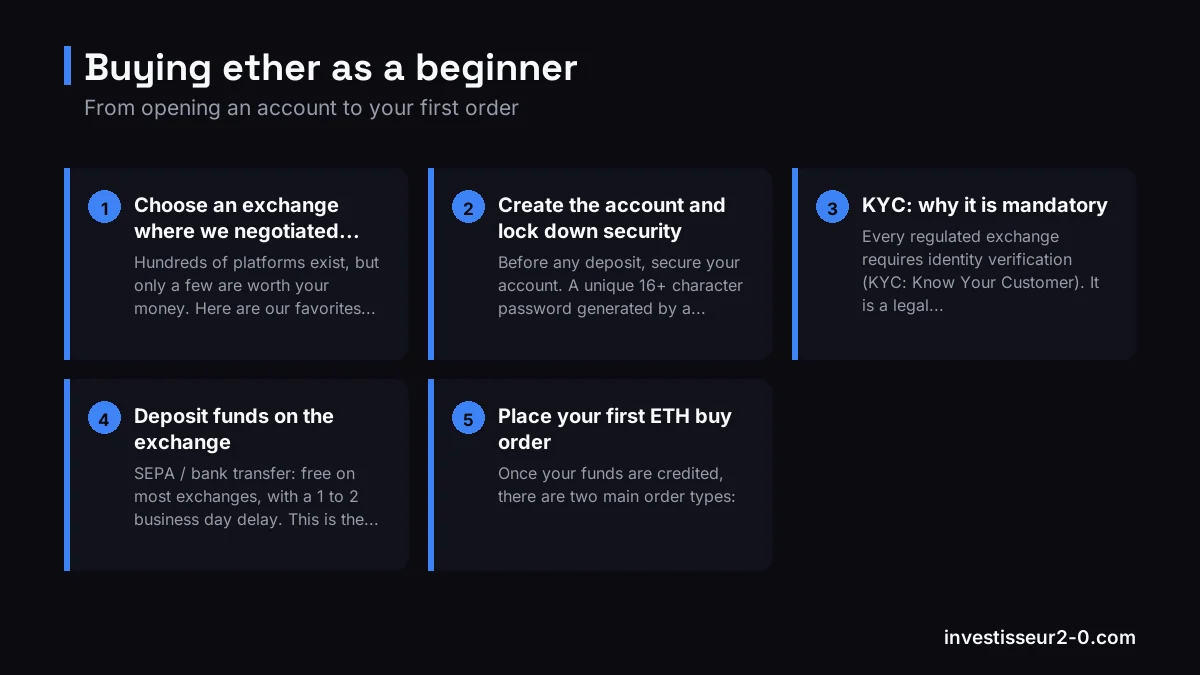
Step 1, Choose an exchange where we negotiated conditions
Hundreds of platforms exist, but only a few are worth your money. Here are our favorites to buy ETH in 2026:
- Bybit: MiCA licence from the Austrian FMA (May 2025) with a passport covering the whole EEA, deep ETH liquidity and a beginner-friendly spot interface. Our first pick for a European buying ETH in 2026.
- OKX: licensed in Malta under MiCA (January 2025), monthly Proof of Reserves, and a Web3 wallet if you later want to explore DeFi. The other solid EU option.
- BingX (readers outside the EU): particularly accessible interface, external copy trading, and a negotiated deposit bonus through our partner link. Its MiCA application with the Austrian FMA is still pending, so it cannot onboard EU residents for now. Sign up via our partner link.
- XT.com (readers outside the EU): 0.0150% maker / 0.0460% taker fees through the Investisseur 2.0 partnership (versus 0.20% standard). XT.com closed its doors to EU residents on 2026-07-01. Sign up via our link for VIP2 status.
- MEXC (readers outside the EU): huge listings catalog and a deposit bonus negotiated for our community. Off the table if you live in the EU since July 2026.
Our advice: in the EU, open your account on OKX or Bybit, both MiCA-licensed and fully open to European residents. Outside the EU, start on BingX for the combo of simplicity and a negotiated bonus, then move part of your ETH to XT.com (for the lowest fees) once you find your footing. BingX, XT and MEXC links above are partner links, and whatever the venue, only deposit money you can afford to lose. If you are torn between the two giants, our Coinbase versus Binance breakdown lays out the fee and feature gaps.
Step 2, Create the account and lock down security
Before any deposit, secure your account. A unique 16+ character password generated by a manager (Bitwarden, 1Password), 2FA enabled via Google Authenticator or Authy (never by SMS, too vulnerable to SIM swap), and ideally a dedicated crypto email used nowhere else.
Step 3, KYC: why it is mandatory
Every regulated exchange requires identity verification (KYC: Know Your Customer). It is a legal anti-money-laundering obligation, not a whim. You send a photo of your ID plus a selfie, and validation takes anywhere from a few minutes to 24 hours. Until it is approved, you cannot deposit.
Step 4, Deposit funds on the exchange
Two main options:
- SEPA / bank transfer: free on most exchanges, with a 1 to 2 business day delay. This is the cheapest route.
- Bank card: instant but charged 1 to 3% in fees. Use it only if you are truly in a hurry.
The minimum deposit is usually 10 or 20 dollars, sometimes less. You do not need to put in 1000 dollars at once to start: begin with 50-100 dollars.
Step 5, Place your first ETH buy order
Once your funds are credited, there are two main order types:
- Market order: you buy immediately at the best available price. Simple and fast, but slightly more expensive in "taker" fees.
- Limit order: you set the maximum price you are willing to pay. The order only fills if the market drops to it. More favorable "maker" fees.
For a first buy with a small amount, a market order is more than enough. A difference of a few tenths of a percent changes nothing on 100 dollars. No leverage at the start. Futures trading is not for your first buys.
Step 6, Secure your ETH (and optionally stake it)
As long as your ETH sits on the exchange, it does not truly belong to you in the cryptographic sense: the exchange holds the keys. For real amounts, transfer to a personal wallet.
Cold wallet (hardware): Ledger Nano S Plus, Ledger Nano X, Trezor. The reference for long-term security. Budget 80 to 200 dollars for a new device (never used: risk of a backdoor). This is what we recommend above 1000 dollars.
Software wallet (hot wallet): MetaMask, Rabby, Rainbow. Essential to interact with DeFi (Uniswap, Aave, etc.) or NFTs. Less secure than a cold wallet, so keep it to operational amounts only.
Staking. If you want to put your ETH to work passively, staking earns you between 3 and 5% annually:
- Solo staking: 32 ETH minimum, a dedicated server, technical skills required. Maximum net yield but reserved for experts.
- Staking via exchange: BingX, Binance and others offer one-click staking. Simple but centralized, and yields are lower (the exchange takes a cut).
- Liquid staking: Lido (stETH), Rocket Pool (rETH). You deposit ETH and receive a token that represents your staked position but stays liquid (you can sell it or reuse it in DeFi). Our preferred option for combining yield and freedom.
Taxes on ETH: what you need to know
Rules differ by country, but three principles hold almost everywhere:
- Capital gains are usually taxed at conversion to fiat, not on crypto-to-crypto trades. As long as you stay in crypto, there is generally no tax event.
- Foreign account reporting may be required depending on your jurisdiction. Many tax authorities now ask you to declare accounts held on offshore exchanges.
- Staking rewards are often treated as taxable income, either when received or when converted, depending on the country.
When in doubt, keep a clean record of every transaction and consult a tax professional in your country. To go deeper on platform selection and risk, see our complete guide to crypto trading risk management.
The 5 classic mistakes to avoid
- Going all in at the top of a rally. Prefer DCA, buying a fixed amount at regular intervals to smooth your average entry price.
- Buying on Revolut or mainstream apps. You do not truly own your ETH (you cannot withdraw it to a wallet). Use a real exchange.
- Putting your ETH on a "wallet" promising an absurd yield. A guaranteed 10%+ APY equals a scam or huge risk. Lido and Rocket Pool run at 3-5% and that is the norm.
- Panic selling in a bear market. If your plan was long term, respect your plan.
- Forgetting to report to tax authorities. Regulated exchanges increasingly share data with governments. Better to report correctly from day one.
Going further
Once your first ETH is bought and secured, here are the resources that will take you to the next level:
- Best crypto exchanges for 2026, full ranking
- Crypto trading risk management, the complete guide
- How to buy Bitcoin in 2026, complete beginner guide
- Cheaper alternatives to Coinbase in 2026
- How to secure your crypto, wallets, 2FA and cold storage
FAQ, the questions that keep coming up
What is the minimum amount to buy Ethereum?
On most exchanges you can buy ETH starting from 1 to 10 dollars. To really learn without taking on risk, we suggest starting with 50 to 100 dollars and spreading your buys with DCA rather than going all in at once.
Should a beginner buy Ethereum or Bitcoin in 2026?
Bitcoin remains the most liquid crypto asset, the relatively least volatile, and the one with the longest track record. For a very first purchase, BTC is generally recommended. Ethereum comes as a complement: more volatile but with real utility (smart contracts, DeFi, staking). A balanced beginner portfolio is typically 60-70% BTC and 20-30% ETH.
What is the best exchange to buy Ethereum in 2026?
We only recommend exchanges where we negotiated concrete conditions for the Inv 2.0 community: BingX (accessible interface plus copy trading plus a deposit bonus through our partner link), XT.com (0.0150% maker / 0.0460% taker negotiated versus 0.20% standard), and MEXC for breadth of listings. Mainstream exchanges like Coinbase can do the job for a first 50 dollar buy, but their 1-2% fees add up quickly over time. See our full ranking of the best crypto exchanges 2026.
Do I owe taxes when I sell my ETH at a profit?
In most jurisdictions, a capital gain is only triggered when you convert crypto back to fiat currency, not on crypto-to-crypto trades. Rates and reporting rules vary by country, so check your local framework and keep a clean record of every buy and sell. When in doubt, consult a tax professional in your country.
What is Ethereum staking and how does it work?
Since The Merge in 2022, Ethereum runs on Proof of Stake. You can lock your ETH in a validator to help secure the network and earn an annual reward (3 to 5% depending on the period). Three options exist: solo staking (32 ETH minimum, complex), staking via an exchange (BingX, Binance, simple but centralized), and liquid staking (Lido, Rocket Pool, you keep liquidity through stETH/rETH).
Is it too late to buy Ethereum in 2026?
Ethereum is the dominant smart contract ecosystem (over 50% of total DeFi TVL and hundreds of thousands of active developers). Institutional adoption is accelerating with approved spot ETH ETFs. That said, ETH remains volatile, with historical drawdowns of 50-70%. Only invest what you are prepared to lose, and favor DCA over going all in at once.
Do I need a personal wallet to buy Ethereum?
Not required to get started: you can leave your ETH on the exchange when you are new. But beyond 1000 dollars, or if you want to interact with DeFi, a personal wallet becomes essential. For maximum security: a hardware cold wallet (Ledger Nano, Trezor). For active use: a software wallet (MetaMask, Rabby). The golden rule: 'Not your keys, not your coins'.