
Coinbase vs Binance: 2026 comparison
Coinbase and Binance are the two names that come up most often when an investor looks for where to buy their first cryptocurrencies in 2026. Coinbase, the safe, NASDAQ-listed choice built for simplicity. Binance, the global giant with unbeatable liquidity and the most complete catalog. This comparison reviews fees, catalog, beginner-friendliness, compliance, security, mobile app and features, with an honest verdict per category.
Transparency: this article contains affiliate links. If you open an account through our links, we may earn a commission at no additional cost to you. This comparison remains objective: we present each platform with its strengths and its limitations.
Why compare Coinbase and Binance?
Coinbase and Binance embody two visions of crypto trading. Coinbase bets everything on simplicity and trust: it is a US company publicly listed on the NASDAQ, designed to reassure the general public and the beginner investor. Binance, on the other hand, is the global leader by volume: maximum liquidity, a broader catalog, low fees and a very complete product ecosystem for the active trader.
Our goal is not to crown "the best exchange" in absolute terms, because that concept does not exist. The right choice depends on your level, your strategy and what you plan to do with your capital. We give you the elements to decide with full context.
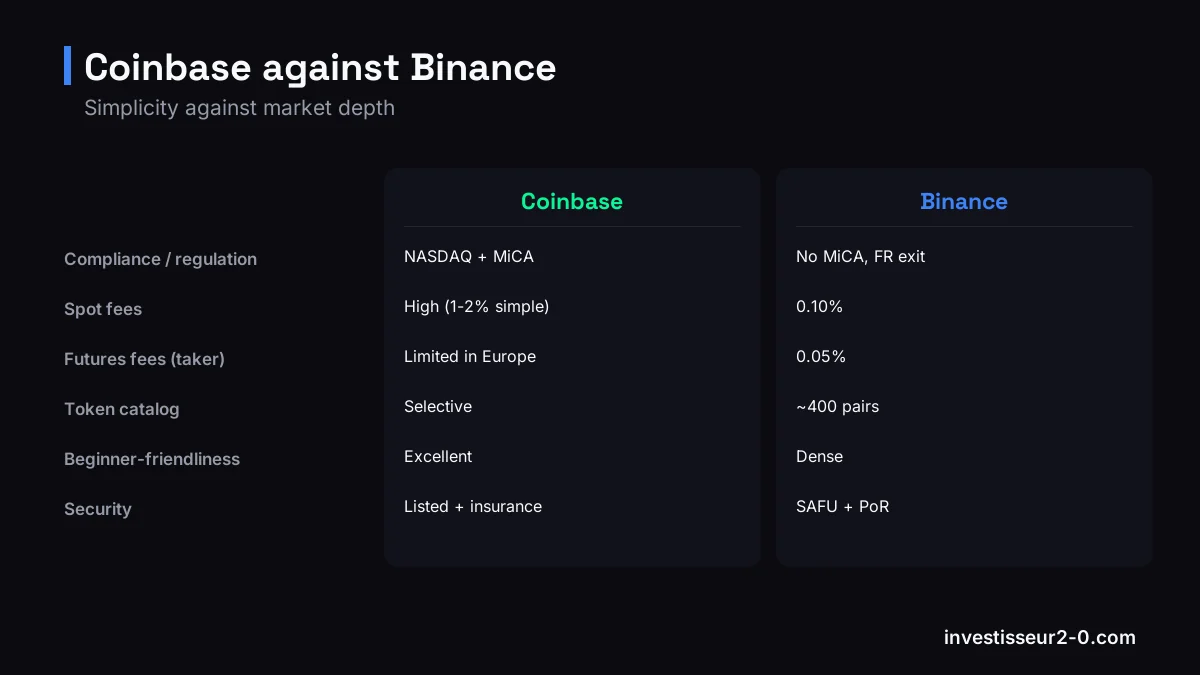
Trading fees: spot and futures
Fees are often the most underestimated criterion for beginners, and the most painful in the long run. On regular purchases, every percentage point counts. This is where the gap between the two platforms is widest.
Spot fees
- Coinbase: on the simple consumer interface, fees are high, a mix of spread and commission that can exceed 1 to 2% per trade on small amounts. The Coinbase Advanced interface cuts that cost sharply (around 0.4 to 0.6% depending on volume), but it still sits above Binance.
- Binance: 0.10% maker / 0.10% taker on standard, with an additional discount when paying fees in BNB (-25%). It is structurally far cheaper than Coinbase.
Futures fees
- Coinbase: a more limited, US-market-oriented derivatives offering; for the European trader, futures access is far less developed than on Binance.
- Binance: 0.02% maker / 0.05% taker, with a futures market among the deepest and most complete in the sector.
Fee verdict: Binance dominates clearly. Whether on spot or futures, Binance is structurally cheaper than Coinbase, especially against the latter's simple interface. For the precise figures on the Coinbase side, our line-by-line fee analysis spells out spread, Advanced and Coinbase One. To understand how fees compound over time, also see our Binance, XT.com and Bybit comparison.
Cryptocurrency catalog
The catalog determines the range of opportunities accessible from a single account. Both platforms stay selective, but with different philosophies.
- Coinbase: a solid but deliberately selective catalog, focused on established projects and majors. Coinbase adds tokens cautiously, which reassures but limits access to emerging narratives.
- Binance: around 400 spot pairs, a broader range of altcoins and derivatives. Binance lists more projects than Coinbase, but stays rigorous and often later than platforms specialized in small caps.
Catalog verdict: Binance edges out Coinbase on the number of tokens and products. But for early-stage altcoins and small caps, both show their limits, a point we return to in the verdict. To go further, read our complete Binance review.
Beginner-friendliness
For a first crypto purchase, usability matters as much as fees. A confusing flow scares people off, or even pushes them into costly mistakes.
- Coinbase: the absolute reference for simplicity. Fast sign-up, buying in a few clicks, a clean localized interface and responsive support. Everything is designed so a total beginner can buy their first bitcoin stress-free.
- Binance: very complete but dense. The sheer amount of features, tabs and products can intimidate a new user. The learning curve is real, even if simple buying remains accessible.
Beginner-friendliness verdict: Coinbase wins without debate. It is the most reassuring and fluid platform for taking your first steps in crypto. Binance becomes interesting once the basics are acquired. If Coinbase is your pick, our standalone test of the platform digs into every detail.
Compliance and regulation
With MiCA and the strengthening of the European framework, compliance has become a survival criterion for exchanges, and a mark of seriousness for the user.
- Coinbase: a US company listed on the NASDAQ, subject to the SEC and to high financial transparency, operating in the EU within the MiCA framework. Hard to be more reassuring on the institutional side.
- Binance: French PSAN registration lapsed on June 30, 2026 with no MiCA authorization filed; EU and French residents are no longer accepted and French accounts are in wind-down. In non-EU markets where it is licensed, you can still register with Binance with full KYC (affiliate link; deposits remain exposed to full market risk).
Compliance verdict: Coinbase, by a wide margin. It is the only one of the two an EU resident can legally use in 2026. Binance's regulatory standing now depends entirely on the jurisdiction you trade from.
Security and track record
Security is non-negotiable. An exchange can be simple or cheap, but if your funds vanish, nothing else matters.
- Coinbase: no major hack of client funds to date, cold storage of most assets, insurance on funds held in hot wallets and the transparency of a listed company. A solid track record.
- Binance: hot wallet hack in 2019 (7,000 BTC) fully reimbursed via the SAFU fund. Since then, reinforced architecture, public Proof of Reserves and regular audits. It is now an industry standard.
Security verdict: a tie, with different approaches. Coinbase relies on the rigor of a listed company and a record without major incident; Binance on its battle-tested SAFU fund and its Proof of Reserves. In all cases, never leave more capital on an exchange than you are prepared to lose. The rest goes to cold storage.
Mobile app
Trading and portfolio tracking increasingly happen on the move. The app has become a choice criterion in its own right.
- Coinbase: one of the simplest and best-rated apps in the sector. Buying, selling and tracking in a few gestures, ideal for the general public.
- Binance: a very complete app, with spot, futures, Earn and advanced charting. Denser, but it reproduces almost every desktop feature.
Mobile app verdict: a close match. Coinbase wins on simplicity, Binance on functional depth. Both broadly cover the essentials.
Unique features
Each platform has distinctive strengths that can tip the balance depending on your profile.
- Coinbase: extreme simplicity, integrated staking, Coinbase Learn (earn crypto by learning) and a self-custody wallet (Coinbase Wallet). A consumer-focused ecosystem oriented toward accessibility.
- Binance: a complete ecosystem (Binance Earn, Launchpad, Academy, the BNB token for discounts), deep futures and a wide range of products. It is a universe unto itself for the active trader.
Worth noting: if neither Coinbase nor Binance covers an altcoin you are after, XT.com is an interesting alternative, oriented toward low fees, a broad catalog and early listings. Registration is done via this link (affiliate link; XT.com has no MiCA license and does not take EU or French clients, and small-cap altcoins carry brutal drawdowns).
Full comparison table
| Criterion | Coinbase | Binance | Winner |
|---|---|---|---|
| Spot fees | High (1-2% simple) | 0.10% | Binance |
| Futures fees (taker) | Limited in Europe | 0.05% | Binance |
| Token catalog | Selective | ~400 pairs | Binance |
| Beginner-friendliness | Excellent | Dense | Coinbase |
| Compliance / regulation | NASDAQ + MiCA | No MiCA, FR exit | Coinbase |
| Security | Listed + insurance | SAFU + PoR | Tie |
| Mobile app | Very simple | Complete | Tie |
| Ecosystem / features | Staking, Learn | Earn, BNB, futures | Binance |
Our verdict: which exchange should you choose?
There is no universal answer. The choice depends on your profile:
- Beginner seeking simplicity and trust: Coinbase. A clean interface, a NASDAQ-listed company, a frictionless buying flow. It is the most reassuring entry point into crypto.
- Active trader seeking low fees and tools: Binance. Structurally lower fees, a broader catalog, maximum liquidity and a complete ecosystem. It is the more powerful of the two.
But the main shared limitation is real: both stay expensive or selective as soon as you step outside the majors. Coinbase is costly on its simple interface; Binance, while cheaper, remains rigorous and often late on early-stage altcoins. For anyone hunting small caps and early listings at low fees, neither is the ideal tool.
This is where an alternative like XT.com makes full sense: very low fees, a gigantic altcoin catalog and some of the earliest listings on the market. For the trader focused on early opportunities and cost optimization, it is often the most effective option. Registration is done directly via this link.
In the same spirit, MEXC is another relevant alternative, also known for its very low spot fees and its huge altcoin catalog. To open an account and claim the bonus:
The second XT.com link and the MEXC bonus are affiliate offers. Both platforms operate outside MiCA, are closed to EU and French residents (MEXC is on the AMF blacklist), and trading there puts your full deposit at risk.
Many investors actually combine these platforms: Coinbase or Binance to buy and hold majors within a reassuring framework, and a specialized platform like XT.com or MEXC for low-fee early altcoins. For a broader overview including other platforms, see our ranking of the best crypto exchanges in 2026 and our roundup of the best Binance alternatives.
In all cases, the golden rule stays the same: only keep on an exchange the capital needed for your activity. The rest goes to cold storage. No exchange, however solid, is immune. And if you would rather pit Coinbase against a security-first rival, see our Coinbase and Kraken matchup.
FAQ
Which exchange has the lowest fees: Coinbase or Binance?
Binance, clearly. It applies 0.10% on spot and 0.02% / 0.05% on futures. Coinbase, on its simple interface, charges much higher fees (spread + commission that can exceed 1 to 2% on small amounts). Coinbase Advanced narrows the gap, but Binance stays structurally cheaper.
Coinbase or Binance for a beginner?
Coinbase is built for the beginner: clean interface, simplified buying, responsive support and a NASDAQ-listed company that reassures. Binance is more powerful but denser. For a first frictionless purchase, Coinbase wins; to scale up afterward, Binance offers far more tools.
Are Coinbase and Binance regulated in France?
Only Coinbase. It operates in the EU under MiCA as a NASDAQ-listed US company. Binance's French PSAN lapsed on June 30, 2026 without a MiCA authorization; it no longer serves EU or French residents and French accounts are winding down.
Which one offers the broadest cryptocurrency catalog?
Binance, with around 400 spot pairs and more altcoins and derivatives than the more selective Coinbase. However, for early-stage altcoins and small caps, both remain limited compared with platforms like XT.com or MEXC.
Why consider an alternative to Coinbase and Binance?
Coinbase is expensive on its simple interface, and Binance, while cheaper, stays selective on altcoins. For low fees combined with a very broad catalog and early listings, XT.com or MEXC are often more relevant for traders focused on early opportunities.
Can you use Coinbase and Binance at the same time?
Yes, and it is common: Coinbase to buy simply and hold majors, Binance to trade actively with lower fees and more tools. Spreading your capital reduces counterparty risk. The rest should stay in cold storage.