Crypto for beginners: where to start in 2026?
Want to get into crypto but don't know where to begin? Here is the roadmap we wish we'd had when we started in 2017. Seven steps to go from zero to a first secured crypto investment, without paid courses or promises of financial freedom in six months.
About 2 hours of setup, ~€100 to start, and a 4 to 8 year horizon once you are in.
The real question first: what are you looking for?
Before clicking the first "Buy Bitcoin", settle this question. Three beginner profiles come up often:
- The long-term HODLer: buys, secures, waits 4 to 8 years. It is statistically the most profitable and least stressful profile. 80% of beginners should be in this category.
- The disciplined DCA investor: same long-term logic, but with regular purchases (50 EUR/week for example) rather than one large lump sum. This is what we recommend to most newcomers.
- The active trader: wants to exploit volatility with technical analysis, Smart Money Concepts, leverage. It is a professional skill that requires 12-24 months of learning and strict risk management. Not for a beginner.
If you're starting out, you're probably profile 1 or 2. The rest of this article is calibrated for that.
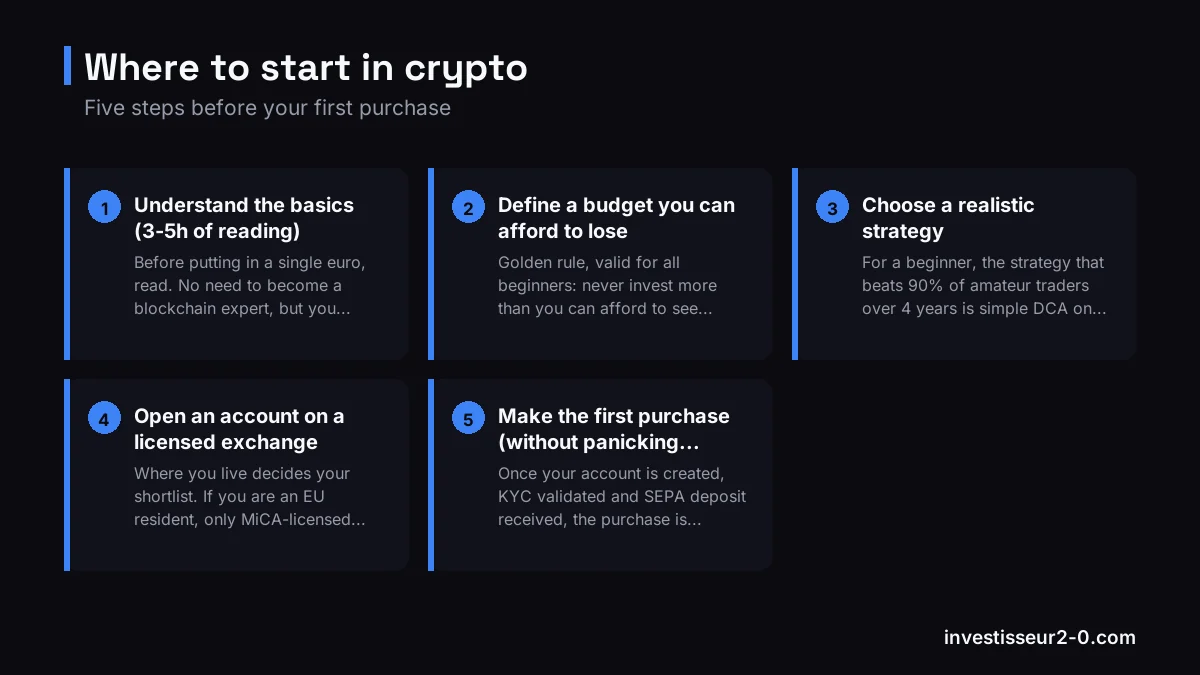
Step 1: understand the basics (3-5h of reading)
Before putting in a single euro, read. No need to become a blockchain expert, but you must understand:
- What a blockchain is (a public, decentralized, immutable ledger).
- The difference between Bitcoin (the currency) and Ethereum (the smart contracts platform).
- What a wallet, private keys, and a seed phrase are - and why you must never share them.
- The difference between a centralized exchange (BingX, Pionex, Binance) and a personal wallet (Ledger, MetaMask).
Our free resources to get started:
- Best crypto exchanges 2026 - to choose where to buy.
- Crypto trading risk management - the foundation of capital protection.
Step 2: define a budget you can afford to lose
Golden rule, valid for all beginners: never invest more than you can afford to see drop by 80%. The crypto market has gone through three major corrections (-83% in 2014, -85% in 2018, -78% in 2022). If your crypto budget is part of your rent or bill money, you will panic at the worst moment.
Classic recommendation: 5 to 10% maximum of your available savings (excluding your emergency fund). For many, that represents 200 to 1000 EUR to start.
Step 3: choose a realistic strategy
For a beginner, the strategy that beats 90% of amateur traders over 4 years is simple DCA on BTC + ETH:
- 70% Bitcoin (store of value, the most mature asset).
- 30% Ethereum (exposure to smart contracts, DeFi, staking).
- A fixed-amount purchase monthly or weekly.
- A horizon of 4 to 8 years minimum (one full Bitcoin halving cycle).
- No leverage, no active trading, no memecoins.
Step 4: open an account on a licensed exchange
Where you live decides your shortlist. If you are an EU resident, only MiCA-licensed venues can legally take you in 2026: Bybit (FMA Austria licence, May 2025), OKX (MFSA Malta, January 2025) or Pionex, whose European clients go through its licensed entity Pionew Ireland (Webot).
Outside the EU, our partner picks still apply, with one house rule: we ONLY recommend exchanges where we have negotiated concrete terms (fees or bonuses) for the community.
- Pionex: 0.05% spot fees, 31 free trading bots including automatic DCA. Via our partner link, you get exclusive bonuses and access to the Inv 2.0 VIP channel. Ideal if you want to automate your DCA, and the one partner open to EU residents (via Pionew Ireland).
- BingX (non-EU only): accessible interface, external copy trading (follow other public traders), deposit bonus negotiated via our partner link. Its MiCA application in Austria is still pending, so no EU or French accounts.
- XT.com (non-EU only): 0.015% maker / 0.046% taker fees via the Investisseur 2.0 partnership (versus 0.2% standard everywhere else). No MiCA licence, so EU residents are out.
The links above are partner links: signing up through them earns us a commission at no extra cost to you. Crypto is volatile; only invest money you can lose.
We do NOT push Coinbase, Bitpanda, Revolut or Trade Republic to our community because we have not negotiated any terms with them and their 1-2% fees quickly add up on a 5-year DCA. They can do in a pinch for a first 50 EUR test, that's all. If you started on Coinbase, here are the lower-fee Coinbase alternatives worth a look.
Full comparison: Best crypto exchanges 2026, or head-to-head: Coinbase vs Binance.
Step 5: make the first purchase (without panicking over the price)
Once your account is created, KYC validated and SEPA deposit received, the purchase is ridiculously simple:
- Go to the "Buy" or "Trade" section.
- Select BTC or ETH.
- Enter the amount in euros (50 to 100 EUR to start).
- Choose "Market Order" (at the current price, simple and fast).
- Confirm.
Once the order is executed, you see your first fraction of Bitcoin (or Ethereum) appear in your portfolio. Welcome to crypto.
Classic mistake to avoid: do not try to "time the bottom". The best traders in the world get the short-term timing wrong half the time. With DCA, you buy regardless of the price, and that's the whole point.
Step 6: secure and organize
Now that you have your first coins, secure them. Three priorities:
- 2FA enabled on your exchange account via Google Authenticator (not SMS).
- Hardware cold wallet (Ledger Nano S Plus, Ledger Nano X, Trezor) above 1000 EUR. Budget 80 to 200 EUR for a new device. Never buy used: backdoor risk.
- Tax traceability from day one: record every purchase (date, amount in euros, unit price). It will make your tax declaration easier later.
Our crypto trading risk management guide details how to protect your capital.
Step 7: progress via free education
Once your first purchase is made and secured, the classic beginner trap is to think you need to pay 1500 EUR for a course to "level up". That's false. Almost all quality content is free:
- Best crypto exchanges 2026 - to understand where and how to buy.
- Crypto trading risk management - the skill that protects your capital long term.
- DCA crypto strategy for beginners - the exact method to automate your monthly buys.
- How to secure your crypto - wallets, 2FA and cold storage explained step by step.
Taxes: the three rules to remember
- Flat tax on capital gains: only triggered when converting crypto to euros. As long as you stay crypto-to-crypto, no taxation. Rules vary by country, so check your local framework.
- Declaring foreign accounts: many jurisdictions require declaring accounts held on exchanges based abroad (Binance, Pionex, XT, Coinbase US) each year.
- Keep your purchase proofs: exchange statements, dates and amounts in euros. Tax authorities can ask you for supporting documents.
Absolute mistakes to avoid as a beginner
- Putting everything in at once at peak hype.
- Buying memecoins promoted by influencers without disclosure.
- Enabling leverage on futures before mastering spot.
- Panic selling at the worst moment of the cycle.
- Believing you can "get rich in 6 months", when the realistic horizon is 4 to 8 years.
- Buying on consumer apps that don't give you real custody.
- Paying 1500-3000 EUR for a "course" promising financial freedom.
FAQ: the recurring questions
What exactly is crypto for a complete beginner?
A cryptocurrency is a digital currency that runs on the blockchain, a public and decentralized ledger. No one can print more Bitcoin than the amount set by the protocol (21 million max). You can buy, send, receive and hold cryptos without needing a bank. To start, focus on Bitcoin and Ethereum - the two most mature and institutional assets.
How much do you need to start in crypto?
You don't need much. On most exchanges, you can start with 10 to 50 EUR. To really learn the mechanics (buy, secure, track, declare), a budget of 100 to 200 EUR spread out via DCA is more than enough. Absolute rule: never invest rent or bill money.
Which crypto should you buy first as a beginner?
Bitcoin (BTC) first. It is the most liquid asset, with the longest track record (since 2009), the best institutional adoption (spot ETFs, MicroStrategy, sovereign funds) and the relatively lowest volatility. In second place: Ethereum (ETH), to get exposure to the smart contract ecosystem. Avoid memecoins and exotic altcoins until you understand the basic mechanics.
DCA or a one-time purchase - which is better for a beginner?
DCA (Dollar Cost Averaging), no hesitation. You invest the same amount every week or every month, regardless of price. Over the long term, it smooths out your purchases: you buy more when it's low, less when it's high. It is statistically the best approach for a beginner who lacks timing experience. See our beginner DCA crypto strategy guide.
Do you need to pay for a crypto course to really learn?
No. Almost all quality content is available for free (free academies from established platforms, white papers, specialized YouTube channels). Paid courses at 1500-3000 EUR promising financial freedom are almost systematically disappointing. Our free Investisseur 2.0 academy offers 47 lessons covering beginner to advanced with no subscription.
What are the pitfalls to avoid as a crypto beginner?
Seven classic pitfalls: (1) Putting everything in at once at the top of a rally. (2) Panic selling in a bear market. (3) Buying on apps where you can't withdraw your coins. (4) Following the advice of paid influencers who don't disclose it. (5) Using leverage on futures without understanding it. (6) Forgetting to declare to the tax authorities. (7) Believing you can 'get rich in 6 months' - the realistic horizon is 4 to 8 years (one full cycle).
How long before you see results in crypto?
The realistic horizon for a beginner DCA investor is one full Bitcoin market cycle (about 4 years between two halvings). Over 4-8 years, the historical average return of BTC is far higher than stocks or real estate, but with immense volatility. In the short term (3-6 months), you may well see your portfolio at -40% before turning positive again. Patience is the number one skill of the crypto beginner.
Should you do active trading or simply buy and hold?
For 95% of beginners, simple buy & hold beats active trading over the long term. The statistics are clear: 90%+ of amateur traders lose money on crypto futures. If you're starting out, begin with simple DCA on BTC/ETH. Active trading (Smart Money Concepts, ICT, scalping) requires months of learning and strict risk management - it is a professional skill, not a hobby.