
CFD trading: the complete 2026 guide
The CFD is the tool that gives you access, from a single account, to forex, indices, stocks, commodities and crypto, long or short, with leverage. Used well, it's a remarkably flexible instrument. Here's how it works, what it costs, and which regulated brokers to trade it with.
What is a CFD?
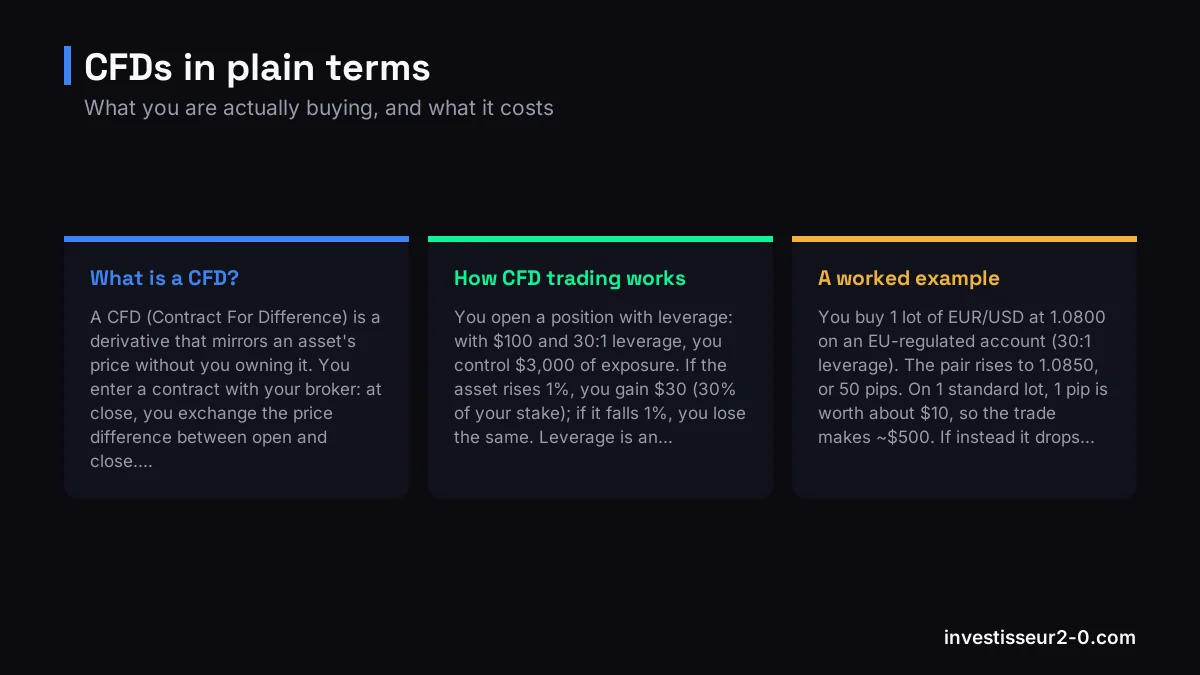
A CFD (Contract For Difference) is a derivative that mirrors an asset's price without you owning it. You enter a contract with your broker: at close, you exchange the price difference between open and close. The big advantage is versatility: a single CFD account gives you access to currencies, indices, stocks, commodities and crypto, and lets you trade both long (buy) and short (sell).
How CFD trading works
You open a position with leverage: with $100 and 30:1 leverage, you control $3,000 of exposure. If the asset rises 1%, you gain $30 (30% of your stake); if it falls 1%, you lose the same. Leverage is an amplifier, both ways. The broker earns through the spread (the gap between buy and sell price) and, on raw accounts, a small commission per lot.
A worked example
You buy 1 lot of EUR/USD at 1.0800 on an EU-regulated account (30:1 leverage). The pair rises to 1.0850, or 50 pips. On 1 standard lot, 1 pip is worth about $10, so the trade makes ~$500. If instead it drops to 1.0750, you lose ~$500. That's why you never trade without a stop loss and proper position sizing: our risk calculator does that math for you in seconds.
The fees to know
- The spread: your main cost. Tighter is better (EUR/USD from ~0.8 pip standard, 0.0 pip raw + commission).
- The commission: on raw accounts, a few dollars per round-turn lot.
- The swap (overnight fee): charged if you hold a position from one day to the next.
- Inactivity fees: often ~$10/month after a year of dormancy.
Where to trade CFDs: our recommended brokers
We only recommend brokers we've tested and built into our own setup. Two stand out, each excellent in its lane.
Axi, our pick for a regulated framework across the 24 EEA countries its European arm covers. Those clients go through a CySEC entity (negative balance protection, investor compensation), with MT4, MT5 and TradingView, very competitive raw spreads and even a funded-account program, Axi Select. For trading CFDs seriously in a protective framework, it's our reference. Open an Axi account · our Axi review.
BlackBull, our pick for platforms. It lines up MT4, MT5, cTrader and TradingView, with some of the tightest ECN spreads and fast execution. For an active trader who wants the best toolkit, it's hard to beat. Open a BlackBull account · our BlackBull review.
Torn between the two? Our Axi vs BlackBull comparison settles it by profile, and our best forex/CFD broker guide lays it all out.
Getting started with CFDs
The golden rule: a CFD is a tool, not a magic formula. Start on a demo account, then with small amounts. Keep risk per position under 1%, always use a stop loss, and choose a regulated broker. Above all, read our risk management guide: it's what separates traders who last from the 74-89%.
FAQ
What is a CFD, simply?
A contract where you exchange the price difference of an asset with the broker, with leverage, without owning the asset. Currencies, indices, stocks, commodities, crypto.
What is the best CFD broker?
Axi for the regulated CySEC framework, BlackBull for platform choice (cTrader). Both are in our top tier.
Is CFD trading risky?
Yes, it's a leveraged product where most retail accounts lose. Powerful in trained, disciplined hands, dangerous without risk management.
Disclaimer. CFD trading carries a high risk of rapid capital loss due to leverage. Most retail accounts lose money. This article is educational and not investment advice. Affiliate links may compensate us at no extra cost to you and never change our verdict.