
Binance fees explained: the complete 2026 breakdown
Binance remains the most-used crypto exchange in the world, yet its fees are often misunderstood. Between spot, futures, deposits, withdrawals, spread and conversion, the real bill can surprise you, especially for an active trader. This guide breaks down every type of fee, calculates the cumulative impact, then compares Binance to cheaper alternatives such as XT.com, BingX and MEXC.
Transparency: this article contains affiliate links. If you open an account through our links, we may earn a commission at no extra cost to you, and in the case of XT.com, with a fee advantage (VIP2 status) passed on to you. We only recommend platforms we actually use.
Why Binance fees deserve a serious look
When you start out, you watch the price of Bitcoin and forget about fees. That is a classic mistake. Fees are a recurring cost, charged on every transaction, that silently erodes performance. For an investor who buys and holds, the impact stays marginal. But for an active trader who practices regular analysis and capital rotation, every basis point counts.
Binance advertises some of the most competitive fees among large mainstream platforms. But "competitive" does not mean "cheapest", and several exchanges, including XT.com via our VIP2 status, do better. For the platform in full, see our complete Binance review. Let's first look in detail at what you actually pay on Binance.
Spot trading fees
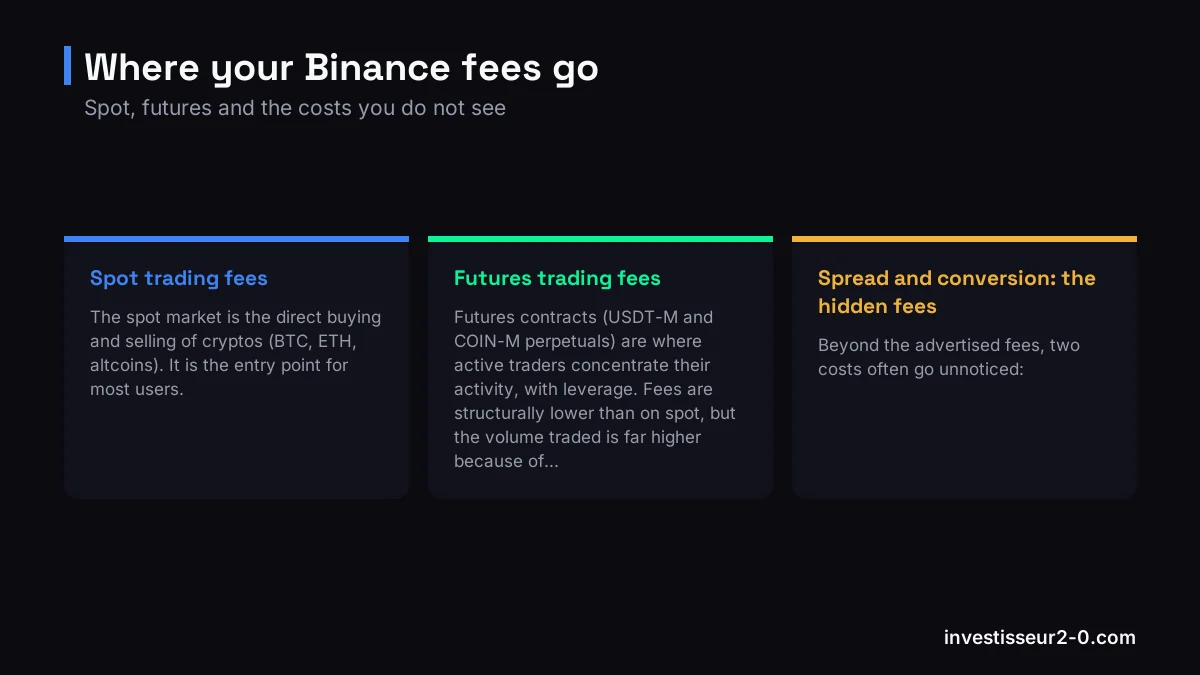
The spot market is the direct buying and selling of cryptos (BTC, ETH, altcoins). It is the entry point for most users.
- Standard fees: 0.10% maker / 0.10% taker. This rate applies to all new accounts, with no volume requirement.
- With BNB discount: by enabling fee payment with the BNB token, you get a 25% reduction, bringing fees down to 0.075% maker / 0.075% taker.
- VIP tiers: above a certain monthly volume and BNB balance, fees decrease further in steps (VIP1 to VIP9).
Concretely, on a 1,000 EUR spot trade, you pay 1 EUR in fees at standard rate, or 0.75 EUR with the BNB discount. It is small per trade, but multiply it by the number of trades in a month and the total becomes visible.
Futures trading fees
Futures contracts (USDT-M and COIN-M perpetuals) are where active traders concentrate their activity, with leverage. Fees are structurally lower than on spot, but the volume traded is far higher because of leverage.
- Standard USDT-M fees: 0.02% maker / 0.05% taker.
- With BNB discount: -10% on futures, roughly 0.018% maker / 0.045% taker.
- VIP tiers: VIP levels strongly reduce the taker fee (down to 0.017% maker / 0.030% taker for high VIPs), but they require very large monthly volumes, out of reach for most retail traders.
The key point: a trader with 10x leverage on a 1,000 EUR position actually exposes 10,000 EUR. A 0.05% taker fee on 10,000 EUR is 5 EUR per opening, and as much on closing. Leverage amplifies fees too, not just gains.
Deposit and withdrawal fees
They are often overlooked, but the fees to move capital in and out matter, especially for euro-denominated accounts.
- Crypto deposit: free. You only pay the network fees of the originating blockchain.
- Crypto withdrawal: variable network fees. Withdrawing USDT on Tron (TRC-20) costs a fraction of a cent; on Ethereum (ERC-20) it can climb to several euros depending on congestion.
- EUR deposit via SEPA: generally free or a few cents. It is the cheapest way to fund your account in euros.
- EUR deposit by card: significantly higher fees (often 1.8% to 2%). Avoid for large amounts.
- EUR withdrawal via SEPA: low fixed fees (in the range of a few tens of cents to 1 EUR).
Simple advice: always fund via SEPA, never by card, and withdraw your cryptos on the cheapest available network.
Spread and conversion: the hidden fees
Beyond the advertised fees, two costs often go unnoticed:
- The spread: the gap between the best bid and the best ask. On major pairs (BTC/USDT, ETH/USDT) it is near zero thanks to Binance's liquidity. On small caps it can be significant.
- Conversion (Binance Convert): handy for quickly swapping two cryptos without going through the order book, but the rate embeds a margin above standard spot fees. For large amounts, it is better to use the spot market with a limit order.
The cumulative impact of fees on an active trader
Let's take a concrete example. An active trader executing 40 futures trades per month, average size 5,000 EUR of notional per position (entry + exit = 80 executions):
- Binance standard (taker 0.05%): 80 x 5,000 x 0.05% = 200 EUR / month, i.e. 2,400 EUR / year.
- Binance with BNB (taker ~0.045%): around 180 EUR / month, i.e. 2,160 EUR / year.
- XT.com VIP2 (taker 0.0460%): 80 x 5,000 x 0.0460% = 184 EUR / month, but with a 0.0150% maker instead of 0.02%, the saving on limit orders is even more pronounced.
The lesson: over a year, the choice of platform and fee optimization can make a difference of several hundred euros. And that is before counting the effect on liquidation mechanisms, where fees add to losses in a worst-case scenario.
The cheaper alternatives to Binance
Binance is not the cheapest option on the market. Here are three platforms we use or recommend for their reduced fees:
- XT.com: every Investisseur 2.0 member gets VIP2 status included via our link, i.e. 0.0150% maker / 0.0460% taker on futures, below Binance's standard fees. It is our main platform for altcoin futures (see our Binance vs XT.com vs Bybit comparison).
- BingX: competitive futures fees and well-regarded copy trading. Sign up via our BingX link (see our Binance vs BingX comparison).
- MEXC: known for some of the lowest maker fees and a vast catalog of listings. See our MEXC bonus page and our Binance vs MEXC comparison.
Fee comparison table
| Platform | Spot | Futures maker | Futures taker |
|---|---|---|---|
| Binance (standard) | 0.10% | 0.02% | 0.05% |
| Binance (with BNB) | 0.075% | ~0.018% | ~0.045% |
| XT.com (VIP2 included) | 0.0150% | 0.0150% | 0.0460% |
| BingX | 0.10% | 0.02% | 0.05% |
| MEXC | 0% - 0.10% | 0.01% | 0.04% |
How to concretely reduce your fees
Whether you stay on Binance or switch to an alternative, these four levers cut your bill immediately:
- Favor limit orders (maker): a maker order adds liquidity to the book and costs less than a market order (taker). On Binance futures, that is 0.02% versus 0.05%, more than twice cheaper.
- Pay your fees in BNB: -25% on spot, -10% on futures. Simply keep a small BNB balance and enable the option in the settings.
- Climb VIP tiers: if your volume justifies it, VIP levels durably reduce your fees. But never force volume just to reach a tier: the cost of useless trades exceeds the saving.
- Choose the right platform: the most powerful lever is to trade where fees are structurally lower. The VIP2 status included on XT.com via our link immediately gives fees below Binance's standard, with no volume requirement.
Our verdict
Binance remains an excellent choice for liquidity and security. If those are your priorities and you live outside the EU, you can register on Binance in a few minutes (affiliate link; not open to EU or French residents since July 1, 2026, and trading crypto can cost you your entire stake). But on the single criterion of fees, it is not unbeatable. For an active futures trader, the saving achieved with VIP2 status on XT.com via our link (0.0150% maker / 0.0460% taker) compounds trade after trade and ends up weighing heavily over a year.
XT.com links are affiliate links too. XT.com holds no MiCA license either and does not serve EU or French residents; futures with leverage can liquidate an account in minutes.
Our setup at Investisseur 2.0: XT.com for reduced-fee altcoin futures, with Binance kept for liquidity on majors where it remains accessible. For a complete overview of the platforms, see our ranking of the best crypto exchanges in 2026 and our Binance vs XT.com vs Bybit comparison.
FAQ
What are Binance spot trading fees in 2026?
0.10% maker and 0.10% taker at standard tier. By paying fees with the BNB token, you get -25%, i.e. 0.075% maker / 0.075% taker.
How much do Binance futures fees cost?
0.02% maker and 0.05% taker at standard tier. These fees drop with VIP levels (volume + BNB balance), and the -10% BNB discount also applies.
Are there deposit and withdrawal fees on Binance?
Crypto deposits are free (excluding network fees). Crypto withdrawals cost the blockchain network fee. In EUR, SEPA is free or very cheap, while card deposits charge around 1.8% to 2%.
How can I reduce my fees on Binance?
Pay in BNB (-25% spot, -10% futures), use limit orders (maker) rather than market orders, climb VIP tiers through volume, and fund via SEPA rather than card.
Which exchange offers lower fees than Binance?
XT.com grants VIP2 status to all our members via our link (0.0150% maker / 0.0460% taker on futures), below Binance standard. BingX and MEXC are also competitive, often below Binance without the BNB discount.
Do Binance fees really matter for an active trader?
Yes. With dozens of trades per month, cumulative fees quickly reach hundreds of euros. Optimizing your fees (maker, BNB, platform) represents meaningful savings over a year.