
Binance vs MEXC: 2026 comparison
Two philosophies collide when a crypto trader compares Binance and MEXC in 2026. Binance, the regulated giant with unbeatable liquidity. MEXC, the platform of near-zero fees and the broadest altcoin catalog on the market. This comparison reviews fees, catalog, early listings, liquidity, security, AMF compliance and the mobile app, with an honest verdict per category.
Transparency: this article contains affiliate links. If you open an account through our links, we may earn a commission at no additional cost to you. This comparison remains objective: we present each platform with its strengths and its limitations.
Why compare Binance and MEXC?
Binance and MEXC answer two different needs. Binance is the world leader by volume: it is the reference for liquidity and institutional-grade security. MEXC, for its part, has built a solid reputation on two precise axes: spot fees often at 0% and a gigantic altcoin catalog with some of the earliest listings in the sector.
Our goal is not to crown "the best exchange" in absolute terms, because that concept does not exist. The right choice depends on your strategy, your capital and your tolerance to regulatory risk. We give you the elements to decide with full context.
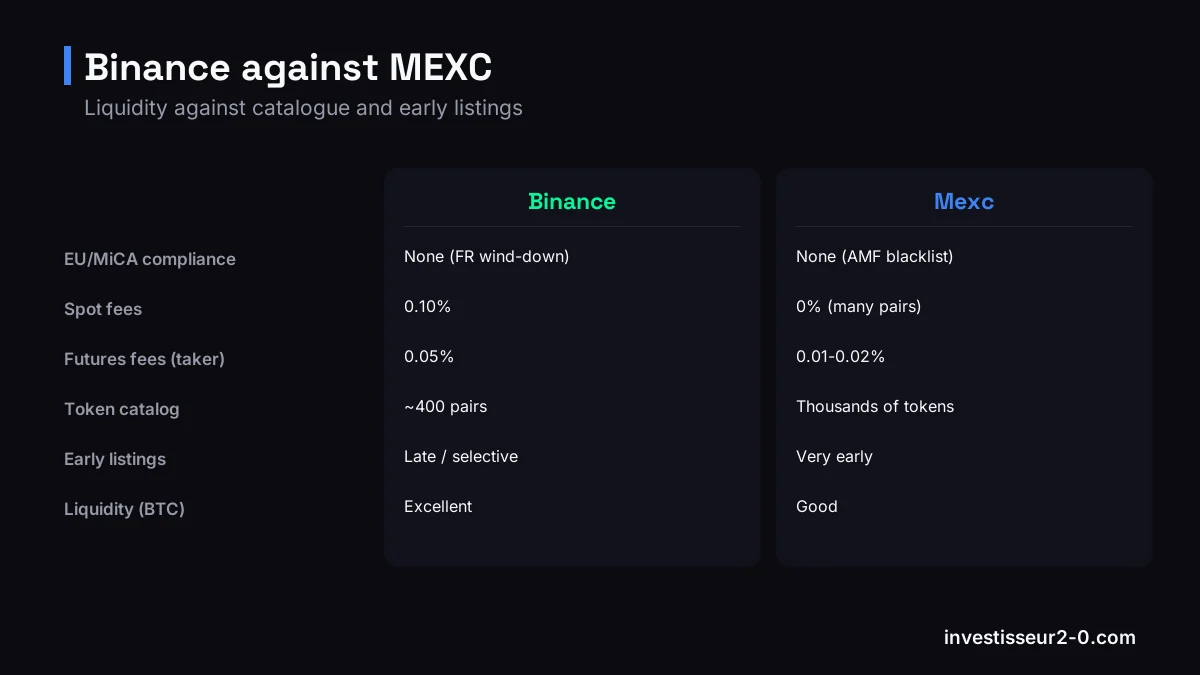
Trading fees: spot and futures
Fees are the first criterion for an active trader. Across dozens of monthly trades, the gap between 0% and 0.10% taker fees represents hundreds of dollars saved over the year. This is where MEXC strikes hardest.
Spot fees
- Binance: 0.10% maker / 0.10% taker (BNB discount available: -25%)
- MEXC: 0% maker / 0% taker on many spot pairs, one of the platform's major selling points. Even outside promotions, spot fees remain among the lowest on the market.
Futures fees
- Binance: 0.02% maker / 0.05% taker
- MEXC: very low futures fees, often around 0% maker / 0.01 to 0.02% taker depending on running promotions. MEXC regularly runs reduced-fee campaigns on futures.
Fee verdict: MEXC dominates clearly. With its 0% spot pairs and futures fees among the most aggressive on the market, it is the cheapest exchange to use. For a trader who multiplies entries and exits, the savings are concrete and compound trade after trade. For the detail of every Binance cost, see our Binance fees explained guide, and to compare more platforms our Binance, XT.com and Bybit comparison.
Catalog and early listings
The catalog determines your ability to seize opportunities before the rest of the market. This is MEXC's second major strength.
- Binance: around 400 spot pairs, a selective catalog focused on established projects. Listings are rigorous but often later: a token frequently arrives on Binance after already performing elsewhere.
- MEXC: several thousand tokens listed, including a huge coverage of small caps and emerging projects. MEXC is known for its very early listings: many altcoins are available there well before Binance or Coinbase.
Catalog verdict: MEXC crushes the comparison in token count and listing speed. It is the go-to platform for hunting early-stage altcoins and nascent narratives. To dig into how it works, see our complete MEXC review.
Liquidity depth
Liquidity determines the slippage you will experience at execution. A deep order book means your orders fill at the desired price, even on significant sizes.
- Binance: deepest liquidity in the market on major pairs. Near-zero spread on BTC/USDT and ETH/USDT. It is the undisputed king on this criterion.
- MEXC: good liquidity on major pairs, but behind Binance. On small caps, the order book can be thin, so always check the depth before entering with a meaningful size.
Liquidity verdict: Binance stays ahead. If you trade large positions on BTC or ETH, this is where slippage will be lowest. On MEXC's altcoins, the trade-off for catalog depth is more variable liquidity, so strict execution discipline is required.
Security and track record
Security is non-negotiable. An exchange can offer the best fees in the world, but if your funds vanish, nothing else matters.
- Binance: hot wallet hack in 2019 (7,000 BTC) fully reimbursed via the SAFU fund. Since then, reinforced architecture, public Proof of Reserves and regular audits. It is the industry standard.
- MEXC: no major security incident widely reported to date. The platform publishes Proof of Reserves elements and has operated since 2018. A solid track record, but without an insurance fund on the scale of Binance's SAFU.
Security verdict: Binance for the depth of its SAFU fund and its proven reimbursement history. MEXC is credible, but Binance has the most battle-tested record. For the full assessment of the market leader, read our complete Binance review. In all cases, never leave more capital on an exchange than you are prepared to lose, with the rest in cold storage.
Regulatory compliance (France / AMF)
With MiCA now applied across the EU, compliance separates the exchanges that kept the European market from those that gave it up. Both of these gave it up.
- Binance: French PSAN registration lapsed June 30, 2026 with no MiCA authorization filed; since July 1 French accounts are winding down, withdrawals only. Still licensed in many jurisdictions outside the EU.
- MEXC: no MiCA authorization, no PSAN, and listed on the French AMF blacklist since June 2024. Serves non-EU markets with KYC.
Compliance verdict: a draw at a low level. From inside the EU, neither is an option. From elsewhere, Binance's larger stack of national licenses gives it the edge, but check what actually applies to your country.
Mobile app
Trading increasingly happens on the move. The app has become a choice criterion in its own right.
- Binance: very complete but dense app, with a steep learning curve. All desktop features are available.
- MEXC: fluid and accessible app, with integrated charting, spot, futures and quick access to new listings. A good experience for tracking altcoins on the go.
Mobile app verdict: a close match. Binance is more complete, MEXC more direct for spotting and trading new tokens. Both apps broadly cover the essentials.
Unique features
Each platform has distinctive strengths that can tip the balance depending on your profile.
- Binance: complete ecosystem (Binance Earn, Launchpad, Binance Academy, BNB token for fee discounts). It is a full universe in its own right, well beyond a simple exchange.
- MEXC: 0% spot fees, a huge altcoin catalog, early listings, airdrop and kickstarter programs on new projects. The platform is built for hunting early opportunities.
Worth noting: if MEXC does not cover a token you are after, XT.com is an interesting complementary alternative, also oriented toward early listings and altcoin futures. Registration is done via this link (affiliate; XT.com is not MiCA-licensed and closed to EU residents, and altcoin futures are among the fastest ways to lose a deposit).
Full comparison table
| Criterion | Binance | MEXC | Winner |
|---|---|---|---|
| Spot fees | 0.10% | 0% (many pairs) | MEXC |
| Futures fees (taker) | 0.05% | 0.01-0.02% | MEXC |
| Token catalog | ~400 pairs | Thousands of tokens | MEXC |
| Early listings | Late / selective | Very early | MEXC |
| Liquidity (BTC) | Excellent | Good | Binance |
| Security | SAFU + PoR | PoR | Binance |
| EU/MiCA compliance | None (FR wind-down) | None (AMF blacklist) | Neither |
| Mobile app | Complete | Fluid | Tie |
Our verdict: which exchange should you choose?
There is no universal answer. The choice depends on your profile:
- Beginner seeking a mature platform: Binance. Maximum liquidity, localized interface and a complete educational ecosystem. You can set up a Binance account if you live outside the EU (affiliate link; EU and French residents are not accepted, and any crypto deposit can lose most of its value).
- Altcoin and low-fee hunter: MEXC. The broadest catalog, some of the earliest listings on the market, and spot fees often at 0%. This is where you will find early opportunities before everyone else.
Our recommendation for the altcoin-oriented trader focused on fee optimization: MEXC. The combination of near-zero fees + early listings + a gigantic catalog makes it the most effective tool for seizing early-stage opportunities, where the difference in cost and timing translates directly into performance. To open an account and claim the bonus:
Bonus link = affiliate link. MEXC takes no EU or French clients (no MiCA license, AMF blacklist) and early-stage altcoins routinely lose 80 to 90 percent of their price; size positions accordingly.
If your activity concentrates on BTC/ETH with large sizes, Binance remains the most rational choice where it is available. Many traders actually use both: Binance for majors, MEXC for early altcoins.
In all cases, the golden rule stays the same: only keep on an exchange the capital needed for your active trading. The rest goes to cold storage. No exchange, however solid, is immune. For a broader overview including other platforms, see our ranking of the best crypto exchanges in 2026 and our roundup of the best Binance alternatives.
FAQ
Which exchange has the lowest fees: Binance or MEXC?
MEXC. Many spot pairs are at 0% maker and taker fees, and futures fees are very competitive (often 0% maker / 0.01-0.02% taker depending on promotions). Binance charges 0.10% on standard spot and 0.02% / 0.05% on futures. On raw cost, MEXC is clearly ahead.
Is MEXC accessible to European residents in 2026?
No. MEXC has no MiCA authorization and sits on the AMF blacklist, and Binance stopped taking EU clients on July 1, 2026. This comparison serves traders in countries where the platforms operate legally.
Why is MEXC popular for altcoins?
MEXC has one of the broadest catalogs on the market, with thousands of tokens and very early listings on small caps. Many projects are available there before Binance or Coinbase, making it a top choice for early-stage opportunities.
Binance or MEXC for a beginner?
Binance if you prioritize liquidity and a polished interface; MEXC if you hunt early altcoins and minimal fees. Neither takes EU or French residents (no MiCA license), so EU beginners should pick an authorized venue instead.
Is MEXC's liquidity sufficient?
On major pairs it is good but below Binance. On small caps, the order book can be thin: check the depth before entering with a significant size and avoid market orders on illiquid tokens.
Can you use Binance and MEXC at the same time?
Yes, and it is a logical combination: Binance for liquidity and compliance on majors, MEXC for early altcoins and low fees. Spreading your capital also reduces counterparty risk. The rest should stay in cold storage.