
Order Block vs Support/Resistance: the difference
Many traders confuse Order Block and classic Support/Resistance. Both describe zones where price reacts, but their underlying logic is radically different. Here is how they actually differ.
Precise definitions
Classic Support/Resistance
A horizontal level (sometimes diagonal) where price has reacted several times in the past. The logic: "this level held, so it should hold again." A purely technical approach, with no direct link to institutional order flow.
Order Block (OB)
The last consolidation candle before an impulsive directional move. For a bullish OB: the last bearish candle before a violent bullish breakout. For a bearish OB: the last bullish candle before a breakdown. The logic: this is where market makers absorbed enough orders to trigger the move.
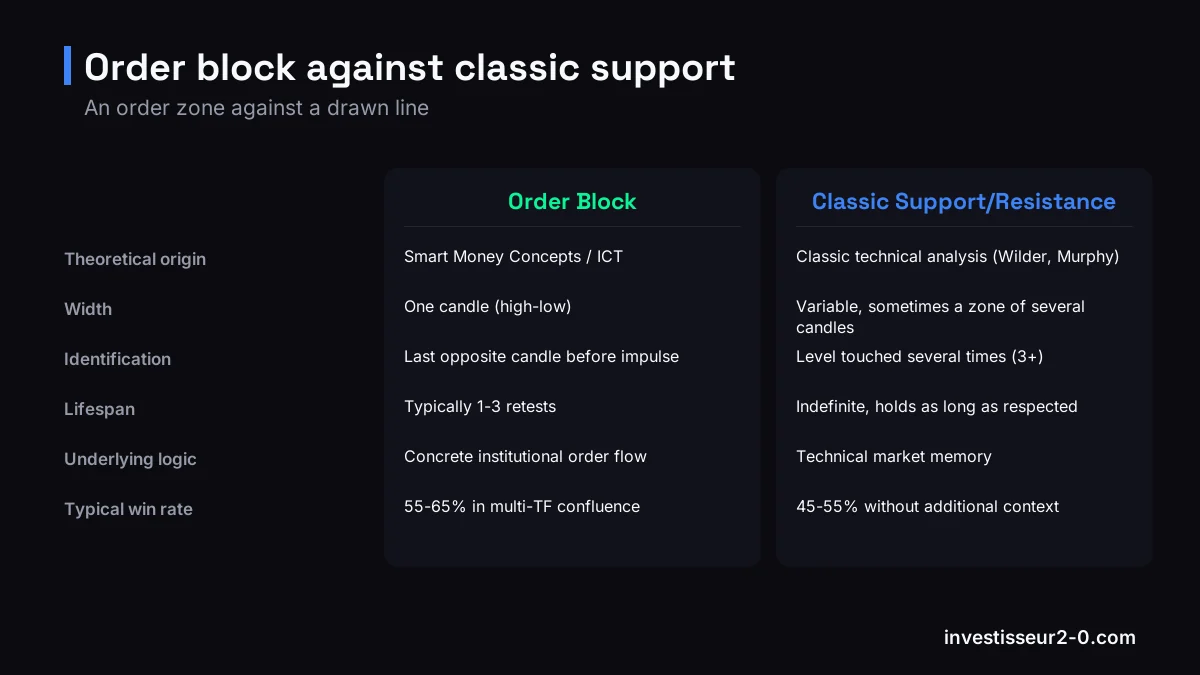
Comparison table
| Criterion | Order Block | Classic Support/Resistance |
|---|---|---|
| Theoretical origin | Smart Money Concepts / ICT | Classic technical analysis (Wilder, Murphy) |
| Width | One candle (high-low) | Variable, sometimes a zone of several candles |
| Identification | Last opposite candle before impulse | Level touched several times (3+) |
| Lifespan | Typically 1-3 retests | Indefinite, holds as long as respected |
| Underlying logic | Concrete institutional order flow | Technical market memory |
| Typical win rate | 55-65% in multi-TF confluence | 45-55% without additional context |
| Stop placement | Beyond the OB, +1x ATR buffer | Below/above the level, arbitrary buffer |
| Ideal confluence | FVG + Premium/Discount + Killzone | Volume profile + RSI divergence |
Why the Order Block is more precise
The fundamental difference is causal. A classic S/R works because it has worked, a self-fulfilling correlation. An Order Block works because it physically marks the zone of institutional accumulation.
When price retraces into a bullish OB, it meets:
- Limit orders left unfilled during the initial formation.
- Market makers who want to defend their long position.
- Informed SMC traders placing their orders at the same level.
On a classic S/R without an OB, you only have the 3rd layer (traders who remember the level). Far more fragile.
How to draw an Order Block (practical example)
- Identify a recent BOS on the trading timeframe (H1 or H4). The BOS confirms that an institutional move took place.
- Go back to the last opposite candle right before the impulse. For a bullish BOS: the last red candle. For a bearish BOS: the last green candle.
- Draw the rectangle from the high of that candle to its low, and extend it to the right. Strict version: use the body open and close (ignore the wicks).
- Check the confluence: is there a Fair Value Gap in the move that follows? Is the OB inside the Discount zone (in a bullish trend)?
- Place the limit order inside the OB, stop just beyond it with an ATR(14) x 1.5 buffer, take-profit on the next opposite liquidity zone (BSL or EQH).
The full breakdown is in our Order Blocks crypto guide.
When to use each approach?
Favor Order Blocks
- Short/medium-term trading (intraday to 1-2 week swing).
- Markets with high institutional volume (BTC, ETH, top altcoins).
- Continuation setups after a confirmed BOS.
Keep classic S/R
- Round psychological zones ($60k, $70k BTC) that act as liquidity magnets.
- Major historical levels (ATH, ATL, halving levels).
- Long-term position trading (months) where price-action precision is not critical.
The best approach is to combine them: an Order Block inside a historical S/R zone = maximum confluence. This double reading sits at the core of the Smart Money Concepts framework. To time the entry inside the OB precisely, layer in the OTE 62-79% zone.
Frequently asked questions
Is an Order Block a support/resistance level?
Not exactly. An Order Block is a precise zone (the last consolidation candle before an impulsive move), whereas a classic support/resistance is a horizontal level defined by several touches. The Order Block is narrower (one candle), more contextual (tied to an institutional move), and has a limited lifespan (typically 1-3 retests).
Why do Order Blocks work better than classic S/R levels?
Because they represent a concrete zone of institutional order absorption, not a mere visual correlation. When an OB forms, you know a major player accumulated or distributed at that price. Classic S/R levels can be simple technical coincidences with no order flow logic behind them.
How do you draw an Order Block correctly?
1) Identify a recent impulsive move (confirmed BOS). 2) Go back to the last opposite-colored candle before that move. 3) Draw a horizontal rectangle from high to low (and more precisely from body open to body close for a strict OB). 4) Extend it to the right until mitigation or invalidation.
How long does an Order Block stay valid?
An OB is typically valid for 1 to 3 retests. Beyond that, its probability of reaction drops because the residual orders have been absorbed. If price breaks through the OB convincingly (a candle body closing beyond it), the OB is invalidated and can become a Breaker Block in the opposite direction.
Can you combine Order Blocks and classic support/resistance levels?
Yes, and it is even recommended. The best confluence is: an Order Block sitting on a historical S/R level, in confluence with a Fair Value Gap, inside a Premium or Discount Fibonacci zone. More layers of confluence = higher probability. This is exactly what our AI SMC Analyzer measures automatically.
Want to see how all of this fits into a complete trade plan? Read our guide to crypto trading risk management.
Identify an OB in 10 seconds
Instead of drawing manually, upload a chart screenshot to our free AI SMC Analyzer. The AI automatically detects Order Blocks, their confidence level, and the confluence with FVG / liquidity. 3 free analyses per day.
Join the free Telegram channel