Bitcoin and ether options on Kraken Pro: what you actually buy when you pay a premium
Since 26 October 2026, eligible clients in the European Economic Area can trade options on bitcoin and ether from Kraken Pro, on web and mobile. Few crypto exchanges available in Europe offer this product, and few people know how to read it. This page covers the vocabulary (call, put, premium, strike, expiry), the quoting mechanism specific to Kraken, and above all what these contracts do not do.
Risk warning. Trading financial instruments, including derivatives, involves significant risks and is not appropriate for all investors. You could lose more than your initial investment. See our Risk Disclosure on eu.kraken.com. Derivatives products are provided by Payward Europe Digital Solutions (CY) Limited, regulated by the Cyprus Securities and Exchange Commission (CySEC), licence no 342/17.
What Kraken opened on 26 October
Two markets, no more for now: options on bitcoin (XBT/USD) and on ether (ETH/USD). They are European style, meaning they can only be exercised at expiry, and cash settled: on the set date you receive or lose a difference in dollars, and no bitcoin changes hands. Available expiries are weekly, monthly, quarterly and semi-annual.
The service is provided by Payward Europe Digital Solutions (CY) Limited, Kraken's Cypriot entity authorised by CySEC under MiFID II (licence 342/17), the same one that already carries US stocks for the EEA. Deposited crypto-assets stay with Payward Europe Solutions Limited, the entity authorised under MiCA by the Central Bank of Ireland. In other words, an EEA resident deals with a regulated framework, which does not make the product any less risky.
Options are available in the EEA countries where Kraken already offers derivatives, and Kraken flags possible restrictions in Spain and Belgium. The only reliable way to know whether your account qualifies is to start the activation in the app: the appropriateness assessment is mandatory and can deny you access if your answers show the product is not right for you. That is a safeguard, not a formality.
Call, put, premium, strike: the four words to know
An option is a contract. The buyer pays an amount, the premium, and receives a right in return, never an obligation. A call is the right to buy the underlying at a price set in advance, the strike, until a date set in advance, the expiry. A put is the right to sell it at that same fixed price. A call leans towards a rise, a put towards a fall.
What matters for a beginner fits in one line: for the buyer, the maximum loss is the premium, and it is known before you click. If the market does not go the hoped-for way, the option expires worthless and the premium is lost, full stop. There is no margin call on a bought option, unlike a futures position where the loss can keep growing while it is open.
The seller of an option sits on the other side of the contract. They collect the premium and take on a risk with no ceiling: Kraken states in plain words that a seller's losses can substantially exceed the margin posted. This page is about buying options. Selling them is a different trade, and not one we would suggest to anyone discovering the product.
Three dimensions instead of one
Spot and futures know only one question: will the price go up or down? Options add two more. Volatility, meaning the expected size of the move, and the time left before expiry. An option is worth more when the market is agitated and the expiry is far away, because the odds of it finishing in the money are higher. Each day that passes without a move takes value away from it.
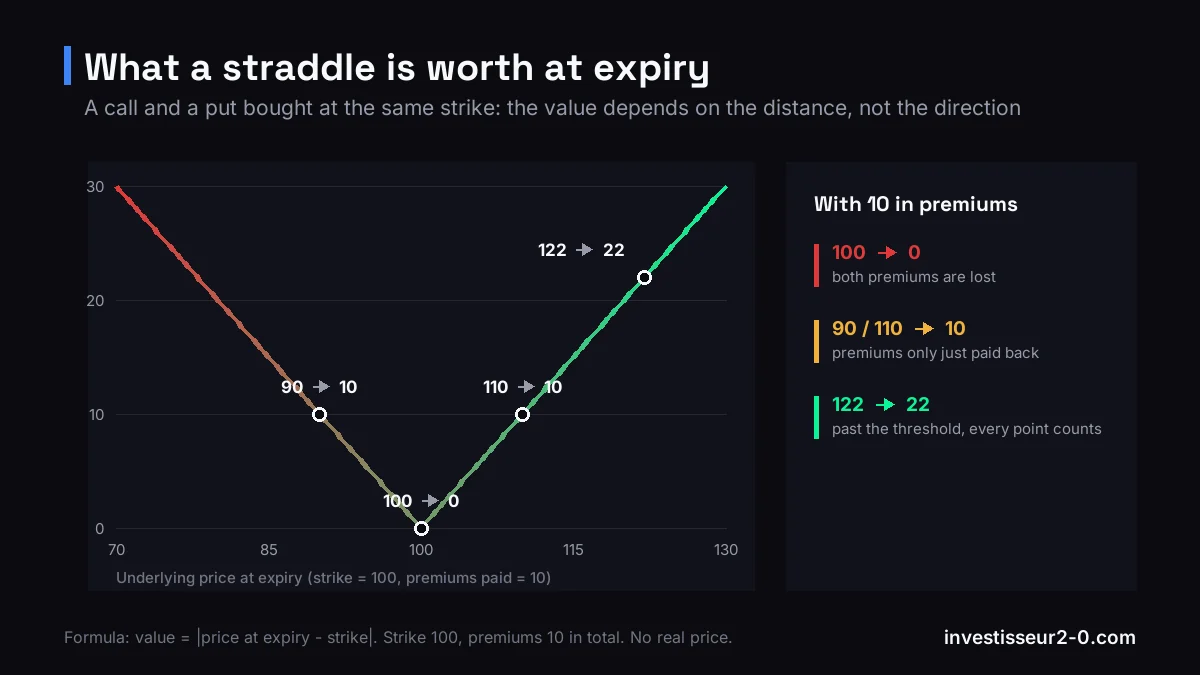
That lets you express views a plain BTC purchase cannot: "this is going to move hard, but I do not know which way", or the opposite, "nothing will happen for a month". The straddle, a call and a put bought at the same strike, is the classic example of the first view. It wins if the move exceeds the cost of both premiums, in either direction, and it loses if the market stays calm.
How it works in practice on Kraken Pro
No new app and no new account: options live inside your existing Kraken Pro account, with the same login. You first enable derivatives if that is not already done, then answer the appropriateness questionnaire. If the Pro interface is new to you, our Kraken Pro fee guide explains how the Pro side of the account works.
The real particularity is the way trades are negotiated. There is no order book for options yet: everything goes through a request for quote, the RFQ. You pick BTC or ETH, a strategy (a single call, a single put, a straddle, up to five legs in one request), a strike and an expiry, then submit. Quotes arrive within seconds, each valid for a limited time. You accept or you pass. An accepted quote is binding immediately, with no way back.
A few practical details are worth knowing before a first attempt:
- One wallet. Spot, futures and options share the same collateral, with more than thirty currencies and crypto-assets accepted. No need to deposit dollars, even though settlement is in USD.
- Portfolio margin is on by default. Positions that offset each other (a call and a put, for instance) require less margin than each taken separately. The flip side: margin requirements can change at any time, and an account that falls below them can be liquidated.
- Options and futures do not behave the same way in the same account. Options neither pay nor charge funding; a perpetual open next to them does.
Three uses, for illustration only
The three cases below are there to make the mechanics clear. They are not recommendations, and none of them guarantees any outcome.
Reducing the exposure of bitcoin you hold, by buying a put
You hold BTC and want to limit the impact of a drop over the coming weeks without selling it. You buy a put with a strike below the current price, and you pay a premium. If at expiry BTC has fallen below the strike, the put pays you the difference, which offsets part of the loss on your coins. If it stayed above, the premium is lost, like an insurance policy that was not used. The put has a cost and does not remove market risk: between the current price and the strike, the drop is still yours.
Expressing a bullish view, by buying a call
You think BTC could rise by expiry and want exposure at a cost known in advance rather than through a futures contract. You buy a call. If BTC finishes above the strike, the call pays the difference. Otherwise you lose the premium, and only the premium. The price of that capped loss is that BTC has to climb beyond the strike plus the premium for the trade to come out ahead.
Playing the size of the move rather than its direction, with a straddle
An event is coming and you expect a large move without knowing which way. You buy a call and a put at the same strike at the same time, in a single RFQ: both legs are quoted and executed together. If the move covers the cost of both premiums, in either direction, the straddle wins. If the market moves less than expected, or not at all, both premiums melt away. The figure above shows that V shape.
What options are not
An option never covers a portfolio for free: the premium is a real cost, paid every time, whether the cover is used or not. Nor does it help guess the bitcoin price, which nobody knows, and a well-built option can lose value while the market goes the right way, if the move comes too slowly or stays too small. It also makes little sense before futures do: our pages on perpetuals and on leverage are the prerequisite, not a complement.
One simple rule for a first contact: put into a premium only what you accept to lose entirely, and size that premium as seriously as a stop on a spot trade. Our risk calculator works for that too: the premium is your maximum loss, and it should not exceed the share of capital you allow yourself on one trade.
Sign-up and identity verification take about ten minutes. Options are then activated from Kraken Pro, after enabling derivatives and answering the appropriateness questionnaire, which can deny you access.
Open a Kraken accountAffiliate link. Trading financial instruments, including derivatives, involves significant risks and is not appropriate for all investors. You could lose more than your initial investment. See our Risk Disclosure on eu.kraken.com. Derivatives products are provided by Payward Europe Digital Solutions (CY) Limited, regulated by the Cyprus Securities and Exchange Commission (CySEC), licence no 342/17.
FAQ
Who can trade options on Kraken Pro?
Eligible clients in the European Economic Area, in the countries where Kraken already offers derivatives, from their existing Derivatives account. An appropriateness assessment is mandatory before the first trade, and Kraken flags possible restrictions in Spain and Belgium. The only reliable check is to start the activation in the app.
How much can you lose when you buy an option?
For a buyer, the maximum loss is the premium paid, known at the outset. If the option expires worthless, the whole premium is gone. A seller is in a different position: losses can substantially exceed the margin posted, and Kraken states they may be unlimited.
What is the difference between a call and a put?
A call is the right to buy the underlying at a fixed price (the strike) by a fixed date; it gains value when the price rises above the strike. A put is the right to sell at the strike; it gains value when the price falls below it. In both cases the buyer pays a premium and has no obligation to exercise.
How does an options order work on Kraken Pro?
Through a request for quote, or RFQ. You build the request (up to five legs, for instance a call plus a put for a straddle), submit it, then receive quotes that are valid for a limited time. You accept or pass. An accepted quote is binding; there is no cancelling afterwards.
Do I need a new account or a US dollar deposit?
No. Options are activated from the existing Kraken Pro account, same login, once derivatives are enabled and the questionnaire has been passed. Spot, futures and options share a single collateral wallet, with more than thirty currencies and crypto-assets accepted as collateral. Settlement is in USD, but a dollar deposit is not required.
Risk warning. Trading financial instruments, including derivatives, involves significant risks and is not appropriate for all investors. You could lose more than your initial investment. See our Risk Disclosure on eu.kraken.com. Derivatives products are provided by Payward Europe Digital Solutions (CY) Limited, regulated by the Cyprus Securities and Exchange Commission (CySEC), licence no 342/17.
Disclosure. This article is partner content marked as an ad: the account link is an affiliate link that pays us, at no extra cost to you. The explanations and the reservations are ours. Product features taken from Kraken's announcement of 26 October 2026; a Key Information Document is available for each option in the app. Past performance is no guide to future results; nothing here is personalised investment advice.