
Crypto vs a savings account: where should you put your money in your 20s and 30s?
A savings account keeps your money safe, but its interest rate rarely keeps pace with inflation, so the cash that feels secure quietly loses purchasing power year after year. Crypto, on the other hand, can fall 70 percent in a single year. The real answer is therefore not one or the other: it is both, in a precise order.
Different tools for different jobs: the cushion first, the performance bucket second.
What the bank statement does not show
Say you put 10,000 in a savings account paying a modest rate. A year later the balance has grown by a small amount, and everything looks fine. But if prices have risen faster than your interest over the same period, you now need more than what you started with to buy the exact same things. You gained a few nominal currency units and lost real purchasing power. A regulated savings account is not really an investment, it is a parking spot: excellent for cash you might need tomorrow, costly as a long-term strategy when its real (inflation-adjusted) return is negative.
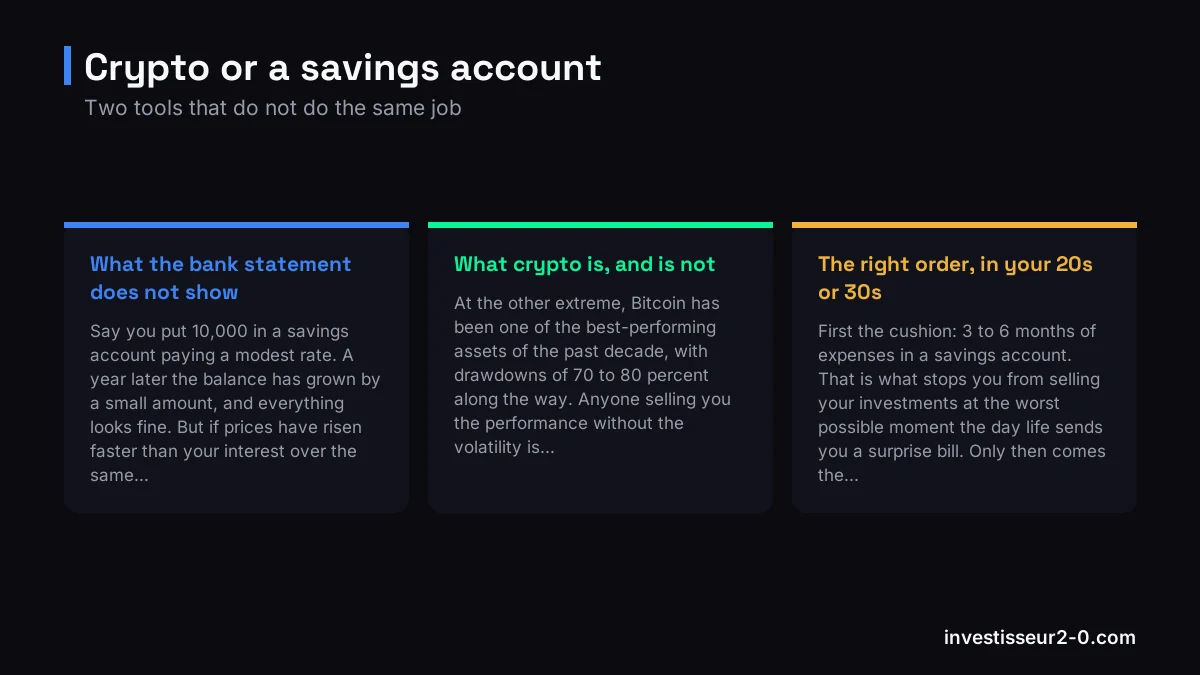
What crypto is, and is not
At the other extreme, Bitcoin has been one of the best-performing assets of the past decade, with drawdowns of 70 to 80 percent along the way. Anyone selling you the performance without the volatility is lying. Crypto is not an alternative to a savings account, it is a different asset class with a different role: the part of your wealth that chases performance while accepting risk. The two tools do not play the same position.
The right order, in your 20s or 30s
First the cushion: 3 to 6 months of expenses in a savings account. That is what stops you from selling your investments at the worst possible moment the day life sends you a surprise bill. Only then comes the performance bucket: crypto should be a reasonable fraction, 1 to 5 percent of your wealth, ideally through a regulated exchange and a monthly dollar-cost-averaging plan rather than a single lump-sum purchase. If you have never bought before, our guide on how to buy your first crypto walks through it step by step. The structural advantage of your age is time. A three-decade horizon forgives volatility that a saver at 55 cannot afford.
The trap of the two extremes
Everything in a savings account out of fear, and inflation nibbles at your savings for decades, in silence. Everything in crypto out of impatience, and the first winter down 70 percent pushes you out of the market, often for good. Both mistakes share the same root: confusing safety with stagnation on one side, performance with haste on the other. The discipline that keeps you invested through the swings is the same one covered in our complete guide to risk management.