
Crypto Risk/Reward Calculator
Instantly compute the R:R ratio of your crypto trade and the recommended position sizing per the 1% rule. Essential before any SMC execution.
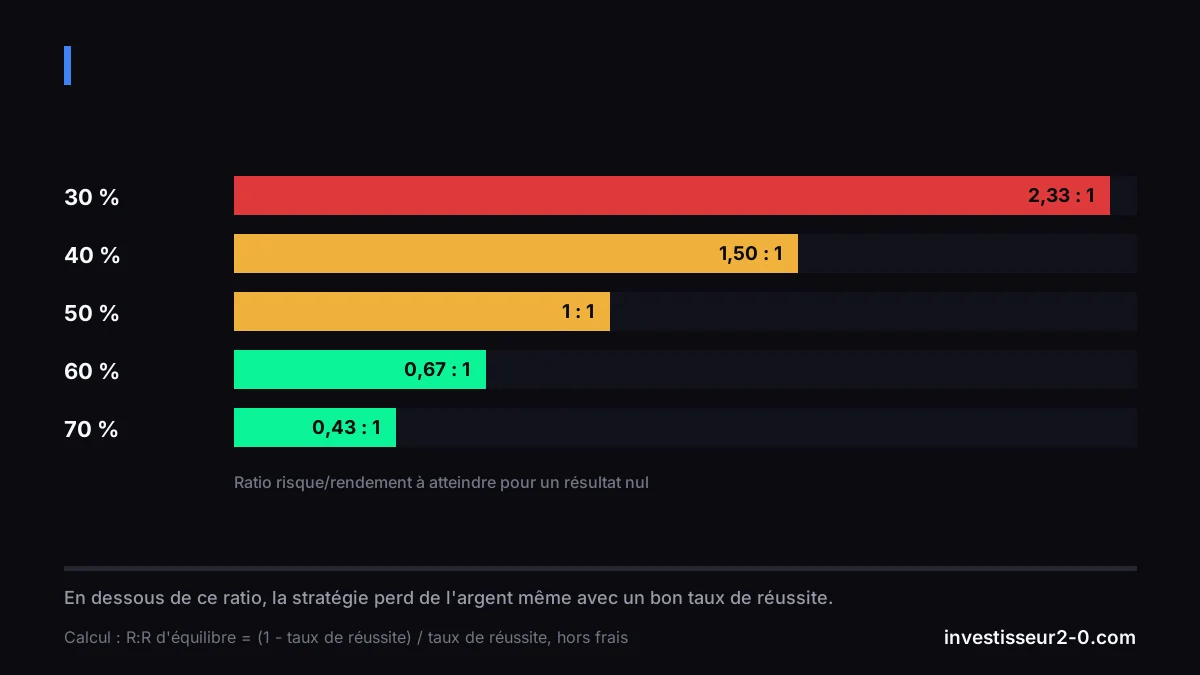
Why R:R is critical in SMC
In Smart Money Concepts, R:R isn't an option, it's the foundation. Institutions don't take 1:1 trades. They look for unmitigated liquidity zones offering a minimum 1:3 R:R, ideally 1:5+ on Daily mitigations. That's what allows them to stay profitable with relatively modest winrates (35-55%).
Golden rule: the lower your winrate, the higher your R:R must be. With a 40% winrate (realistic in live), you need a minimum 1:1.5 R:R for breakeven. To generate meaningful profitability, target 1:3 minimum.
Reference table: minimum R:R by winrate
| Winrate | Breakeven R:R | Profitable R:R | Ideal SMC R:R |
|---|---|---|---|
| 25% | 1:3.0 | 1:5 | 1:7+ |
| 35% | 1:1.86 | 1:3 | 1:5+ |
| 45% | 1:1.22 | 1:2 | 1:4+ |
| 55% | 1:0.82 | 1:1.5 | 1:3+ |
| 65% | 1:0.54 | 1:1 | 1:2+ |
Reading: with a 45% winrate (realistic for an experienced SMC trader), you need a minimum 1:1.22 R:R for breakeven and target 1:4+ for institutional SMC results.
Frequently asked questions
What is the Risk/Reward ratio (R:R) in crypto trading?
The Risk/Reward ratio (R:R) compares what you risk losing (entry → stop-loss distance) to what you aim to gain (entry → take-profit distance). A 1:3 R:R means you target $3 of profit for every $1 risked. It's the fundamental KPI that determines the long-term profitability of any trading strategy. In institutional SMC, we target a minimum 1:3 R:R, ideally 1:5+ on Daily mitigations.
What minimum R:R to be profitable in crypto?
Mathematically, with a 50% winrate, breakeven sits at a 1:1 R:R. To absorb fees and slippage, target a minimum 1:2. In SMC, the average winrate ranges between 35% and 55% depending on the trader and timeframe. With a 40% winrate, you need a 1:1.5 R:R to breakeven, so target 1:3 minimum. Golden rule: minimum 1:3 R:R, and the lower your winrate, the higher your R:R must be.
How to calculate R:R on an SMC trade?
Formula: R:R = (Entry → Take-Profit distance) ÷ (Entry → Stop-Loss distance). On a long BTC trade: entry $65,000, stop $64,200 (distance $800 = risk), take-profit $67,400 (distance $2,400 = reward). R:R = 2400 / 800 = 3, so 1:3. In SMC: stop below Order Block + ATR buffer, target on the next liquidity zone (unmitigated BSL/SSL).
What's the net gain formula based on R:R and winrate?
Mathematical expectancy = (Winrate × Reward) − (Loss-rate × Risk). For 100 trades with 40% winrate and 1:3 R:R (risk 1, reward 3): expectancy = (0.4 × 3) − (0.6 × 1) = 1.2 − 0.6 = 0.6R per trade on average. Over 100 trades risking 1% of capital: +60% capital. That's why a modest winrate with a high R:R beats a high winrate with a low R:R.
Why is R:R more important than winrate in SMC?
The crypto market is volatile and unpredictable. A trader can have a 70% winrate on paper trading then drop to 45% in live due to emotional stress. In contrast, R:R is mathematically controllable: you choose your entry, stop, and target. An SMC strategy with 1:5 R:R remains profitable even at 25% winrate. That's why institutional SMC systematically favors high-potential R:R setups on unmitigated liquidity zones over high-winrate-low-R:R setups.
How to adjust R:R based on the crypto traded?
The more volatile the crypto, the higher the R:R needed to compensate noise. Bitcoin (2-3% daily range volatility): minimum 1:3 R:R. Ethereum (3-4% volatility): 1:3 to 1:5 R:R. Solana (4-5% volatility): minimum 1:5 R:R, ideal 1:7+. For memecoins (10%+ volatility): 1:10 R:R or skip. Our crypto-smc-guides dataset details target R:R per asset.
Complementary tools
- 🧮 Crypto risk calculator (1% sizing)
- 🤖 AI SMC Analyzer (free, 3 analyses/day)
- 📘 Full SMC pillar guide
- 📋 Trade plan template (14 criteria)
- 📚 Complete risk management guide