
Still on Binance EU: where to send your funds, and how to move them safely
Binance stopped serving customers in France on 1 July 2026 for lack of a MiCA authorisation, and plenty of accounts have simply been left sitting there with balances on them. Here is the procedure, in order, with the exact places where people lose money.
Step 1: get your history out before anything else
This is the step almost everyone skips, and the only one that is genuinely irreversible. Your crypto you can retrieve. Your transaction history you cannot: the day the account closes, the prices you paid go with it.
Those prices decide your taxable gain when you eventually sell. Without them you are reconstructing years of purchases from memory, or declaring a zero cost basis, which means paying tax on the entire proceeds. Download the full export, keep it in two separate places, and open it once to confirm it is readable.
Step 2: decide where you are going before you move a satoshi
Opening the receiving account first avoids the classic scenario of a withdrawal fired off with no verified destination. Identity checks sometimes take days, and nobody wants to discover an administrative block with funds already in motion.
Two different logics, depending on what the assets are for:
- You keep buying and selling. You need a platform holding a MiCA authorisation, the only status that permits serving EU residents. Two names meet that condition and work with us: OKX through OKX Europe Ltd, authorised by the Malta MFSA on 27 January 2025, and Kraken through Payward Europe Solutions Limited, authorised by the Central Bank of Ireland on 25 June 2025.
- You are holding and not touching it. A personal wallet makes you the sole keyholder. No operator can freeze, close or go under with your funds inside. The trade: your recovery phrase becomes the single point of failure, and nobody can reissue it for you.
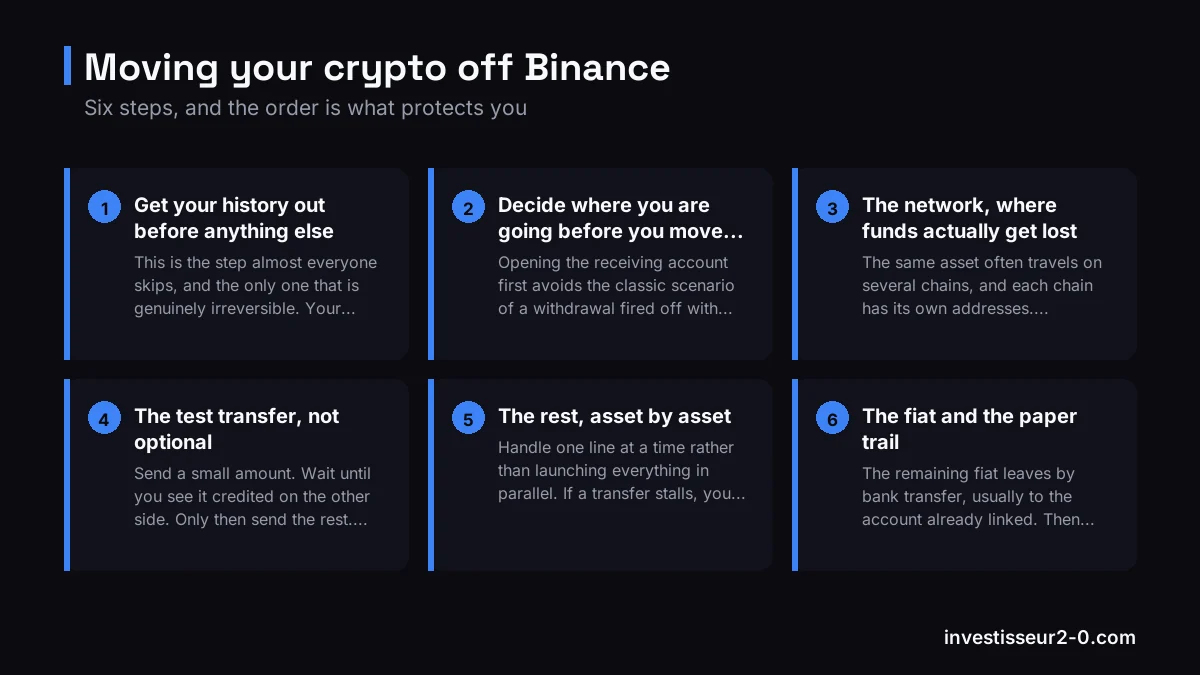
Step 3: the network, where funds actually get lost
The same asset often travels on several chains, and each chain has its own addresses. Sending a stablecoin over a chain the receiving platform does not support on that address means a deposit that never arrives and generally cannot be recovered.
The method always runs in the same direction:
- Generate the deposit address on the receiving side, for that specific asset.
- Note the network the receiving platform displays next to it.
- On the sending side, select that exact network before pasting the address.
- Check whether the asset needs a memo or tag. XRP, XLM, TON, ATOM and a few others work that way, and a deposit without one lands in a manual queue at best.
Step 4: the test transfer, not optional
Send a small amount. Wait until you see it credited on the other side. Only then send the rest. It adds ten minutes and one set of fees, against certainty that the address, the network and the memo are right. On a portfolio worth thousands, that trade is hard to argue with.
Step 5: the rest, asset by asset
Handle one line at a time rather than launching everything in parallel. If a transfer stalls, you know which one.
Then there is dust, those few-euro balances that network fees make absurd to move on their own. Convert them into a liquid asset directly on the sending platform, then move the combined amount in one operation. You pay one set of fees instead of fifteen.
Step 6: the fiat and the paper trail
The remaining fiat leaves by bank transfer, usually to the account already linked. Then archive everything that traces the operation: statements, transaction identifiers, withdrawal confirmations. A bank seeing a five-figure transfer arrive from a crypto platform asks questions, and a documented answer settles it in one exchange.
The mistakes that come up most
| Mistake | Consequence |
|---|---|
| Closing the account before exporting the history | Cost basis lost, taxable gain inflated at the eventual sale |
| Picking the network on the sending side without reading the receiving one | A deposit that never arrives, recovery rarely possible |
| Forgetting the memo on an asset that requires one | Funds held pending manual handling by support |
| Sending everything at once with no test transfer | One address mistake takes the whole balance instead of a few euros |
| Waiting until the final weeks | Support saturated, any verification snag becomes a blocker |
What about tax?
A transfer between two wallets you own is not a disposal. Under French rules the triggering event is conversion into legal tender or the purchase of goods and services, so moving your assets sets off nothing by itself, and consolidating dust into another crypto asset stays in the same neutral perimeter. Other countries treat this differently, so verify against your own.
The real tax question is the one from step 1: the history. We covered the calculation and the relevant forms in our French crypto tax guide. For a substantial portfolio or an unusual situation, a professional beats an article.
Where to actually land
Spot, derivatives and a Web3 wallet on one account, under the Malta authorisation.
Open an OKX accountOpen since 2011 with no publicly reported system intrusion, deep euro pairs.
Open a Kraken accountTo dig in before deciding: the OKX regulatory file in our reputation evaluation, the Kraken one in its own piece, and the direct comparison in OKX vs Kraken. The full regulatory context sits in our take on the Binance exit.
Frequently asked
I still have crypto on Binance, can I still withdraw it?
An orderly wind-down is designed around exactly that: withdrawals are the last function to close, well after deposits and trading. Do not read that as a comfortable deadline. Support runs thin during this phase, and a single identity-verification snag can hold a case for weeks. Handle the withdrawal now rather than in the final quarter.
Does moving my crypto trigger tax?
Moving an asset between wallets you own is not a disposal, so under French rules it is not a taxable event: tax is triggered by converting to legal tender or buying goods and services. Consolidating dust into another crypto asset stays inside that neutral perimeter too. The real tax risk is not the transfer, it is losing your acquisition history by closing the account. Rules differ by country, so check yours.
Where should you send your funds from inside the EU?
To a platform holding a MiCA authorisation, the only status that permits serving European Economic Area residents now that the transitional period has closed. OKX operates through OKX Europe Ltd, authorised by the Malta MFSA on 27 January 2025. Kraken operates through Payward Europe Solutions Limited, authorised by the Central Bank of Ireland on 25 June 2025. Unlicensed venues that still accept EU sign-ups leave you outside the European framework with no recourse in a dispute.
Licensed platform or personal wallet?
It depends on what the funds are for. If you buy, sell or rotate regularly, a licensed platform remains the right tool. If you are holding for years without touching anything, a personal wallet removes any dependence on an operator, at the cost of full responsibility for your recovery phrase. The 2026 collapse of Dutch broker Knaken, which left customers locked out of their funds, was a reminder that operator risk exists regardless of how good the service looks.
What does the transfer cost?
Two costs stack up: the withdrawal fee charged by the sending platform, and the fee of the blockchain network you route through. The second varies enormously by chain and by moment. The same stablecoin can cost several euros on Ethereum and a few cents on a lighter chain, for an identical result on arrival. Check the network before confirming, that is usually where most of the bill sits.
Transparency: OKX and Kraken are our two lead partners and both links above are affiliate links, paying us a commission at no extra cost to you. Binance is not a partner and no paid link to it appears on this page. This article describes a technical procedure, it is neither investment nor tax advice. Crypto assets can wipe out your capital.
Sources: AMF statement on the transitional period ending 1 July 2026; MFSA, Central Bank of Ireland and ESMA registers for the authorisations cited; article 150 VH bis of the French tax code for the triggering event.