Is MiCA actually bad for users? An honest scorecard
The complaint has been everywhere for a year: MiCA turned Europe into a dead zone, with fewer venues, fewer tokens and more forms. A good part of that is fair. The other side of the ledger is harder to see because it only shows up on the day something breaks. Here are both columns, without the sales pitch.
What you lost, concretely
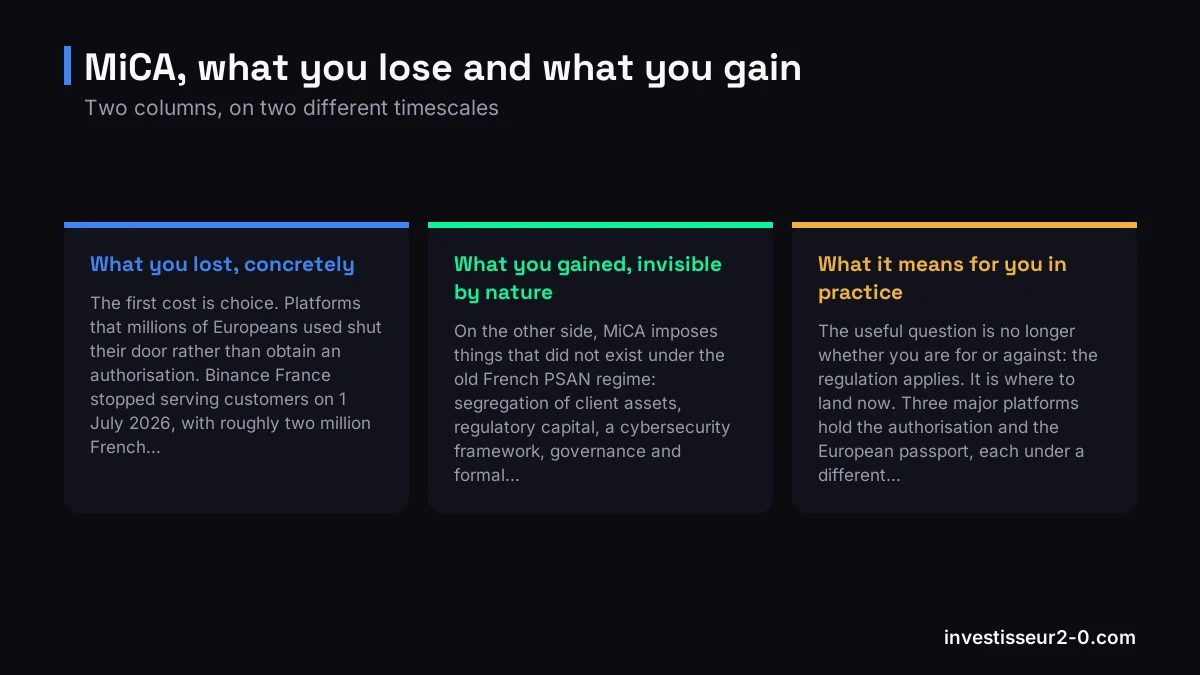
The first cost is choice. Platforms that millions of Europeans used shut their door rather than obtain an authorisation. Binance France stopped serving customers on 1 July 2026, with roughly two million French users affected. XT, BingX and MEXC are no longer open to French residents. These were not sanctions, just operators that did not clear the bar or chose not to try.
The second cost is the catalogue. Listing an asset now commits the venue that lists it, with documentation obligations and a specific regime for tokens referencing a currency. Listing broadly means multiplying control points. European catalogues therefore narrow to what can be defended in front of a regulator, and newer tokens land later than elsewhere, when they land at all.
The third cost is friction. Systematic identity checks, supporting documents, source-of-funds questionnaires. For someone who bought in three minutes back in 2017, the drop in experience is real and the irritation is understandable.
What you gained, invisible by nature
On the other side, MiCA imposes things that did not exist under the old French PSAN regime: segregation of client assets, regulatory capital, a cybersecurity framework, governance and formal conflict-of-interest management. In plain terms, your holdings must not be mixed with company funds, and an identified entity answers to a regulator you can escalate to.
The 2026 collapse of Dutch broker Knaken, which left customers locked out of their funds, shows what that column is worth. It is not a guarantee, it is a lower probability and a route to recourse. Nobody notices a disaster that did not happen, which is exactly why the debate always tilts towards the grievances.
The misunderstanding driving the argument
Many people read MiCA as a bank-style deposit guarantee. It is not one. No European mechanism automatically reimburses you if a licensed platform collapses. What the regulation changes is the probability of collapse and what happens next, not the existence of a safety net.
That misreading explains the two camps. Active traders pay the cost daily and never touch the benefit. People parking capital are buying insurance they hope never to claim. Both are right from where they stand.
What it means for you in practice
The useful question is no longer whether you are for or against: the regulation applies. It is where to land now. Three major platforms hold the authorisation and the European passport, each under a different regulator.
| Platform | European entity | Regulator | Authorised |
|---|---|---|---|
| OKX | OKX Europe Ltd | MFSA (Malta) | 27 January 2025 |
| Bybit | Bybit EU GmbH | FMA (Austria) | 28 May 2025 |
| Kraken | Payward Europe Solutions | Central Bank of Ireland | 25 June 2025 |
OKX moved earliest, close to five months ahead of the next one, and covers the widest scope of the three: spot, futures, options and a Web3 wallet inside a single app. For anyone who wants to stay inside the European framework without shrinking what they can do, that is the cheapest compromise. We broke down its European pricing in euros in the tier-by-tier fee guide and its full regulatory file in our reputation evaluation.
OKX serves EEA residents through OKX Europe Ltd under the Malta authorisation, with the widest product scope among licensed venues.
Go to OKXIf you still hold funds on a platform that is closing, the retrieval procedure is in our exit guide. And if you are wondering how much to keep online rather than in a personal wallet, that is the subject of our piece on exchange balances.
Frequently asked
Is MiCA good or bad for ordinary users?
Both, on different timescales. What you lose is immediate and visible: fewer venues reachable from Europe, a narrower token catalogue, services withdrawn and heavier onboarding. What you gain stays invisible until something breaks: an identified, supervised entity, written rules on segregating client assets, regulatory capital, and a regulator you can escalate to. That is where the disagreement comes from. Active traders pay the cost every day; people parking long-term capital are buying insurance they hope never to claim.
Why are fewer coins available in Europe since MiCA?
Because listing an asset now commits the venue that lists it. MiCA imposes documentation and compliance obligations on the assets offered, plus a specific regime for tokens referencing a currency. A licensed platform that lists broadly multiplies its control points and therefore its regulatory exposure. The mechanical result is that European catalogues narrow to what can be defended in front of a regulator, and newer or more exotic tokens arrive later, if at all.
Which platforms are still legally available inside the EU?
Those holding a MiCA authorisation passported across the European Economic Area. OKX operates through OKX Europe Ltd, authorised by the Malta MFSA on 27 January 2025. Kraken operates through Payward Europe Solutions Limited, authorised by the Central Bank of Ireland on 25 June 2025. Bybit operates through Bybit EU GmbH, authorised by the Austrian FMA on 28 May 2025. Binance France, by contrast, stopped serving customers on 1 July 2026 for lack of an authorisation, and XT, BingX and MEXC are no longer open to French residents.
Does MiCA actually protect my money if a platform fails?
It improves your position without guaranteeing it. MiCA requires segregation of client assets, meaning your holdings must not be mixed with company funds, plus regulatory capital and governance rules. This is not a deposit guarantee scheme like the one banks have: no European mechanism automatically reimburses you if a platform collapses. The difference is in probability and recourse, not in insurance. That is why splitting across two venues, or moving part of your holdings into a personal wallet, still makes sense under MiCA.
Does MiCA force me to hand over more personal data?
Onboarding is heavier than it used to be: systematic identity verification, supporting documents, questionnaires on source of funds and experience. It is the most common complaint from long-time users and it is a fair one. The counterpart is that those obligations sit on an identified European entity, subject to GDPR and to a regulator, rather than on an offshore company where you know neither where your data lives nor who to escalate to.
Transparency: OKX is our lead partner and the link above is an affiliate link, paying us a commission at no extra cost to you. Bybit is also a partner; Binance, XT, BingX and MEXC are not, and no paid link to them appears here. Crypto assets can wipe out your capital.
Sources: MiCA regulation (EU) 2023/1114; AMF statement on the transitional period ending 1 July 2026; MFSA, FMA, Central Bank of Ireland and ESMA registers for the authorisations cited.