
Maximum Drawdown in crypto trading: how to measure and limit it
A trader who says "I make +200% per year" without mentioning their drawdown is hiding the essential. Maximum drawdown is the real measure of risk, and the reason most accounts end up burned.
Must-read companion: To embed drawdown control into a global strategy, see our Integral Risk Management Guide and protect your capital with our 1% Rule Calculator.
What is maximum drawdown?
Drawdown measures the decline in your capital from its last peak to the next trough. The Maximum Drawdown (MDD) is the largest of those declines over a given period.
Concrete example: you start with $10,000. Your account climbs to $15,000, then drops to $9,000 before recovering. The drawdown over this sequence is (15,000 - 9,000) / 15,000 = 40%. That is the maximum drawdown for the period, regardless of whether the account eventually went green again.
Maximum drawdown is much more telling than return alone. A fund posting +150% over 3 years with a 70% MDD is far riskier than a fund at +80% with a 15% MDD, even if the former "performs better" on the surface.
Why drawdown destroys crypto traders
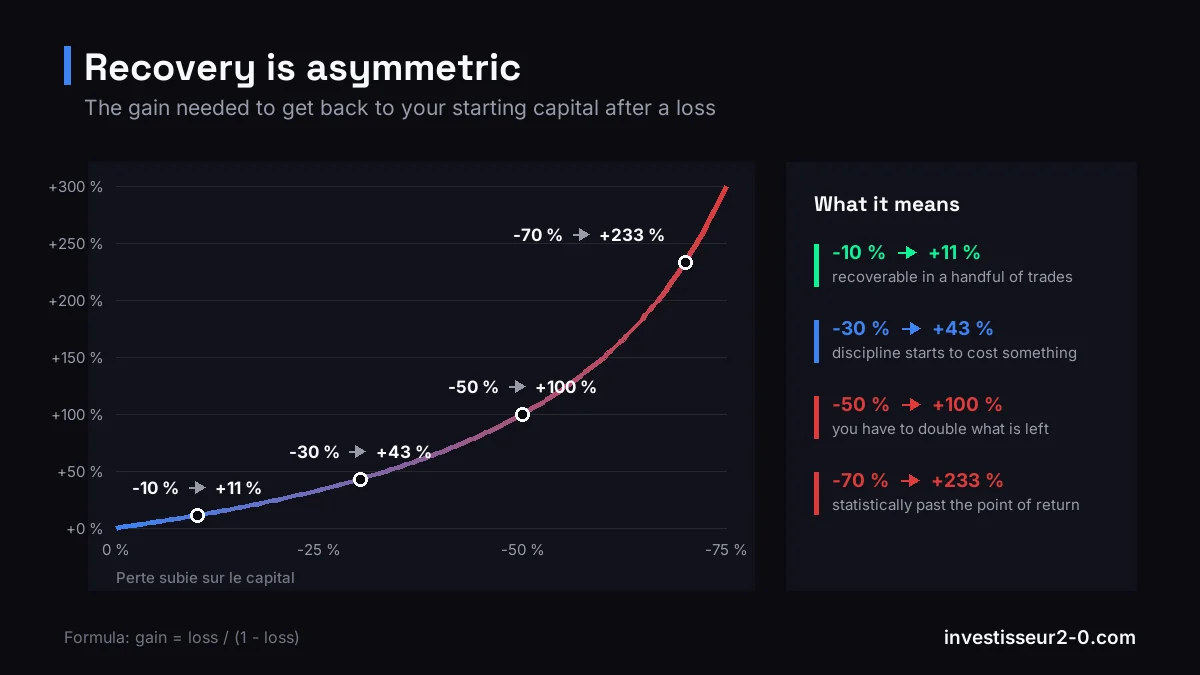
Drawdown math is asymmetric and brutal. To recover from a loss, you need a proportionally larger gain:
- 10% loss → +11% needed to break even
- 25% loss → +33% needed
- 50% loss → +100% needed
- 75% loss → +300% needed
- 90% loss → +900% needed
That is why a trader who "hopes to make it back" after a large drawdown is structurally in a losing position: they need exceptional performance just to return to breakeven. See also our article on the 7 classic crypto trading mistakes. Revenge trading after a drawdown is one of the leading causes of account destruction.
Acceptable drawdown vs catastrophic drawdown
There is no universal rule, but here are reference points from professional practice:
- 0 à 10%: very controlled drawdown. Defensive strategy or conservative capital. Common among institutional managers.
- 10 à 20%: acceptable drawdown for an active trader with a well-defined and tested strategy.
- 20 à 35%: vigilance zone. The strategy still works but psychological stress rises. Risk of bad decisions.
- 35 à 50%: danger zone. Mathematical recovery becomes very hard and emotional trading takes over.
- +50%: destruction zone. Most traders quit or burn what's left here.
In crypto, 40-60% drawdowns on the trading capital (not on the spot portfolio) are unfortunately common among traders without strict risk management rules.
4 rules to limit your drawdown
1. The 1% per trade rule
Never risk more than 1% of total capital on a single trade. With $10,000, your max risk per position is $100. Under this rule, even 10 consecutive losing trades only cost you 10%, which is recoverable. Without this rule, a few high-risk trades can trigger a catastrophic drawdown.
To calibrate risk to actual market volatility, see our ATR guide.
2. The maximum daily drawdown rule
Set a daily loss limit, typically 2-3% of capital. If you hit it before the session ends, you stop trading for the day, no exception. This rule prevents "devastating days" where you stack bad trades under emotional pressure.
3. The maximum monthly drawdown rule
Define a maximum monthly drawdown, generally 10-15% for an active crypto trader. If you reach it before month end, you switch to observation mode only (paper trading or no trading) until the next month. It's radical, but that is what separates survivors from victims.
4. Reduce sizing after a drawdown
After a 15-20% drawdown, cut your position size by 50%. This simple rule does two things: it mechanically limits drawdown deepening, and it forces you to "earn" the return to full sizing by stringing together profitable trades first.
How to compute your maximum drawdown on TradingView
If you use TradingView's Strategy Tester to backtest a strategy, MDD is computed automatically in the performance statistics. For live trading, keep a trading journal with your balance after each session. Note the peak reached and compute the drawdown from that peak, and that's your current MDD.
A trading journal is not optional. It is the foundational tool that lets you objectively measure performance and spot recurring loss patterns. Without measurement, no improvement is possible.
Drawdown and psychology: the invisible factor
A 30% drawdown does not just destroy your capital. It destroys your confidence, distorts your judgment, and pushes you into irrational behaviors (revenge trading, overtrading, premature exits on winning positions).
The answer is not to "harden up psychologically". It is to never let drawdown reach the level where psychology takes over. Strict risk management rules are a psychological tool as much as a financial one: they pull the decision out of the emotional sphere.
To understand why most traders fail at this level, see our analysis of why 90% of crypto traders lose money.