Funding rate arbitrage: market-neutral yield and its real risks
While everyone argues about where BTC goes next, some large desks run a trade that does not care. In late August 2026, several trading firms held hundreds of millions of dollars of short perpetual positions while pulling spot off exchanges. They had no view on direction; they were getting paid to hold both sides.
Crypto arbitrage, the short guide
Crypto arbitrage comes in three forms. Cross-exchange arbitrage buys an asset where it is cheaper and sells it where it is dearer; in 2026 the spreads on major pairs are closed in milliseconds by market makers, so it is not a retail trade. Triangular arbitrage cycles through three pairs on one exchange; same problem, plus fees on three legs. The one a retail trader can actually run is funding-rate arbitrage, or cash-and-carry: buy spot, short the same notional in a perpetual, and collect the funding paid by longs every eight hours. On Binance's BTCUSDT perpetual it paid about 6.82% annualised over the 30 days to 24 September 2026 and 3.40% over twelve months, with 23% of intervals negative. The rest of this guide sets it up step by step, with the break-even and the ways a hedged position still loses. Updated 19 October 2026.
Setting up the trade step by step
- Check that funding has stayed positive for a while. A single high print often reverses at the next settlement. Look for several consecutive days above zero.
- Buy spot for a defined notional, for example $10,000 of BTC.
- Short the perpetual for the same notional, 1x in exposure terms, with deliberately generous margin.
- Collect funding at every settlement, and watch two things: the sign of the rate, and the margin ratio on the short leg.
- Unwind both legs together once funding stays below the level that covers your costs.
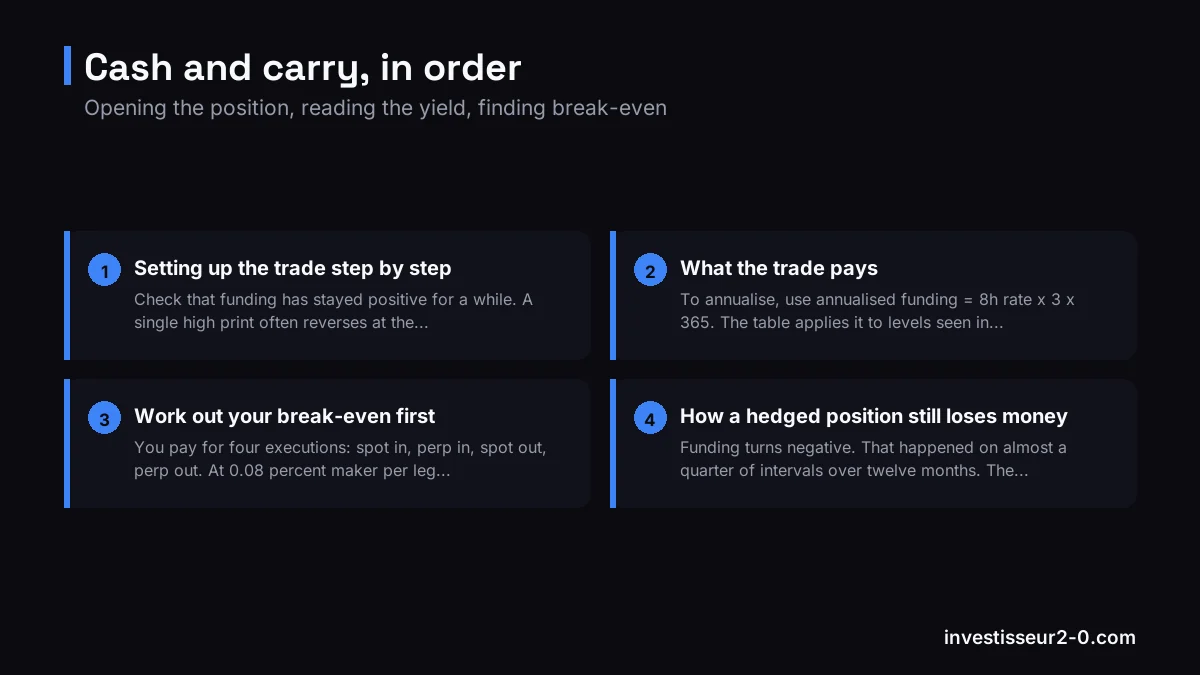
What the trade pays
To annualise, use annualised funding = 8h rate x 3 x 365. The table applies it to levels seen in the market.
| Funding rate | Annualised | Context |
|---|---|---|
| 0.010% / 8h | ≈ 10.95% | Stretched bull market, heavy leverage demand. Rarely lasts for weeks. |
| 0.006% / 8h | ≈ 6.57% | Close to the 30-day BTC average observed in late September 2026. |
| 0.003% / 8h | ≈ 3.29% | Close to the twelve-month average. Fees start to matter a lot. |
| −0.005% / 8h | ≈ −5.48% | Negative funding: the short pays. Roughly one interval in four. |
For scale, look at public data: on Binance's BTCUSDT perpetual, funding paid roughly 6.82 percent annualised over the 30 days to 24 September 2026 and 3.40 percent over twelve months, with 23 percent of intervals negative. Expect something closer to a volatile bond yield than a steady income.
Work out your break-even first
You pay for four executions: spot in, perp in, spot out, perp out. At 0.08 percent maker per leg, that is about 0.32 percent over the cycle. If you are targeting 6 percent annualised, those fees alone eat close to three weeks of funding. Holding for only a few days usually loses money.
On top of that comes the entry spread between the two legs (a few basis points if your execution is sloppy) and withdrawal costs if you have to move margin. Our fee schedule page lists the tiers you would pay.
How a hedged position still loses money
- Funding turns negative. That happened on almost a quarter of intervals over twelve months. The position keeps costing until you unwind.
- The short leg gets liquidated. A vertical rally can exhaust short margin before you top it up. You are then long spot, unhedged, usually at the worst moment.
- Counterparty risk. Both legs sit with a third party. Recent exchange failures showed that a 6 percent yield is worth little if you lose 100 percent of the deposit.
- The leverage illusion. Some pitches scale notional to advertise double-digit returns. Leverage does not change the rate; it only multiplies the probability of liquidation.
Where to run it
Keeping spot and perpetuals on one account means fewer transfers, so lower costs. OKX offers both, and its European entity OKX Europe Limited has been MiCA-licensed by the Maltese regulator since 27 January 2025 and passported across the EEA, which matters if you are based in the EU. Compare the alternatives in our OKX vs BingX vs MEXC breakdown.
Frequently asked questions
Crypto arbitrage trading guide: which type can a retail trader actually run?
Crypto arbitrage comes in three forms. Cross-exchange arbitrage buys an asset where it is cheaper and sells it where it is dearer; in 2026 the spreads on major pairs are closed in milliseconds by market makers, so it is not a retail trade. Triangular arbitrage cycles through three pairs on one exchange; same problem, plus fees on three legs. The one a retail trader can actually run is funding-rate arbitrage, or cash-and-carry: buy spot, short the same notional in a perpetual, and collect the funding paid by longs every eight hours. On Binance's BTCUSDT perpetual it paid about 6.82% annualised over the 30 days to 24 September 2026 and 3.40% over twelve months, with 23% of intervals negative. The guide below sets it up step by step, with the break-even and the ways a hedged position still loses.
How does funding rate arbitrage work?
You buy an asset in the spot market and short the same notional in a perpetual future. The two legs offset: if price rises, the spot gain cancels the short loss, and vice versa. Your return is the funding: a periodic payment from longs to shorts whenever the perpetual trades above the spot index. Most venues settle funding every 8 hours; some onchain venues settle hourly.
What annualised yield can you expect?
On Binance's BTCUSDT perpetual, funding averaged 6.82 percent annualised over the 30 days to 24 September 2026 and 3.40 percent over the full year, with 23 percent of funding intervals negative. In late August 2026 the 30-day average BTC funding rate reached 6.7 percent annualised and the 7-day average 8.7 percent. Treat it as a floating rate that resets every few hours and can go below zero, never as a fixed yield.
What are the real risks of a delta-neutral position?
There are four to watch. Funding can turn negative, in which case you pay. The short leg can be liquidated if margin is thin during a violent rally, which breaks the hedge. Execution fees, withdrawal fees and the entry spread between the two legs eat part of the yield. Finally, you keep the full counterparty risk, since the assets sit with a third party.
How is this different from a dated futures basis trade?
Classic cash and carry uses an expiring contract, so the yield is known upfront because the futures price converges to spot at expiry. With a perpetual there is no expiry: the yield depends on a rate that moves continuously. Perpetual basis swings more than three-month basis, so depending on the period one structure pays better than the other.
Go further
This article is informational and is not investment advice. A delta-neutral position is not a risk-free position: hedge-leg liquidation, negative funding and platform failure can all cause partial or total loss. This page contains an affiliate link.
Sources: Binance BTCUSDT funding data to 24 September 2026 (30-day and 12-month averages), CoinDesk, 30 August 2026, on delta-neutral positioning by trading firms, Glassnode "Annualized Perpetual Funding vs 3m Rolling Basis" methodology, MFSA MiCA register. Accessed 27 September 2026.