
Best altcoins 2026: top 7 by category
The short answer: in 2026 the most defensible altcoins are Ethereum and Solana (Layer 1), Chainlink (infrastructure), Arbitrum (Layer 2), and a few selective bets like Toncoin and Avalanche. Forget the lists of coins that will supposedly do 100x. Here is our ranked top 7 by category, with the thesis and risk level of each, and the method to judge any altcoin yourself.
Our top 7 altcoins for 2026
- 1Lower risk
Ethereum (ETH)
Layer 1The blue-chip altcoin. It powers DeFi, stablecoins and most smart contracts, has a spot ETF, and pays a 3-4% staking yield. The safest altcoin allocation, and the benchmark every other one is measured against.
- 2Medium risk
Solana (SOL)
Layer 1The fastest mainstream L1 (around 65,000 TPS, fees near $0.00025), with the most active DeFi and memecoin ecosystem. Higher upside than ETH, but also higher volatility in risk-off phases.
- 3Medium risk
Chainlink (LINK)
InfrastructureThe dominant decentralized oracle, critical plumbing for DeFi and tokenized assets. Quiet but deep institutional adoption (DTCC, Swift pilots). A bet on the infrastructure layer rather than a single app.
- 4Medium risk
Arbitrum (ARB)
Layer 2Ethereum's leading Layer 2 by activity. It cuts ETH fees drastically and benefits directly from Ethereum adoption. Token value depends on real L2 usage, which is the metric to watch.
- 5Higher risk
Toncoin (TON)
DistributionIntegrated into Telegram and its ~900M users, with mini-apps and in-app payments. A rare case of native distribution at scale. More speculative, tied to Telegram's execution.
- 6Higher risk
Avalanche (AVAX)
Layer 1Subnets aimed at enterprise and institutional use cases, with pilots from JPMorgan and several governments. Solid fundamentals, more discreet narrative, more volatile token.
- 7Higher risk
Polkadot (DOT)
InteroperabilityMulti-chain interoperability with parachains and the upcoming JAM upgrade. Technical and less hyped, with one of the higher staking yields, but the token has lagged in price.
How to evaluate any altcoin (the 5-point grid)
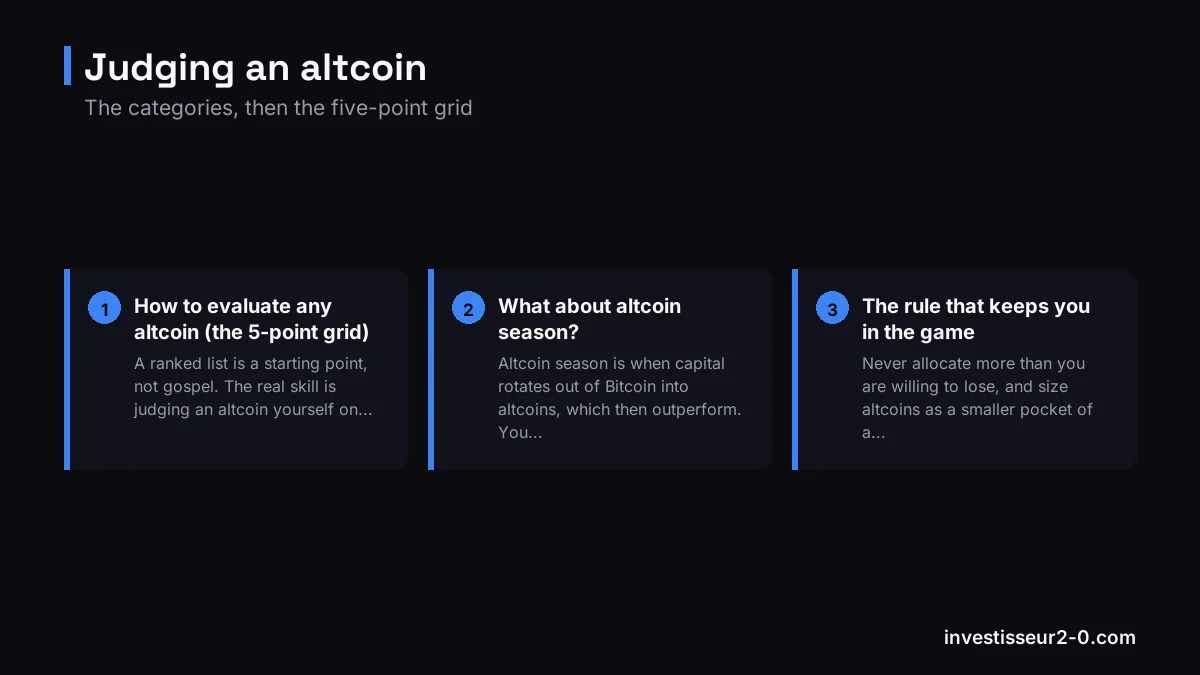
A ranked list is a starting point, not gospel. The real skill is judging an altcoin yourself on five things: real use (what the token does), liquidity(volume and where it trades), tokenomics (total supply and upcoming unlocks that can crush the price), on-chain activity and team, and maximum drawdown (how much it has already fallen). If you cannot explain why a token has value, you are gambling.
What about altcoin season?
Altcoin season is when capital rotates out of Bitcoin into altcoins, which then outperform. You read it through falling Bitcoin dominance and rising altcoin volumes, with dedicated indicators rather than gut feeling. It usually follows Bitcoin's big moves rather than leading them, so chasing it late is how most people buy the top.
The rule that keeps you in the game
Never allocate more than you are willing to lose, and size altcoins as a smaller pocket of a mostly BTC and ETH portfolio. Small and mid-caps are volatile and can fall 70 to 90% in a bad cycle. We cover the full method in our free academy.
Frequently asked questions
What are the best altcoins to buy in 2026?
There is no guaranteed list, and anyone selling you coins that will do 100x is usually selling their own bags. The most defensible altcoins in 2026 sit in clear categories: Ethereum and Solana (Layer 1), Arbitrum (Layer 2), Chainlink (infrastructure), and a few selective bets like Toncoin or Avalanche. The best altcoin is one whose use, liquidity and risk you actually understand.
How do you evaluate an altcoin before buying?
Check five things: real use (what the token is actually for), liquidity (volume and where it is listed), tokenomics (supply and upcoming unlocks that can dump the price), on-chain activity and team, and maximum drawdown. If you cannot answer why this token has value, you are gambling, not investing.
What is altcoin season?
Altcoin season is the phase when capital rotates from Bitcoin into altcoins, which then outperform BTC. You spot it through falling Bitcoin dominance and rising altcoin volumes, tracked with dedicated indicators rather than by feeling. It tends to follow Bitcoin's big moves, not lead them.
Which altcoins will explode in 2026?
No one can predict that with certainty, and explosion also means it can crash. Historically the more asymmetric bets sit in the most active ecosystems (Solana), in distribution plays (Toncoin), and in invisible infrastructure (Chainlink). Whatever you pick, never allocate more than you are willing to lose.
How much of a portfolio should be in altcoins?
For a retail investor, a common balanced split is mostly Bitcoin, a portion of Ethereum, and a smaller pocket (often 10-20%) spread across 3 to 5 selected altcoins. Beyond 5 to 10 holdings you stop being able to follow each asset and you lose focus.
Where can you buy altcoins in 2026?
Small and mid-cap altcoins are often listed earliest on exchanges like BingX and XT (800+ pairs), then MEXC for the widest catalogue, but be aware that none of these three holds a MiCA licence and they no longer take EU or French residents (July 2026). EU readers should look at MiCA-licensed venues like OKX or Bybit instead. We use our partner platforms through our links (affiliate links) for reduced fees and bonuses, and we keep strict risk management on every position.
⚠️ Educational content, not investment advice. Altcoins are highly volatile and risky; you remain solely responsible for your decisions and risk management.