
Best crypto for passive income in 2026: top 5 by yield
The short answer: for risk-adjusted passive income, stablecoin lending (4-10% APY) is the simplest pick, then staking Ethereum (3-4%) or Solana (6-7%) if you already hold majors. Passive income in crypto is real, but it is a yield against a risk, never free money. Here is our ranked top 5, the realistic yields, and where to do it.
Top 5 cryptos for passive income in 2026
- 14-10% APY
Stablecoins (USDC, USDT)
The best risk-adjusted passive income in crypto. You lend stablecoins or place them in exchange earn products and collect interest, with almost no price volatility. The catch is platform risk, not market risk, so spread across serious platforms.
- 2~3-4% APY
Ethereum (ETH)
The reference for staking on a major Layer 1. You help secure the network and earn a yield, but your ETH stays exposed to price swings. Best for holders who plan to keep ETH long term anyway.
- 3~6-7% APY
Solana (SOL)
Higher staking yield than ETH, on a fast and very active network. Higher reward comes with higher volatility: SOL can swing hard in a risk-off phase while you collect rewards.
- 4~2-5% APY
BNB (BNB)
Simple staking and earn products inside a large exchange ecosystem. Modest yield, real use case (fee reduction), but sensitive to regulation. A small allocation for diversification.
- 5~10-12% APY
Polkadot (DOT)
One of the higher staking yields among established L1s, but the token is more volatile and less hyped. High APY never comes for free: part of that yield offsets inflation and price risk.
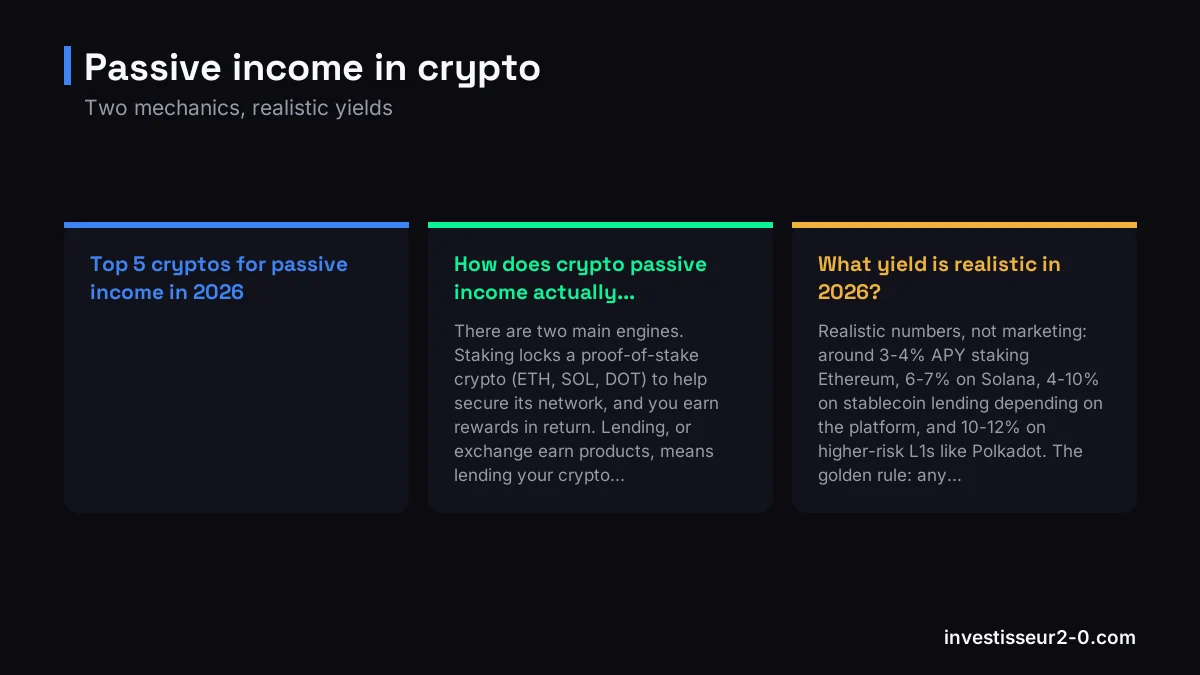
How does crypto passive income actually work?
There are two main engines. Staking locks a proof-of-stake crypto (ETH, SOL, DOT) to help secure its network, and you earn rewards in return. Lending, or exchange earn products, means lending your crypto (usually stablecoins) for interest. Both pay a yield, both carry risk. The difference is what you are exposed to: a staked token keeps its price risk, a stablecoin keeps its value but adds platform risk.
What yield is realistic in 2026?
Realistic numbers, not marketing: around 3-4% APY staking Ethereum, 6-7% on Solana, 4-10% on stablecoin lending depending on the platform, and 10-12% on higher-risk L1s like Polkadot. The golden rule: any offer promising 20% or 50% guaranteed is a red flag. High yield is never free, it always prices in a risk you may not see.
Which is better, staking or stablecoin lending?
It depends on the risk you accept. Stablecoin lending gives a steadier return with low price volatility, but you depend on the platform staying solvent. Staking a major L1 pays more and keeps your upside, but the token can fall while you collect rewards. A common balanced setup: stablecoins for the stable base, staked ETH or SOL for growth plus yield.
The risks you should never forget
Price risk (your staked token can lose more than the yield pays), platform risk (insolvency, hack, frozen withdrawals) and lock-up risk (funds immobilized for a set period). Yield does not cancel any of these. Spread across serious platforms, keep most of your long-term capital in a personal wallet, and never stake money you might need at short notice.
Frequently asked questions
What is the best crypto for passive income in 2026?
For risk-adjusted passive income, stablecoins (USDC, USDT) via lending or exchange earn products are the simplest choice: 4 to 10% APY with very little price volatility. If you already hold majors long term, staking Ethereum (around 3-4%) or Solana (around 6-7%) adds yield on top of assets you keep anyway.
What is the difference between staking and lending?
Staking means locking a proof-of-stake crypto (like ETH or SOL) to help secure its network in exchange for rewards. Lending means lending your crypto, often stablecoins, in exchange for interest. Staking keeps you exposed to the token's price; stablecoin lending keeps your value stable but adds platform risk.
How much yield can you realistically expect in 2026?
Realistic ranges in 2026: around 3-4% APY staking Ethereum, 6-7% staking Solana, 4-10% on stablecoin lending depending on the platform, and 10-12% on higher-risk L1s like Polkadot. If a platform promises 20% or 50% guaranteed, treat it as a red flag: that is almost always hidden risk or a scam.
Is crypto passive income risk-free?
No. You keep price risk (a staked token can lose more value than the yield pays), platform risk (insolvency, hack, frozen withdrawals) and sometimes lock-up risk (your funds are immobilized for a period). Yield never cancels these risks, so never put in capital you need.
Which is better for passive income, staking or stablecoin lending?
It depends on the risk you accept. Stablecoin lending gives a steadier, lower-volatility return but exposes you to the platform. Staking a major L1 pays more and keeps you exposed to upside, but the token price can fall. Many investors combine both: stablecoins for stability, staked ETH or SOL for growth plus yield.
Do you pay tax on crypto staking rewards?
In most countries, staking and lending rewards are taxable as income when received, and selling later can trigger capital gains tax. Rules vary widely by country, so keep a record of every reward and check your local tax treatment. This is not tax advice.
Where can you stake or lend crypto safely in 2026?
Use licensed exchanges with strong track records, and never keep all your capital in one place. In the EU, the MiCA-licensed options include Kraken, OKX, Bybit and Pionex (via its EU entity Pionew Ireland). Outside the EU, our partner platforms (MEXC, BingX, XT) unlock bonuses and reduced fees via our links; note they stopped serving EU residents in July 2026. Withdraw what you do not need to actively use into a personal wallet.
⚠️ Educational content, not investment or tax advice. Yields are not guaranteed and capital is not protected; you remain solely responsible for your decisions.