
Institutional liquidity in crypto: SSL, BSL and equal highs/lows (SMC 2026)
The majority of retail traders lose because they ignore a fundamental reality: crypto markets do not move randomly, they move toward liquidity. Understanding where it sits, how to distinguish it (SSL, BSL, equal highs/lows) and who hunts it means understanding the real market mechanics, the ones institutional desks (Wintermute, Jump, GSR) exploit every day on BTC and ETH.
1. What is institutional liquidity?
In institutional trading, liquidity refers to zones where resting orders concentrate: retail stop losses, swing trader limit orders, breakouts anticipated by algos. These zones sit above recent highs and below recent lows, exactly where retail places its stops, and exactly where market makers need to execute.
An institutional desk that needs to buy $50M of BTC can't stack market orders: price would slip several percent against them. They need available counterparty, so they push price toward a zone where those orders already exist. That is the fundamental mechanic of a sweep.
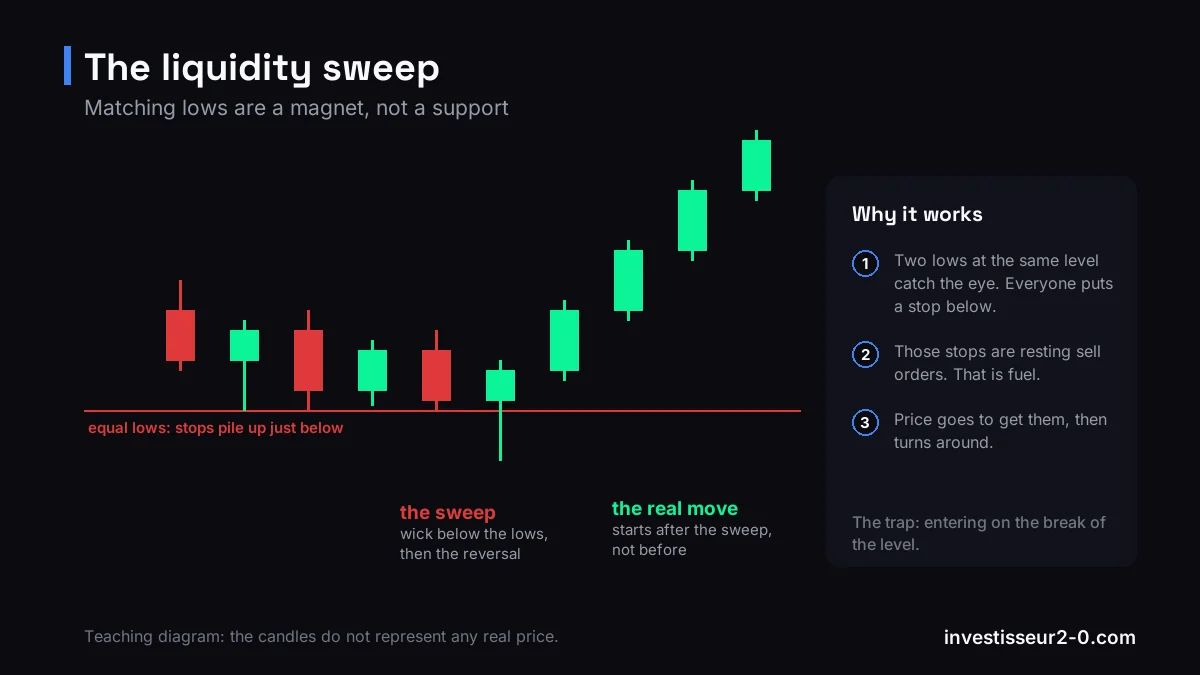
2. SSL vs BSL: the two sides of liquidity
ICT / SMC terminology distinguishes two types of liquidity, depending on the side of the order book:
- SSL (Sell-Side Liquidity): below a low. Mainly stop losses of long positions and pending short orders. MMs hunt SSL before a rally: they break the low, trigger the stops (which become market sell orders), absorb that selling, then reverse.
- BSL (Buy-Side Liquidity): above a high. Short stop losses + breakout orders. MMs hunt BSL before a decline: they break the high, trigger short stops (market buy orders), distribute their position, then reject.
Mnemonic rule: price will hunt BSL before dropping and SSL before rallying. Counter-intuitive for retail, logical for institutions.
3. Equal highs / equal lows: liquidity magnets
Equal highs (perfect double top) and equal lows (perfect double bottom) are configurations where two tops or two bottoms point to the same price level. It's one of the most powerful SMC signals because retail reads them as resistance / support zones, and massively places stops there.
Result: above equal highs, a huge pocket of BSL forms. Institutions know this zone contains the orders they need. Nine times out of ten, the market will go grab them before reversing. An un-swept equal high in a bullish swing is a near-certainty as a short-term target.
4. Concrete example: SSL sweep on Bitcoin (D1)
Configuration observed early April 2026. BTC corrects from an ATH and creates a low at $58,200. That low bounces, price rallies to $62,000, then consolidates. Shorts who sold the rejection place stops just above $62,000; longs who bought the low place stops below $58,200.
Step 1: price pushes to $57,900, a sweep of SSL below $58,200. Long stops trigger, the market prints a $300 low wick then closes above $58,500. Rejection confirmed.
Step 2: bullish displacement within the next 3 candles. Price crosses the FVG left by the wick, rallies above $62,000 to hunt the BSL this time (short stops). Possible entry on the close of the rejection candle, stop below $57,900, target $62,500+ → R:R ≈ 1:3.
5. Concrete example: double BSL sweep on Ethereum (H4)
Ethereum trades in a range between $3,200 and $3,520. Two prior tops form at $3,518 and $3,522, a near-perfect equal high. Retail sees solid resistance and sells.
Price pushes to $3,548 ($28 BSL sweep above the equal highs), prints a wick, closes at $3,495. Within the next 4 candles: drop to $3,280 to hunt internal SSL of the range. An attentive SMC trader could have shorted the rejection close (~$3,495), stop at $3,560, target $3,300 → R:R ≈ 1:3.
6. Internal vs external liquidity: the institutional sequence
External liquidity sits at HTF structural extremes (D1, W1 highs and lows). Internal liquidity sits inside a range, on minor M15/H1 highs/lows.
Typical institutional accumulation-distribution sequence:
- Market consolidates, MMs hunt internal liquidity to accumulate a position.
- Impulsive displacement that breaks structure (BOS).
- Market then targets external liquidity, where the position unwinds.
- Major reversal once external liquidity is touched.
Identifying this sequence provides the timing edge and explains why obvious retail breakouts fail so often.
7. Methodology: how to map liquidity
Our process at Investisseur 2.0, applied before every setup:
- Top-down D1 → H4 → M15. Map HTF zones first: last weeks' highs/lows, obvious equal highs/lows.
- Mark SSL and BSL in two distinct colors. Visualize where your own stops sit, since you are often the target.
- Wait for sweep + displacement. No trade until the rejection is validated.
- Identify the order block / FVG that serves as the entry zone after the sweep.
- Stop beyond the sweep, size calibrated by the 1% rule and ATR.
- Target: opposite liquidity (R:R minimum 1:2, ideal 1:3).
8. Common mistakes to avoid
- Confusing wick and sweep. A wick without opposite displacement is just a failed breakout, not a valid SMC signal.
- Trading without structural context. An SSL sweep in a confirmed downtrend is not a buy signal; it's often the pause before the decline continues.
- Ignoring the higher timeframe. Liquidity is only useful top-down: D1 for context, H4 for zone, M15 for entry.
- Overtrading low-cap altcoins. Wash trading (Cong et al., 2022: 30 to 70% of reported volume on some unregulated exchanges) produces false sweeps. Filter with OBV and real volume.
FAQ: institutional crypto liquidity
What is institutional liquidity in crypto?
These are chart zones where resting orders concentrate (retail stops, limit orders, anticipated breakouts). Market makers and institutional desks push price there to execute large positions without excessive slippage.
What's the difference between SSL and BSL?
SSL (sell-side liquidity) = liquidity below a low, mainly long stops. BSL (buy-side liquidity) = liquidity above a high, short stops. Institutions hunt BSL before a decline and SSL before a rally.
What are equal highs and equal lows?
Two (or more) tops / bottoms at the same price level. Retail massively places stops there, making them liquidity magnets, priority targets for institutional sweeps.
How do I identify a liquidity sweep on Bitcoin?
Three elements: sharp wick beyond a significant high/low, close that returns inside the range (rejection), impulsive opposite displacement within the next 1-3 candles. Without displacement, it's a breakout, not a sweep.
Does liquidity work on all cryptos?
Yes, but signal quality depends on volume. BTC/ETH offer very reliable sweeps. On low-cap altcoins, wash trading can create false sweeps, so cross-checking with OBV, volume delta and top-down context is indispensable.
Internal or external liquidity, which to trade?
The institutional sequence: hunt internal first to accumulate, then external to distribute. Trading external after confirmation gives the best R:R but requires patience.
Can you trade liquidity without full SMC?
No. It must be combined with market structure (BOS/CHoCH), order blocks and FVGs to validate an entry zone. See our Smart Money Concepts pillar.
Julien & Cedric publish daily the SSL / BSL levels and equal highs/lows monitored on BTC, ETH, SOL. 100% free access via Telegram.
Join the channelMarking SSL and BSL zones only pays if your venue has the depth to fill you there. The exchanges we use, and the member fee tiers, are one page away.
Check the venues we use