
Crypto market makers: stop hunts, price manipulation and how to adapt (SMC 2026)
"The market took my stop then went my way." If you've ever experienced this, you were hit by a market maker. It's not bad luck. It's a precise, repeatable, and understandable mechanism within the Smart Money Concepts framework.
Complete guide by Julien & Cedric of Investisseur 2.0: who are crypto market makers (Wintermute, Jump, GSR, whales, exchange desks), their 4 manipulation mechanics, concrete examples on BTC and ETH, method to trade with them, FAQ.
The order book: the market maker constantly posts bids and asks, and pockets the spread.
Who are crypto market makers?
In traditional financial markets, market makers are licensed entities that commit to providing liquidity continuously, both on the buy and sell side. They earn primarily on the spread between bid and ask.
In crypto, the term is broader and more opaque. "Market makers" in the practical trading sense include:
- Professional market-making firms (Wintermute, Jump Crypto, GSR, Cumberland, B2C2): they provide liquidity to centralized exchanges for compensation and have access to tools, data, and execution latencies that retail simply doesn't. These are the most sophisticated players.
- Large whales (wallets holding hundreds or thousands of BTC): their moves create volatility and exploit the liquidity of smaller players. They have no contractual market-making obligation, but their sheer order size impacts the book.
- Exchange proprietary desks: some exchanges (historically documented cases on FTX, early Binance US, and several Asian exchanges) have internal trading desks with real-time order book access, a considerable advantage, subject to recurring criticism from the SEC and other regulators.
The fundamental mechanism: why they need YOUR liquidity
Imagine a market maker wants to buy 500 BTC at the current price. If they place a 500 BTC market order on Binance, they move the price against themselves dramatically (massive slippage, sometimes 1 to 3%). They therefore need to find liquidity without moving price against themselves.
Their solution: trigger other traders' stops to create the liquidity they need. The mechanism in practice:
- BTC consolidates between $85,000 and $88,000. Everyone sees this range. Buyers place their stops just below $85,000 ("round number" + visible support). Short sellers place their stops just above $88,000.
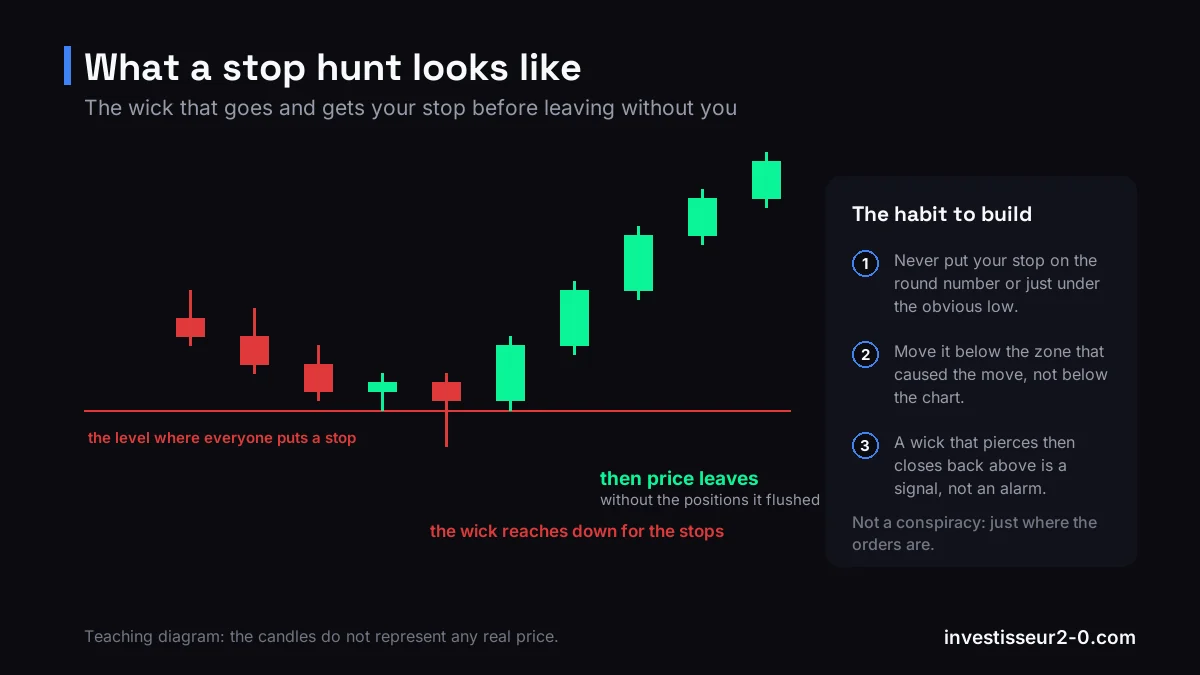
- The market maker wants to buy massively. They start by selling artificially (or stopping their buying) to push price below $85,000, triggering a cascade of long stops, which automatically become additional market sell orders.
- This cascade of sells temporarily depresses price to say $84,200, and that's where they buy massively at a low price, in the liquidity that stops generated.
- Immediately after absorbing this liquidity, price rallies. Traders whose stop was hit at $84,950 watch, helplessly, as BTC climbs back to $87,000 without them.
This is a stop hunt. And it's precisely what we describe in our article on institutional liquidity and why liquidity is the only indicator you need.
The 4 most common manipulation patterns
1. The stop hunt
Described above. The characteristic pattern: a candle wick briefly below an obvious support (or above an obvious resistance) then immediately returns into the range. This wick is the visual signature of a stop hunt. On low timeframes (M5, M15), we sometimes see 3 to 5 stop hunts per week on BTC.
The defense: place your stops beyond 1.5× to 2× ATR, not just below the visible support. See our ATR guide. A stop too close to an obvious level is an invitation to get stop hunted.
2. The false breakout (liquidity grab)
BTC breaks a major resistance with an impressive candle. FOMO traders go long. Price immediately falls back below the resistance, trapping all breakout buyers. In reality, the "break" was designed to generate buy-side liquidity, which the market maker uses to sell their position.
The sign of a false breakout: abnormally low volume on the breakout candle, quick close back below the resistance, no continuation in the following 3-5 candles. This is one of the most used mechanics to trap traders who "chase the breakout" without waiting for a retest.
3. Wash trading
On some less regulated exchanges, entities artificially create volume by buying and selling simultaneously between their own accounts. Goal: inflate a token's apparent volume to attract retail investors, then sell into their demand. Academic studies (Cong et al. 2022) estimate that 30 to 70% of the volume declared by some unregulated exchanges is wash trading.
The defense: trade on exchanges with serious volume verification and cross on-chain data with order book data rather than relying solely on an exchange's volume display.
4. Sentiment manipulation
Large whales and some firms influence media, social networks, and Telegram groups to create FOMO or panic according to their interests. "BTC going to $200K this week" or "imminent crash": these narratives serve their positions, not yours. The typical pattern: massive media announcement followed by a move contrary to the narrative a few hours later.
The defense: ignore predictions and focus on market structure, order blocks and liquidity. Price doesn't lie; influencers do.
Concrete example: stop hunt on Bitcoin H1
A typical scenario regularly observed on BTC/USDT. Price consolidates between $66,000 and $68,500 for 3 days. A very obvious support forms at $66,000 (round number, multiple touches). Retail traders place their stops massively at $65,950 (just below the support). The funding rate goes positive, signaling that longs are over-leveraged.
Outcome: an H1 candle briefly pierces $65,800 (a $200 wick below the support), triggering the stop cascade. Price immediately rallies to $67,200 in the following 2 hours. Stopped traders watch BTC climb without them. On the order book, we observe a punctual volume spike at that exact moment, the signature of a market maker absorbing the liquidity.
Concrete example: false breakout on Ethereum
Typical case on ETH/USDT H4. A resistance forms at $3,800 (double top, very visible). Bullish sentiment is strong, analysts announce "imminent break toward $4,200". An H4 candle breaks $3,800 with a high at $3,845 but closes at $3,795, below the resistance that was supposedly broken, with decreasing volume.
Breakout buyers are trapped. In the following 48 hours, ETH falls back to $3,550. The pattern would have been identifiable in real time by an SMC trader: insufficient volume on the breakout candle + no FVG created + resistance high stop hunt = classic liquidity grab, not a real breakout.
How to trade WITH market makers rather than against them
The good news: market makers leave predictable footprints. Understanding their mechanics allows you to position yourself in their direction, not against them.
Anticipate sweeps
Identify the zones where stops accumulate (equal lows, equal highs, very visible supports and resistances, round numbers like $66,000, $70,000, $4,000). These zones are the next targets of market makers. Instead of placing your stops there, wait for the sweep then enter in the opposite direction. This is the heart of our institutional liquidity approach.
Read order blocks as traces of their activity
Order blocks are precisely the zones where market makers built their positions. When price returns to test these zones, market makers defend their entry price, which creates the bounces we trade. A fresh OB on H4 or Daily, confluenced with a liquidity zone, is a priority setup.
Use Fair Value Gaps
FVGs are the imbalances left by market makers' fast moves. These zones are statistically revisited because market makers return to source their liquidity. It's an actionable edge, particularly in confluence with an OB or liquidity zone.
What you can't control, and how to accept it
Despite all this knowledge, you will sometimes get caught in a stop hunt. It's inevitable. Even professional traders get taken out by unexpected sweeps (unforeseen macro decisions, cascade liquidations, fat fingers from a major player).
What separates a good trader from a bad one is not avoiding 100% of bad exits. It's managing the loss when it comes (1% risk per trade rule, no revenge trading, respecting the maximum drawdown) and staying in the game long enough for probabilities to work in your favor over time.
FAQ: Crypto market makers
What is a stop hunt?
A stop hunt is a price move deliberately pushed by a large player to trigger stop losses accumulated below an obvious level, in order to generate the liquidity needed for a massive execution. Pattern: brief wick below the support (or above the resistance) then immediate return into the range.
How do I avoid getting stop hunted?
Place your stops 1.5× to 2× ATR beyond obvious levels, not right on them. Avoid tight stops on highly volatile cryptos. And above all, trade IN the direction of sweeps (SMC methodology) rather than hoping the market will respect your naive levels.
Can market makers really manipulate Bitcoin?
On short intraday timeframes, yes (1 to 3%). On longer timeframes, pure manipulation becomes economically difficult because BTC has too much liquidity and too many independent participants. On low-cap altcoins, manipulation is far easier.
What is a false breakout?
A resistance/support break that fails immediately after triggering FOMO traders' orders. The market maker uses the apparent impulse to sell (or buy in a short squeeze) then lets price fall back. Signs: low volume on the break, quick close back below the broken level.
How do I trade WITH market makers?
Three complementary SMC approaches: anticipate sweeps by identifying liquidity zones; read order blocks as traces of their activity; use Fair Value Gaps as statistically revisited entry zones.
Summary
Crypto market makers are not your enemies. They're simply rational actors who exploit the liquidity and information asymmetry with retail. Rather than railing against their manipulations, learn to read their footprints: sweeps, order blocks, Fair Value Gaps, false breakouts. This shift in perspective is the heart of the Smart Money Concepts, and it's the only durable way to trade at the same level as big capital.
Disclaimer. This article is educational. Nothing we publish constitutes investment advice. Trading involves a risk of capital loss. Learn the method, test it on a demo account, and never risk more than you can afford to lose.