
Bybit EU turns into a payment institution
A crypto exchange picking up a neobank-grade licence deserves a closer look. On 4 August 2026, Bybit Payments GmbH announced its authorisation as an electronic money institution, granted by the Austrian regulator. For the customer, nothing has moved on screen yet. For the platform's trajectory in Europe, everything has. Here is what the licence allows, what it does not guarantee, and what will show up in the app.
Disclosure: Bybit is one of our partners and the account link is an affiliate link. The facts quoted come from the official Bybit.eu release of 4 August 2026 and the FMA register.
Two Austrian companies, two rulebooks, one regulator
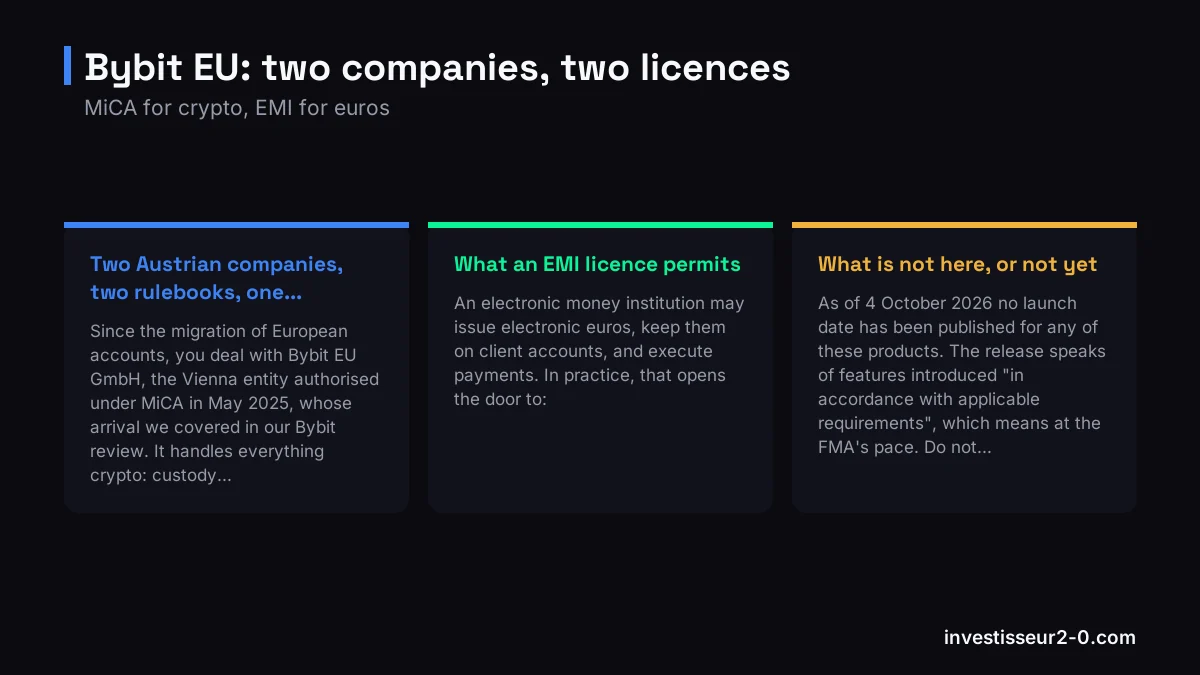
Since the migration of European accounts, you deal with Bybit EU GmbH, the Vienna entity authorised under MiCA in May 2025, whose arrival we covered in our Bybit review. It handles everything crypto: custody, exchange, order book.
The EMI licence is held by a different company, Bybit Payments GmbH. Same shareholder, same city, a different scope: electronic money and payment services. Both are supervised by the FMA, Austria's Financial Market Authority, under two separate texts, MiCA on one side and the e-money directive on the other. The user sees a single screen.
What an EMI licence permits
An electronic money institution may issue electronic euros, keep them on client accounts, and execute payments. In practice, that opens the door to:
- Peer-to-peer payments in euros, inside the platform.
- Open banking, meaning linking your bank accounts to fund or read your balance without leaving the app.
- Merchant payment services, so businesses can accept settlement from a Bybit account.
- A card, mentioned as a future initiative in the release.
- Strong customer authentication, a regulatory obligation for payment services.
Georg Harer, managing director of both companies, summed up the ambition at launch: Europe is setting the global benchmark for how digital assets and financial services can evolve together under clear regulation. Bernhard Krick, managing director of Bybit Payments, added that the licence lets the company build regulated payment capabilities that complement crypto-asset services.
What is not here, or not yet
As of 4 October 2026 no launch date has been published for any of these products. The release speaks of features introduced "in accordance with applicable requirements", which means at the FMA's pace. Do not look for the card or P2P payments in your app: they are not there, and we will update this page when they are.
The licence also has to be read for what it is not. An EMI is not a bank. Your euros do not fall under the EUR 100,000 bank deposit guarantee. What the licence imposes is safeguarding: client funds must sit on accounts segregated from the institution's own, so that a failure of Bybit Payments does not take them down with it. It is serious protection; it is not the same kind.
Why an exchange chases a payment licence
The answer fits in one sentence: keep the money in the app. Today a European customer's cycle is to wire euros from their bank, buy, sell, then withdraw back to the bank. Every exit is a chance not to come back. An account that lets you spend, receive a transfer or pay a merchant removes that detour.
That is the financial super-app model, and Bybit is not alone on it: the large authorised players in Europe stack licences in the same order, MiCA first, payments next. For the user, competition on that ground is good news, on one condition: do not mistake the convenience of an all-in-one account for a reason to leave more there than needed. Our rule on what to keep online applies to euros as much as to crypto.
What it weighs when choosing a platform
On fees, Bybit EU sits in the middle of the authorised pack, as detailed in our OKX vs Bybit comparison. On regulation, it is now the only player in our selection combining a MiCA authorisation and an EMI licence in the same jurisdiction. OKX, for its part, chose another ground with its account protection of up to EUR 100,000. Two different strategies for the same goal: giving a European customer, who now has several authorised platforms to pick from, a reason to stay.
EU residents are onboarded on the authorised European entity; KYC takes a few minutes and euro deposits arrive by bank transfer. Payment services will be added to that same account once launched.
Create my Bybit accountAffiliate link. Bybit EU GmbH is authorised under MiCA by the Austrian FMA. Crypto-assets are volatile: only commit what you can afford to lose.
⚠️ Educational content, not investment advice. The payment products described are announced, not launched: the official Bybit.eu page prevails.
FAQ
What is an EMI licence?
EMI stands for electronic money institution. It is the authorisation that lets a company issue electronic money and provide regulated payment services across the EU: accounts, transfers, cards, peer-to-peer payments. It is the same type of licence neobanks hold, not a crypto licence.
Which Bybit entity holds the licence?
Bybit Payments GmbH, an Austrian company separate from Bybit EU GmbH. The former received the EMI licence from Austria's Financial Market Authority, the FMA, announced on 4 August 2026. The latter has held the MiCA authorisation for crypto-asset services since May 2025. Two entities, two rulebooks, one screen for the user.
What changes for an EU customer in practice?
Nothing visible yet. The licence sets the frame; the announced products, peer-to-peer payments, open banking, merchant services and a card, will arrive over the coming months with no public date as of 4 October 2026. What changes today is the nature of the counterparty: Bybit EU can hold your euros under a payments regime rather than as a plain crypto counterparty.
Are my euros on Bybit EU guaranteed like at a bank?
No. Bank deposit guarantee schemes do not apply to an electronic money institution. An EMI must however safeguard client funds on accounts segregated from its own, which protects them if the institution fails. It is real protection, but of a different kind.
Does Bybit EU keep its MiCA authorisation?
Yes. The MiCA authorisation of Bybit EU GmbH, granted by the Austrian FMA in May 2025, is unaffected. The EMI licence sits alongside it, for the payments and e-money side. Both authorisations passport across the EU.
Why does an exchange want to be a payment institution?
So the money stops leaving the platform. A customer who can spend, transfer and receive euros from their Bybit account no longer needs to withdraw to their bank between trades. That is the financial super-app model, and it explains the race for EMI licences among the large European exchanges.