
Best cold wallets in 2026: Ledger vs Trezor vs Tangem
After the summer of 2026, a well-known logo on the case should not reassure you much. When you buy a hardware wallet, you are trusting how it generates keys, where it stores them, what the screen shows before you approve, and how you recover your funds if the device goes missing.
What changed in July 2026
In late July 2026, a dormant random-number-generator flaw on Coldcard devices (another maker, unrelated to the three brands compared here) allowed recovery phrases to be reconstructed remotely. Roughly 594 BTC, about $38 million, was drained from around 500 wallets in a single night, and the running total tracked by analysts later approached 1,816 BTC, close to $116 million, across more than 5,200 addresses. No device was physically touched.
Ledger, Trezor and Tangem were not affected. The lesson still applies to them: pick a wallet by asking how it is built and whether you can check that, rather than how famous the brand is.
Ledger, Trezor and Tangem compared
| Criterion | Ledger | Trezor | Tangem |
|---|---|---|---|
| Flagship model | Flex ($249) / Stax ($399) | Safe 5 ($129 to $169) / Safe 7 ($249) | Wallet 2.0 (≈ $55) |
| Secure element | ST33K1M5, CC EAL6+ | OPTIGA Trust M V3, EAL6+ (Safe 7: TROPIC01) | Samsung chip, CC EAL6+ |
| Recovery phrase | 24 words (opt-in recovery service) | 12 to 24 words + Shamir backup | None: backup via 2 or 3 cards |
| Connectivity | USB-C, Bluetooth, NFC | USB-C (plus microSD on Safe 5) | NFC only (tap to phone) |
| Open source | Partial (OS partly closed) | Open-source firmware, closed secure element | Partially open |
| Supported assets | 15,000+ | ≈ 1,000 native, more via third-party apps | 6,000+ |
| Mobile | iOS and Android (Bluetooth) | Android full, iOS view-only | iOS and Android (NFC) |
| Best for | Large portfolios, frequent DeFi, mobility | Transparency and advanced backup | Beginners, backup device, tight budget |
Prices taken from the manufacturers' own stores in September 2026, in US dollars. They move with promotions and local taxes.
Ledger: the most assets supported, partly closed code
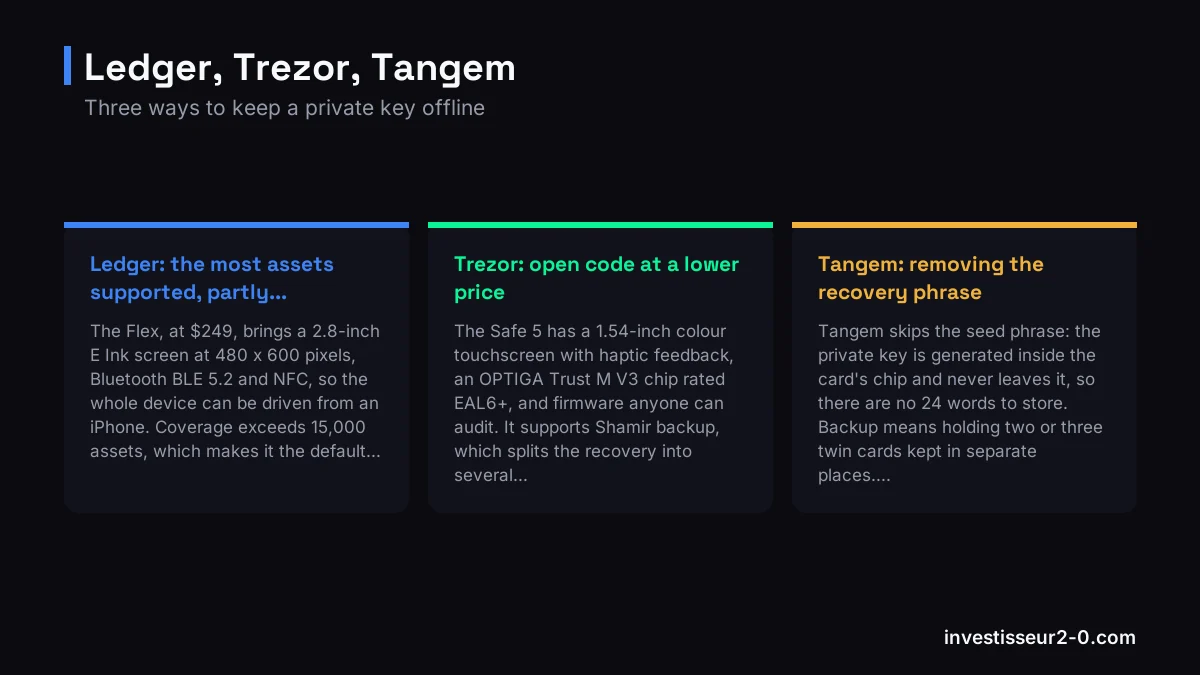
The Flex, at $249, brings a 2.8-inch E Ink screen at 480 x 600 pixels, Bluetooth BLE 5.2 and NFC, so the whole device can be driven from an iPhone. Coverage exceeds 15,000 assets, which makes it the default pick if you hold many long-tail tokens or interact often with decentralised applications. The downside is well documented: the operating system is not fully open.
Trezor: open code at a lower price
The Safe 5 has a 1.54-inch colour touchscreen with haptic feedback, an OPTIGA Trust M V3 chip rated EAL6+, and firmware anyone can audit. It supports Shamir backup, which splits the recovery into several shares where a subset is enough to restore, so losing one sheet of paper no longer locks you out. The limits: USB-C only, and iOS support restricted to viewing. The Safe 7, at $249, adds post-quantum readiness.
Tangem: removing the recovery phrase
Tangem skips the seed phrase: the private key is generated inside the card's chip and never leaves it, so there are no 24 words to store. Backup means holding two or three twin cards kept in separate places. If you know you tend to lose pieces of paper, that is statistically safer than the best chip paired with a badly stored seed. What you give up: there is no screen, so you check transaction details on your phone, and the code is only partially open.
Mistakes that cost people their coins
- Photographing or storing the recovery phrase. A screenshot, a cloud note or a message to yourself undoes everything the device protects.
- Approving without reading. Most 2026 losses came from contract allowances signed too quickly, with the hardware working as designed. Revoke allowances regularly and keep a dedicated address for risky interactions, especially if you farm airdrops (see our Sybil filters guide).
- Buying anywhere but the manufacturer. Marketplaces, unknown resellers, second-hand units: a few dollars saved do not cover the risk of a pre-initialised device.
Which one we would buy
With a large portfolio that you use often, go for the Ledger Flex, which handles the most situations. If you care about auditability and backup design, the Trezor Safe 5 gives you more for $80 to $120 less. For a first device or a spare, Tangem costs under $60 and removes the most common point of failure, a badly stored recovery phrase. Any of the three beats leaving your coins on an exchange because it is convenient.
Frequently asked questions
Which cold wallet should you pick in 2026?
It depends on how you use it. For mobile, multi-chain use with frequent DeFi activity, a touchscreen and Bluetooth device like the Ledger Flex ($249) covers the widest asset range, over 15,000. If auditable code and advanced backup come first for you, the Trezor Safe 5 ($129 to $169 depending on the store) has open-source firmware and supports Shamir backup. For a beginner who fears losing a recovery phrase, Tangem (around $55) removes the seed entirely: the key is created inside the chip and never leaves it, with backup handled by two or three NFC cards.
Does an EAL6+ secure element guarantee safety?
No. The certification covers how well the chip resists physical key extraction. It says nothing about the rest of the product. The large July 2026 theft on Coldcard devices (a different maker, unrelated to Ledger, Trezor or Tangem) showed this: a random number generator that had quietly fallen back to a predictable software routine since a 2021 build let seeds be reconstructed remotely. About 594 BTC were drained in one night, and the running total tracked by analysts approached 1,816 BTC, close to $116 million, across more than 5,200 addresses. No device was ever touched physically.
Can you buy a hardware wallet second-hand or from a marketplace?
Do not. With a pre-initialised or tampered device, someone else may already know the private key. Buy from the manufacturer's official store, and make sure setup generates a fresh recovery phrase on the device itself. A device shipped with a phrase already written on paper is a scam, without exception.
Does a cold wallet protect against signature scams?
Only partly. It stops anyone extracting the private key, but you can still approve a malicious transaction yourself. So look at the screen as closely as the chip: a large display that shows the destination address and amount makes it less likely you approve an unlimited allowance by accident. Keep a separate address for risky interactions, away from your long-term storage.
Go further
This article is informational and is not investment advice. No device protects against a transaction you approve deliberately or a recovery phrase you disclose.
Sources: official Ledger and Trezor product pages (September 2026), Tangem documentation, independent comparisons published in July and September 2026, and Galaxy Research and TRM Labs reporting on the July 2026 Coldcard incident. Accessed 27 September 2026.