
VWAP and Anchored VWAP in crypto day trading: a complete guide
VWAP shows the average price at which the market has actually transacted. Anchored VWAP lets you anchor it to a specific event: halving, FOMC, listing. Combined with SMC concepts, these tools become powerful confluence filters in day trading.
VWAP: definition and calculation
The Volume Weighted Average Price (VWAP) is the average price weighted by volume over a given period. Unlike a standard moving average that treats every candle equally, VWAP gives more weight to price levels where volume was highest.
Simplified formula: VWAP = Sum(Typical Price x Volume) / Sum(Volume), where Typical Price = (High + Low + Close) / 3. The standard VWAP resets at the start of each trading session.
In crypto, where markets run 24/7, the "session" depends on your platform. On TradingView, VWAP resets at midnight UTC by default. You can adjust this in the indicator settings to align with the US session open (2:30 PM UTC) if that is your primary trading window.
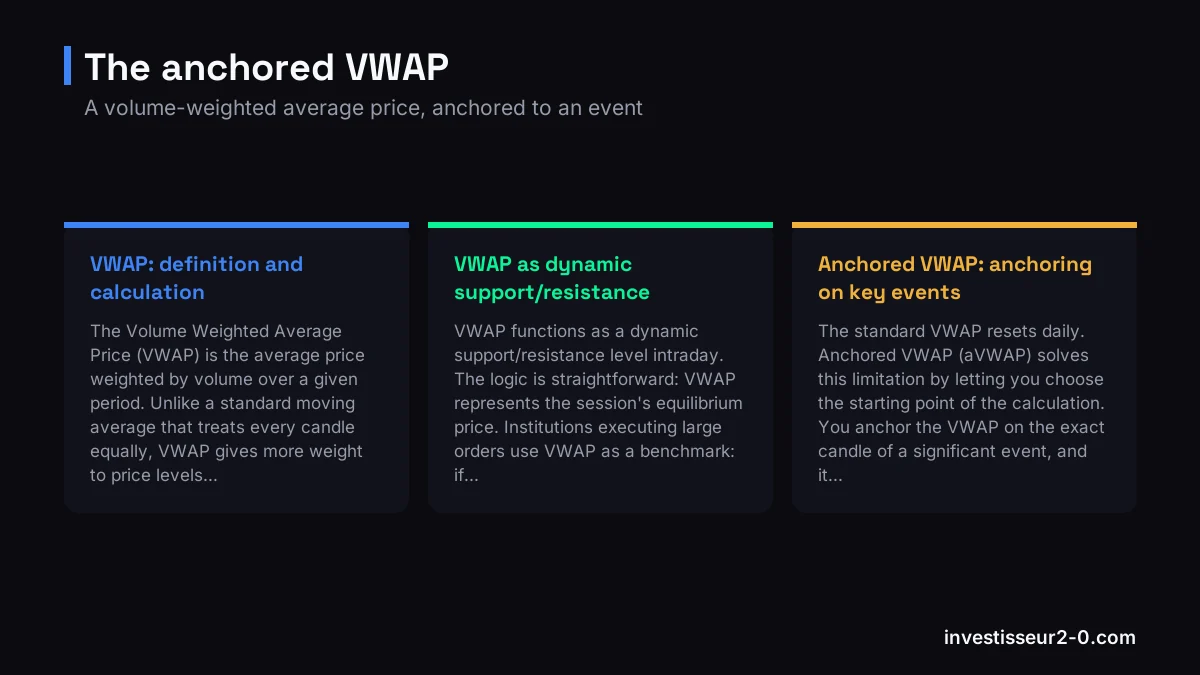
VWAP as dynamic support/resistance
VWAP functions as a dynamic support/resistance level intraday. The logic is straightforward: VWAP represents the session's equilibrium price. Institutions executing large orders use VWAP as a benchmark: if they bought below VWAP, they got a better price than the market average.
In practice:
- Price above VWAP: session buyers are in average profit. Bullish bias. Look for longs on pullbacks toward VWAP.
- Price below VWAP: session buyers are in average loss. Bearish bias. Look for shorts on rallies toward VWAP.
- Price oscillating around VWAP: no clear bias. Ranging session, so avoid forcing directional trades.
For the basics of chart reading and volume interpretation, see our crypto chart reading guide.
Anchored VWAP: anchoring on key events
The standard VWAP resets daily. Anchored VWAP (aVWAP) solves this limitation by letting you choose the starting point of the calculation. You anchor the VWAP on the exact candle of a significant event, and it calculates the volume-weighted average price from that moment forward.
The most relevant anchor points in crypto:
- Bitcoin halving: the aVWAP since the halving shows the volume-weighted average price of all post-halving trades. A retest of this level often acts as a major institutional support.
- FOMC announcements / macro decisions: anchoring on the announcement candle reveals where the market prices in the real impact of the decision.
- Token listing: the aVWAP since the first trade gives the average price of early buyers, a strong psychological support.
- Major liquidation wick: after a flash crash or liquidation cascade, the aVWAP from the wick shows the post-shock equilibrium level.
On TradingView: select the "Anchored VWAP" tool from the drawing toolbar (anchor icon), then click on the starting candle. The line draws automatically.
Application in day trading: BTC, ETH, SOL
VWAP is particularly effective on high-liquidity assets. On BTC intraday (5M/15M), price frequently bounces off the VWAP, especially during US and Asian sessions when volume is concentrated.
On ETH and SOL, behavior is similar but deviations are wider. Use the VWAP standard deviation bands (available in TradingView settings) as intraday overbought/oversold zones:
- +1 deviation: intraday overbought zone, take partial profits on longs or look for shorts if bearish confluence exists.
- -1 deviation: intraday oversold zone, look for longs if bullish confluence exists.
- +/-2 deviations: extremes, where price rarely stays for long. High-probability mean reversion level.
The ATR remains the reference tool for calibrating stops on these setups: VWAP gives direction and level, ATR gives protective distance.
VWAP + SMC: the confluence that changes everything
This is where VWAP reaches its full power. An order block identified on the chart is a zone where institutions accumulated or distributed. VWAP represents the volume-weighted equilibrium price. When both converge on the same level, you have a high-probability confluence.
Concrete scenario on BTC 15M:
- You identify a bullish order block around $68,200 on the 15M chart.
- The session VWAP sits at $68,150 and is slowly rising.
- The Anchored VWAP from the US session open passes through $68,250.
- Three levels converge within a $100 zone, which makes this a high-probability entry zone for a long.
This approach works because two independent logics overlap: structural logic (SMC) and volume logic (VWAP). Institutions returning to sweep liquidity in the order block find a price below VWAP, so it is "cheap" relative to the session. They finish executing their orders, and price moves up.
To go deeper on risk management for these setups, see our complete risk management guide.
Volume as a validation filter
VWAP is built on volume, so it makes sense to validate VWAP signals with raw volume reading. When price touches VWAP and volume spikes significantly, it signals that institutions are reacting to this level. A VWAP touch with anemic volume suggests lack of interest and a likely breakdown.
The OBV (On-Balance Volume) is a useful complement: a bullish OBV divergence near VWAP considerably strengthens the buy signal.
Common mistakes with VWAP in crypto
VWAP looks simple on the surface, but several classic mistakes reduce its effectiveness:
- Using VWAP on too high a timeframe: the standard VWAP is an intraday tool. On daily or weekly charts, it loses relevance because it resets each session. For higher timeframes, use Anchored VWAP.
- Ignoring the volume context: a VWAP calculated on a low-volume session (crypto weekend, US holiday) is less reliable. VWAP is only as strong as the volume behind it.
- Treating VWAP as an exact level: VWAP is a zone, not a line. Price can pierce VWAP by a few dozen dollars before reacting. Use standard deviation bands as buffer zones.
- Stacking too many Anchored VWAPs: anchoring 10 aVWAPs on one chart creates visual noise. Limit yourself to 2-3 anchors on the most significant events.
- Using VWAP alone without confluence: VWAP is not an entry signal by itself. It is a directional filter and a confluence level. It must be combined with structural reading (order blocks, FVG) and ATR-calibrated risk management.
Summary
VWAP and Anchored VWAP are confluence tools, not signal indicators. The standard VWAP gives you the intraday bias, bullish or bearish relative to the session's equilibrium price. Anchored VWAP extends this logic to major market events, revealing levels where institutions have accumulated since a turning point. Combined with SMC zones (order blocks, FVG), they provide high-probability entry points. Follow the rules: never trade VWAP alone, validate with volume, and always calibrate your stop with ATR.