
Can you trade crypto full-time? An honest answer for 2026
Short answer: yes, it is possible. Long answer: not for the reasons you think, not with the capital you imagine, and not at all the way influencers show. Here are the real conditions.
The numbers nobody likes
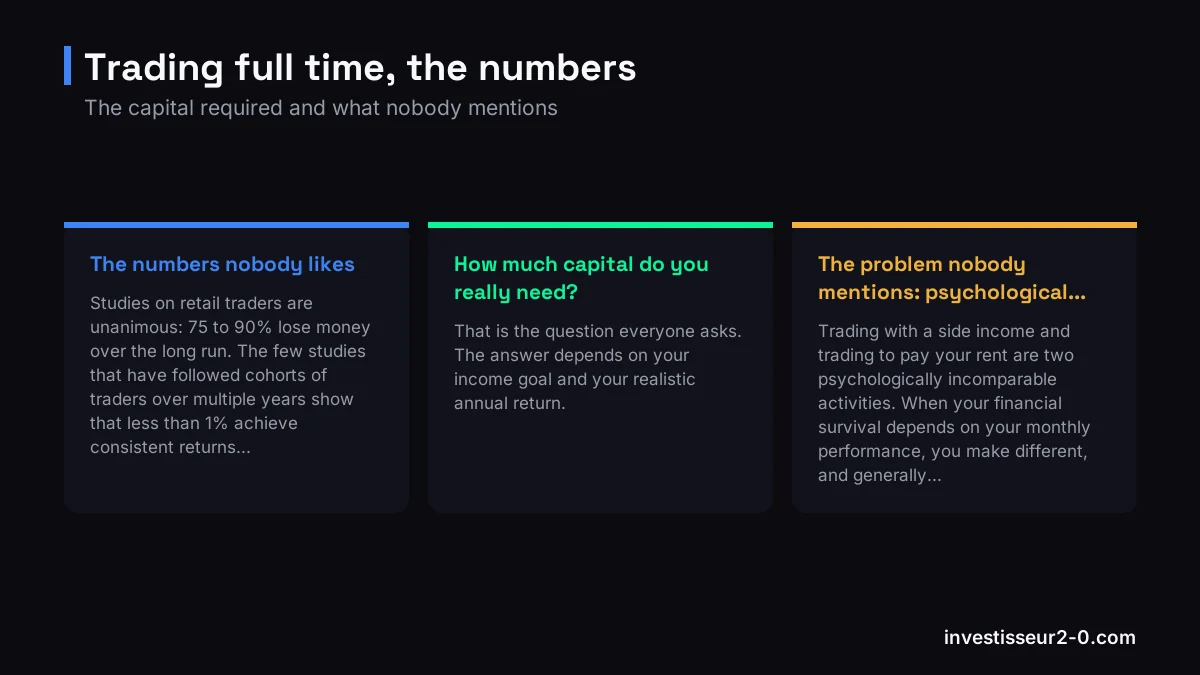
Studies on retail traders are unanimous: 75 to 90% lose money over the long run. The few studies that have followed cohorts of traders over multiple years show that less than 1% achieve consistent returns above a simple Bitcoin ETF.
Not to discourage you, but to prepare you for what the transition to full-time trading actually involves. See our detailed analysis in why 90% of traders lose money.
How much capital do you really need?
That is the question everyone asks. The answer depends on your income goal and your realistic annual return.
An intermediate trader with a solid strategy can target 25-40% net annual return (after fees, taxes, drawdown periods). It is an ambitious but realistic objective for a profile with 2-3 years of real experience and rigorous discipline. Exceptional years (2021 bull market, 2024-2025) can exceed those numbers, but they don't repeat every year.
For a $3,000 monthly net income ($36,000 / year), with a roughly 25-30% effective tax rate on capital gains, you'd need to generate around $50,000 gross per year. With a 30% return on capital:
Required capital ≈ 50,000 / 0.30 = $170,000
The target income sets the capital, not the other way around, and the statistics are a reminder that this is the exception, not the rule.
And that calculation does not factor in down years (-20% is possible), social charges if you operate as self-employed, or the fact that your capital must also absorb your drawdown without putting you in financial trouble. In practice, for real safety, plan for at least $250,000 to target $3,000 net/month without stress.
For a more detailed breakdown of capital needs by goal, see how much capital you need to start trading crypto in 2026.
The problem nobody mentions: psychological pressure
Trading with a side income and trading to pay your rent are two psychologically incomparable activities. When your financial survival depends on your monthly performance, you make different, and generally worse, decisions.
The pressure of "having to win this month" leads to:
- Overtrading: trading too often to "catch up" lean periods, often on suboptimal setups.
- Excessive sizing: increasing positions to recover losses faster, the direct path to catastrophic drawdown.
- Premature winner exits: cashing in gains quickly to "secure" a positive monthly result, instead of letting profitable trades run.
Professional traders who have lived off trading for several years almost universally describe the same thing: the transition was only possible once they had enough capital that ordinary monthly losses would not endanger their lifestyle.
The realistic model: trading + complementary income
Very few traders live exclusively off the P&L of their positions. Most "full-time traders" we know combine:
- Proprietary trading: their own capital, managed with discipline.
- Third-party management (with the appropriate licenses): managing investor capital for a performance fee.
- Educational content: courses, paid communities, advisory. That's one reason so many trading "experts" run YouTube channels or courses: educational income stabilizes the months when trading is hard.
- Side services: tool, bot or analysis-script development for other traders or institutions.
This hybrid model is more stable, less stressful, and paradoxically often improves trading performance, because you're not under pressure to "have to" generate income every month from P&L alone.
The non-negotiable prerequisites
If you still want to aim for full-time trading, here are the minimum conditions we consider non-negotiable:
- At least 2 years of real trading with a documented trading journal, no simulation, no paper trading. Real trades, real market conditions, real emotions.
- A positive track record across at least 2 different market cycles (bull + bear, or at least one bear market navigated profitably). Anyone can make money in a bull market.
- A documented maximum drawdown below 20% on your real history. If your MDD is above 30%, you're not ready.
- A separate personal emergency fund of 6-12 months of expenses, fully independent of your trading capital. That safety net is what lets you trade without existential pressure.
- A written, tested, non-negotiable strategy with documented entry, exit, sizing and drawdown rules. See our 2026 methodology.
Our honest take
Full-time trading is achievable, but not in the first 12 to 24 months. The realistic path for someone starting from scratch looks like: a 1-2 year learning phase (part-time trading, limited risk capital), then growing complementary income (phase 2-4 years), then a possible transition to a primary activity if financial and psychological conditions allow.
People who "go full-time trading" after 3 profitable bull-market months almost always come back to a salaried job after the first bear market or first hard period. Patience in the progression is the rare real skill.