
Pionex bots 2026: all 31 bots dissected
All Pionex bots in detail: Spot, Futures, Moon Bots, Onchain memecoins, Wheel options, Trailing, Hedging, Arbitrage, Copy Trading. Exact mechanics, key parameters, Investisseur 2.0 configurations and risk management. The definitive English-language reference.
Table of contents
- 1. Why a trading bot?
- 2. Pionex in 60 seconds
- 3. Spot Bots (5)
- 4. Futures Bots (6)
- 5. Moon Bots (4)
- 6. Onchain Grid (memecoins)
- 7. Trailing Bots (4)
- 8. Options Bots (5)
- 9. Technical tools (3)
- 10. Copy & Signals (3)
- 11. Which bot for which market?
- 12. Investisseur 2.0 configurations
- 13. Common mistakes
- 14. Risk management
- 15. How to start
- 16. FAQ
The best trading bots for crypto, in one answer
For most people the best crypto trading bots in 2026 are the ones built into an exchange: they cost nothing beyond trading fees and need no API key. Pionex offers about 31 of them, free, at 0.05% maker and taker. The Grid bot for a market that ranges, the DCA bot for accumulating on a schedule, the Infinity Grid for a slow uptrend, and the Moon bots that charge 20% of net profit only when you close in the green. OKX and Bybit also ship grid and DCA bots inside their apps, convenient if you already trade there. A bot does not predict the market; it executes a rule. Pick the rule for the regime you expect, size it with 1 to 2% of capital per bot, and stop it when the regime changes. The rest of this guide goes bot by bot. Updated 19 October 2026.
1. Why a trading bot?
A bot doesn't do more than what you tell it. It doesn't read the market, doesn't adapt to news, doesn't make discretionary decisions. It's not a trader, it's an executor. But that's exactly its strength: it executes without emotion, without fatigue and 24/7. Where a human hesitates to buy back during a fall, the bot mechanically buys at every level.
Good use cases:
- Sideways or trending markets: Grid Bots automatically collect volatility
- Long-term accumulation: DCA Bot buys without emotional bias
- High-frequency strategies: impossible to execute manually
- Funding rate arbitrage: capture funding without monitoring
- Copy trading: replicate experienced traders' performance
Bad use cases: violent breakout markets (Grid underperforms simple buy & hold), discretionary setups requiring human judgment, fundamental news that changes the game.
2. Pionex in 60 seconds
Pionex is a crypto exchange founded in 2019 (Singapore), specialized in native trading bots. Its specificity: most bots are free, only Moon Bots use a premium model (0% fees + 20% management fee on profit). You only pay standard trading fees (0.05% maker/taker) on the others.
Pionex offers 31 distinct bots across 8 categories. The two flagship products are Spot Grid (88,000+ users) and Futures Grid (123,000+ users). Liquidity is aggregated from Binance and Huobi via API, ensuring tight spreads.
For more on Pionex as an exchange (fees, security, KYC, deposits/withdrawals), see our Pionex review. This article focuses exclusively on the bots and their practical use.
3. Spot Bots (5 bots)
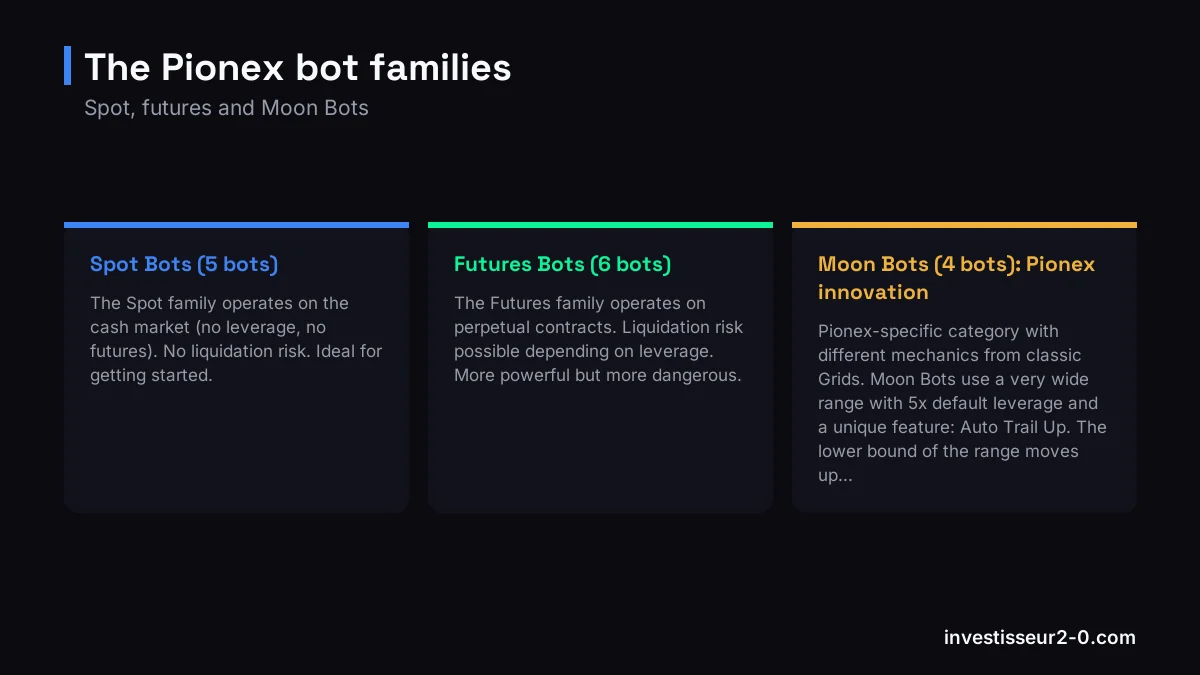
The Spot family operates on the cash market (no leverage, no futures). No liquidation risk. Ideal for getting started.
3.1 Spot Grid: the pillar (88,000+ users)
Pionex's flagship bot. Official tagline: "Buy low and sell high 24/7". You define a range (e.g., $60,000-$80,000 on BTC), a number of grids (typically 50-80), the bot automatically places staggered limit orders at each line. Price drops a line, it buys. Price rises a line, it sells. Each round trip generates a small profit.
Example: BTC at $70k, range $60k-$80k, 50 grids ($400 each). Over 30 days with 100 oscillations, that's ~50% annualized APY on allocated capital. But only if price stays in the range.
When to use: confirmed sideways market on 4H and Daily, high-liquidity pair (BTC, ETH, BNB, SOL), no strong directional conviction. When to avoid: confirmed bullish breakout (underperforms buy & hold), crash in progress, capital too low (<$200, fees eat profits).
3.2 DCA Bot (Dollar-Cost Averaging)
Recurring automatic purchases of a fixed amount at regular intervals (daily, weekly, monthly), regardless of price. Antidote to market timing. Long-term in a globally bullish asset, DCA smooths the average buy price and reduces emotional stress.
Example: weekly $100 DCA on BTC for 12 months (52 buys × $100 = $5,200). If weighted average price is $75k and BTC ends at $85k, your portfolio is worth ~$5,893. If you'd lump-summed at the worst moment ($92k), you'd be at $4,804. DCA saves you from worst timing.
Ideal for: long-term BTC/ETH/blue-chip investment, regular income to convert. Limit: not optimal in prolonged bear (you accumulate a falling asset). DCA pays over 3-5 years, not 6 months.
3.3 Reverse Grid Bot
The inverse of the classic Grid. You start with an asset you want to sell progressively against stablecoin, while collecting volatility. Imagine you have 1 BTC and want to convert it to USDT progressively. The bot sells in tiers up, buys back in tiers down, but with reversed polarity vs the classic Grid. End up with less BTC but more stablecoin than direct sale at average price.
Use cases: progressive distribution of a position that performed well, stockpile USDT for buyback dips, wealth strategy over 6-12 months.
3.4 Infinity Grid Bot
Variant of the classic Grid without high cap. You only set the lower bound. The bot keeps placing sell orders above current price, indefinitely, as price rises. Solves the classic Grid's main problem: if BTC breaks your high cap and rises 50%, the Grid stops (full stablecoin) and you miss the move.
When to use: potentially trending bull market with frequent corrections, asset that already broke its bullish HTF structure.
3.5 Margin Grid Bot
Grid with borrowed funds (spot margin) to amplify positions. Different from Leveraged Grid (which uses futures). No futures liquidation risk, but exposed to a classic margin call if the market reverses strongly. Lets you run a Grid with more capital exposed than your actual balance.
Moderate risk (between spot Grid and Leveraged Grid). Reserved for experienced traders who already master margin trading. Always monitor margin ratio and accumulating borrowing fees.
4. Futures Bots (6 bots)
The Futures family operates on perpetual contracts. Liquidation risk possible depending on leverage. More powerful but more dangerous.
4.1 Futures Grid: the 2nd most-used bot (123,000+ users)
Official tagline: "Long or short to profit from market trends". Same Grid mechanic as Spot, but on perpetual contract with configurable leverage. You choose direction (Long, Short, Neutral) and leverage. Long: profits from upward oscillations. Short: downward. Neutral: pure grid without directional bias.
Most used on Pionex (more than Spot Grid). Why? Leverage amplifies profit per cycle, and Short mode lets you play bear markets that Spot Grid can't exploit.
Main risk: liquidation if price exits violently from the bound opposite to your direction. With 5x leverage, a 20% move against = total liquidation. Always size with capital you can fully lose.
4.2 Futures DCA Bot
Classic DCA but on futures contracts. Schedule recurring buys (long or short) at fixed intervals with leverage. Lets you accumulate a futures position progressively without manual timing.
Use cases: long-term leveraged exposure to an asset without single-shot entry, progressive short in a confirmed bear market. Watch funding fees that accumulate over time: they can make the strategy unprofitable on long periods if funding is unfavorable.
4.3 Cross Margin Futures Grids
Grid Bot with cross margin. Collateral is shared across all your Pionex positions instead of being isolated per bot. Advantage: if a position is at a loss, other positions' collateral absorbs the risk, reducing isolated liquidation risk. Drawback: a massively losing position can drag others into liquidation.
For experienced traders managing a futures bot portfolio who want optimized capital efficiency. Not for beginners.
4.4 COIN-M Futures Grid (New)
Grid on coin-margined futures: collateral is BTC or ETH, not USDT. If you want a Long BTC-margined Grid, you deposit BTC, the bot plays with it, and profits are denominated in BTC. Particularity: you naturally accumulate the underlying crypto when the bot operates.
When to use: you're long-term bullish on BTC/ETH and want bot profits to add to your crypto stack, not stablecoin. More crypto-risk-exposed since collateral fluctuates with price.
4.5 Leveraged Grid Bot ⚠️
Advanced bot. Total liquidation risk if poorly calibrated. Reserved for experienced traders who already master spot Grid and leveraged futures.
Same mechanic as classic Grid but on futures with configurable leverage (3x to 10x). Profits per cycle multiplied by leverage, but losses too. If price exits violently down (Long) or up (Short), position liquidated. You lose 100% of bot-allocated capital. Not 30%, not 50%, everything.
When to use: very confirmed sideways market (stable range 2-3 months), moderate leverage (3x max to start), capital that can be 100% lost (max 5-10% of total portfolio), TradingView alert at liquidation price for manual intervention if needed.
4.6 Hedging Bot
Hedging strategy: simultaneously opens a long and short position on the same pair to neutralize directionality. Profits only from price discrepancies or volatility, not from market direction.
Use cases: protect an existing spot position (you're long BTC spot, the Hedging Bot opens an equivalent short futures to neutralize directional risk during an uncertain period). Low but stable yield, ideal for crypto treasury management.
5. Moon Bots (4 bots): Pionex innovation
Pionex-specific category with different mechanics from classic Grids. Moon Bots use a very wide range with 5x default leverage and a unique feature: Auto Trail Up. The lower bound of the range moves up automatically as price rises, preventing capital erosion and downward liquidation risk.
Moon Bots specific fee model
0% trading fee on all orders while the bot runs. 20% management fee only on net profit when closing or reducing the position. Close at a loss, zero fees. "No-loss-no-fee" model that drastically reduces the risk of losing on fees.
5.1 Futures Moon
Generic Moon Bot: choose the futures pair, direction (Long / Short / Neutral), leverage. Very wide range by default, Auto Trail Up activated. Built to exploit volatility of a significant directional move on any pair.
5.2 BTC Moon
Moon Bot pre-configured on BTC/USDT Perp. Typical range: 66,000-180,000 based on a BTC at $78k. Long direction by default. Parameters reflect a bull-market bullish view on BTC. Ideal for bullish expansion phases where you want to profit from volatility with a range that follows the price.
5.3 ETH Moon
Moon Bot pre-configured on ETH/USDT Perp. Typical range: 1,965-6,000 based on an ETH at $2,300. Same mechanic as BTC Moon but on ETH. Identical usage logic: bull market thesis on ETH with volatility exploitation.
5.4 Bitcoin Growth (= ETH/BTC Moon)
Moon Bot on the ETH/BTC perpetual ratio pair. You bet on relative performance between ETH and BTC. Long = you think ETH will outperform BTC (ETH/BTC ratio rises). Short = you think BTC will outperform ETH. Neutral = you just play the ratio's volatility without bias.
Advanced use case: during altcoin seasons, the ETH/BTC ratio rises massively. During market resets or BTC dominance rallies, it falls. Lets you play these cycles with a dedicated instrument and moderate leverage.
6. Onchain Grid (memecoins with AI)
Unique category on Pionex: Grid Bot on onchain tokens (memecoins, low-cap altcoins). Pionex offers a pre-configured AI strategy for each pair with 30-day backtest visible before launch (typically 15-25% APY backtest with 15-25% drawdown).
Workflow: pick the token (e.g., JELLYJELLY, PEPE, WIF, other memecoin), see the proposed AI strategy with its bounds (upper limit, lower limit) and max backtested drawdown, click "Copy bot" or "Customize" to adjust.
When to use: you want exposure to memecoins without manually calibrating ranges (very difficult on these hyper-volatile assets), you accept the inherent risk of low-cap onchain tokens (rug pulls, brutal listing/delisting). Always allocate capital you can fully lose.
7. Trailing Bots (4 bots)
7.1 Smart Trade Terminal
Not really an autonomous bot but an advanced trading terminal with chained conditional orders in a single action:
- Buy order (market or limit)
- Take Profit in multiple levels (TP1 / TP2 / TP3) with exit percentages
- Stop Loss with optional trailing
- OCO orders (One Cancels the Other)
Ideal use case: discretionary trader following our VIP plans. You receive the signal on Telegram (entry 70,200, stop 69,800, TP1 71,500, TP2 73,000, TP3 75,500), translate directly into Smart Trade Terminal. Clean automated execution.
7.2 Trailing Sell
Automatic sell with trailing stop. Set a trailing percentage (e.g., 5%). As price rises, the sell threshold rises too. When price retraces 5% from its highest reached, the bot automatically sells. Captures maximum profit on a bullish move without guessing the top.
7.3 Trailing Buy
Symmetric to Trailing Sell. You wait for a confirmed bullish breakout to buy. Set a trailing percentage. If price keeps falling, the bot waits. As soon as price rises X% from its lowest, it buys. Avoids buying too early in a fall.
7.4 Reverse DCA / Trailing DCA
Advanced variant of classic DCA with trailing rules. Instead of buying on fixed schedule, the bot buys when price drops a certain percentage from recent high, with dynamic sizing (buys more on deeper drops). DCA optimization for volatile markets.
8. Options Bots (5 bots): advanced section
Reserved for experienced options traders. Pionex documents these bots sparsely in its interface. If you've never traded options, learn the basics first (puts, calls, theta, gamma, IV) before using these bots. They're powerful but can generate significant losses if misunderstood.
8.1 Wheel Strategy
Classic options strategy: sell cash-secured puts (collateral in stablecoin). If assigned, you receive crypto at the strike price. Then sell covered calls on this crypto. If assigned, sell at a higher price. Collect premium at each sale. Profits from theta (time decay of options).
Use case: sideways to slightly bullish market, regular yield generation on stable capital. Risk: if crypto crashes violently after put assignment, you can end up with a losing position.
8.2 ETH/BTC Wheel Strategy
Wheel Strategy on the ETH/BTC ratio pair. Identical logic but with ETH/BTC options instead of classic BTC or ETH options. Much less liquid, reserved for very experienced traders who understand the ratio's specifics.
8.3 Buy The Dip Options
Cash-secured put options strategy: sell an OTM (out-of-the-money) put with strike below current price. If price drops to the strike, you're assigned and receive crypto at a discounted price. Otherwise, collect premium and repeat.
Advantage vs classic DCA: you collect premium even if the dip doesn't come. Drawback: requires locking collateral for the option's duration.
8.4 Covered Call
Classic strategy: hold a crypto in spot, sell an OTM call on it (strike above current price). If price exceeds the strike, your crypto is sold at that price (you miss the rest of the rise). Otherwise, collect premium.
Generates yield on long-term positions as long as you're not assigned. Doesn't suit very bullish views (caps your upside).
8.5 Side Gain (Iron Condor / Strangle)
Multi-leg options strategy to profit from confirmed sideways markets. Combines sold puts and calls with bought protections. Profits from theta on a defined price zone. If price exits the zone strongly (up or down), you incur losses capped by protections.
Reserved for expert options traders. Strike and expiration calibration is critical to stay profitable. Don't use without backtesting.
9. Technical tools (3)
9.1 TWAP Bot (Time-Weighted Average Price)
Executes a large position by fragmenting it over a defined time interval to minimize order book impact. Example: you want to buy $50,000 of ETH, but a single order would move price against you. TWAP fragments into 100 $500 orders spread over 4 hours. Slippage minimal, clean average price.
For: significant capital ($10,000+) on moderately liquid pairs. For sub-$1,000 on BTC/ETH, TWAP is overkill (negligible market impact).
9.2 Stop Limit
More an order type than a bot, but Pionex lists it in the bots section. Conditional order: set a trigger price (stop), beyond which a limit order is placed at the defined limit price. Lets you automate a position exit or an entry on structural break.
9.3 Rebalancing Bot
Automatically maintains target percentages of a multi-asset portfolio. Example: 40% BTC / 30% ETH / 20% SOL / 10% USDT. At each deviation threshold (e.g., 5%), the bot sells what outperformed and buys what underperformed. Systematic buy low / sell high at portfolio level.
Long-term, rebalancing captures relative volatility between assets. Particularly effective in global sideways market with sector rotations.
10. Copy & Signals (3)
10.1 Top traders bots
Copy the configurations of bots (Grid, DCA, Reverse, Moon, etc.) from top public Pionex traders. Pick a trader based on their history (PnL, drawdown, trade frequency), click "copy", the bot launches with their exact parameters.
Watch out for: short history (<6 months) = statistically insignificant data, max drawdown >30% = you'll experience it too, bear market performance (many "top traders" shine in bull and explode in bear).
10.2 CopyBot
Different from above: copy a specific trader's manual trades. Input their URL or identifier, your positions replicate theirs in real time. Classic copy trading but native Pionex, no intermediary.
Advantage vs Top traders bots: you follow a trader's discretionary decisions (entries, exits, stop adjustments). Drawback: quality depends entirely on the followed person. Verify long track record, transparent stats, and strategy followed.
10.3 Signal Bot (TradingView webhook)
Pionex provides zero internal signals. The Signal Bot is a webhook system: set up a TradingView conditional alert with a webhook URL pointing to your Pionex account. At each alert trigger (level break, indicator signal, etc.), the bot automatically executes corresponding orders.
Use case: automate strategies you code in Pine Script on TradingView without having to recode them for Pionex. For example, your Investisseur 2.0 SM Radar could be connected to this bot to automatically execute the SMC signals it detects.
11. Which bot for which market?
| Market / Goal | Recommended bot | Profile |
|---|---|---|
| Simple range / sideways | Spot Grid | All levels |
| Range with leverage | Futures Grid Neutral | Intermediate |
| Strong bull trend | Infinity Grid + DCA + Moon | Intermediate |
| Bull with moderate leverage | BTC Moon or ETH Moon (5x) | Advanced |
| Bear / confirmed fall | Slow DCA or Futures Grid Short | Disciplined |
| Wealth distribution | Reverse Grid | Intermediate |
| Memecoin trading | Onchain Grid (with AI config) | Intermediate (losable capital) |
| Altcoin season (ETH outperforms BTC) | Bitcoin Growth (ETH/BTC Moon Long) | Advanced |
| VIP discretionary setup | Smart Trade Terminal | All levels |
| Market-neutral yield | Hedging Bot or Wheel Strategy | Advanced |
| Coded TradingView strategy | Signal Bot (webhooks) | Technical advanced |
| Very confirmed range + risk capital | Leveraged Grid (3x max) | Expert |
12. Investisseur 2.0 configurations
For VIP INVEST members signed up at Pionex via our affiliate link, we regularly share bot configurations calibrated to current market conditions. Updated at every significant structural change.
Typical config examples:
- Spot Grid BTC/USDT: range $65k-$82k, 60 grids, $500 minimum capital
- DCA Bot ETH: $100 weekly indefinitely, 18-24 month horizon
- Reverse Grid SOL/USDT in distribution phase: activate during last expansion leg
- BTC Moon Long 5x: range $70k-$180k, Auto Trail Up activated, activate on bullish HTF confirmation
- Onchain Grid current memecoins: weekly recommendation with max 1-3% capital sizing
- Hedging Bot BTC: activate to protect a spot position during uncertainty phase
Configurations shared on the VIP Telegram channel with parameter screenshots ready to copy-paste. Adjust to your capital, allocation percentages and logic remain valid.
13. Common mistakes (avoid in advance)
Mistake #1: range too tight on Grid Bot
Range based on recent noise (5% from last 7 days). First week of bull move, price exits up, bot stops, 100% in USDT while it rises. Rule: range based on HTF structure (4H or Daily SMC), not short-term noise.
Mistake #2: full capital on a single bot
100% on a BTC Grid, market crashes, poorly placed Grid buying at each descent level. Massive drawdown. Diversify: never more than 30% of total bot capital on a single bot. Combine Spot + Futures + Moon + Onchain to spread risk.
Mistake #3: ignoring market conditions
The bot runs automatically, but that doesn't mean stop watching the market. Monitor range bounds and HTF structure. If price breaks major structure (Daily BOS), deactivate or adjust, because the bot doesn't know context changed.
Mistake #4: high leverage on Leveraged Grid or Moon Bots
See 10x in the interface, think "multiplies gains". Yes, and multiplies liquidation on any wick. Maximum 3-5x to start, with capital you can fully lose. Moon Bots with Auto Trail Up reduce risk but don't eliminate it if the move is violent against you.
Mistake #5: copying a CCTV/CopyBot trader without checking drawdown
+2,000% over 18 months = classic trap if max drawdown is 75%. A week later, your capital melts. Always read risk stats (drawdown, Sharpe, volatility), not just absolute PnL.
Mistake #6: underestimating Moon Bot management fee
20% of net profit may seem high. Concretely: on $500 profit, Pionex takes $100. But the 0% trading fee largely compensates on high-volume bots. Calculate case by case based on your style. For low-profit bots (<5% APY), classic Grid without fees may be better.
14. Bot portfolio risk management
Some rules to last in the long run:
- Max allocation per bot: 30% of total bot capital. Diversify across 4-6 bots minimum.
- "Bots" capital = max 50% of total crypto capital. Keep the rest in pure holding.
- Zero leverage to start. Spot Grid without leverage has no liquidation risk: a first learning ground.
- Monthly review. PnL per bot, parameter adjustments, deactivate underperformers.
- Mental conditional stop. If a bot loses more than 15% of allocated capital, cut and rethink. No persistence.
- Diversification by category. Mix Spot Grid + Futures Neutral + Moon + Onchain + Hedging instead of 5 Grids on the same pair.
For real discipline, see our complete risk management guide.
15. How to start concretely
- Create your Pionex account via our partner link. Free, with simple KYC. This is what unlocks VIP INVEST access later.
- Deposit minimum $100. Our threshold to validate VIP INVEST access. Also the technical minimum for a Grid Bot to work without fees eating profits.
- Validate your Pionex UID via our Telegram bot (@Invest_bienvenue_bot). Auto verification in 30 seconds, VIP INVEST unlocked.
- Start with the Spot Grid on BTC/USDT with $200-500. Range based on Daily structure, 50 grids. Run 30 days, observe results before expanding to other bots.
- Once you master Spot Grid: add a long-term ETH DCA, then explore a Reverse Grid or an Onchain Grid on memecoin with small capital.
- Intermediate level: move to Futures Grid Neutral (no directional bias), then Moon Bots with moderate leverage (3x).
Recap: start in 4 steps
Pionex account via our link → $100 deposit → Telegram UID validation → first BTC/USDT Spot Grid. ~15 minutes setup, first cycle within 24-48 hours.
Create my Pionex account16. Frequently asked questions
What are the best trading bots for crypto in 2026?
For most people the best crypto trading bots in 2026 are the ones built into an exchange, because they cost nothing beyond trading fees and need no API key. Pionex offers about 31 of them, free, at 0.05% maker and taker: the Grid bot for a market that ranges, the DCA bot for accumulating on a schedule, the Infinity Grid for a slow uptrend, and Moon bots that charge 20% of net profit only when you close in the green. OKX and Bybit also ship grid and DCA bots inside the app, convenient if you already trade there. A bot does not predict the market; it executes a rule. Pick the rule for the regime you expect, size it with 1 to 2% of capital per bot, and stop it when the regime changes.
How many bots does Pionex offer in 2026?
Around 31 distinct bots across 8 main families: Spot (Grid, DCA, Reverse, Infinity, Margin), Futures (Grid, DCA, Cross Margin, COIN-M, Leveraged, Hedging), Moon Bots (Futures Moon, BTC Moon, ETH Moon, Bitcoin Growth/ETH-BTC), Onchain Grid (memecoins with AI), Trailing (Smart Trade, Trailing Buy/Sell, Reverse DCA), Options (Wheel Strategy, Buy The Dip, Covered Call, Side Gain), Tools (TWAP, Stop Limit, Rebalancing), and Copy Trading (Top traders bots, CopyBot, Signal bot via TradingView).
Are Pionex bots really free?
Most Pionex bots are 100% free: no subscription, just standard trading fees (0.05% maker/taker). Exceptions: Moon Bots (Futures Moon, BTC Moon, ETH Moon, Bitcoin Growth) use a 0% trading fee + 20% management fee on net profit when closing or reducing the position. If you close at a loss, zero fees. No-loss-no-fee model.
Which Pionex bot for beginners?
The Spot Grid on BTC/USDT in a sideways market. Starting capital $200-500. You learn the range trading mechanics without excessive risk (no leverage, no liquidation possible). Once comfortable, explore the DCA Bot for long-term accumulation and the Reverse Grid to collect stablecoin from volatility.
What are Moon Bots and what makes them special?
Moon Bots (Futures Moon, BTC Moon, ETH Moon, Bitcoin Growth) are pre-configured Futures Grid Bots with 5x default leverage and a unique feature called Auto Trail Up: the lower bound of the range moves up automatically as price rises, preventing capital erosion and downward liquidation risk. Pricing 0% trading + 20% management fee on profit. Built for bull markets.
What's the difference between Margin Grid and Leveraged Grid?
Margin Grid uses borrowed funds (spot margin) to amplify positions, no futures contracts. Leveraged Grid uses perpetual futures contracts with leverage. Both multiply profits and losses, but Leveraged Grid exposes you to futures liquidation (100% loss possible) while Margin Grid exposes you to a classic margin call. Margin Grid less risky than Leveraged Grid on high volatility.
How does Pionex's Signal Bot work?
Pionex's Signal Bot provides zero internal signals. It's a webhook system compatible with TradingView: you set up a TradingView conditional alert with a webhook pointing to your Pionex account, and each alert triggers automatic order execution (buy, sell, futures position, etc.). Essentially a bridge between your TradingView strategies and Pionex execution.
CopyBot vs Top traders bots, what's the difference?
Top traders bots lets you copy the CONFIGURATIONS of bots (Grid, DCA, etc.) from top Pionex traders. You launch the same bot with their exact parameters. CopyBot copies a specific trader's MANUAL TRADES: you input their URL or identifier, your positions replicate theirs in real time, like classic copy trading.
Do I have to pay for Investisseur 2.0 configurations?
Never. All our bot configurations are shared free with VIP INVEST members on Telegram, after Pionex signup via our affiliate link and UID validation. 100% free policy, funded by exchange affiliate commissions.
Full Pionex review (exchange)
Fees, security, deposits, KYC, vs competitors
Pionex vs 3Commas vs Kryll
Complete comparison of three leading bot platforms
Risk management guide (1%)
1% rule, drawdown, sizing: also applies to bots
Complete Ecosystem page
VIP INVEST, VIP XT, Pionex, AI Analyzer: all services