
Bitcoin vs Ethereum: SMC analysis and trading differences
BTC and ETH share the same SMC methodology but their market behaviors differ significantly. Volatility, structure, correlation, ETH/BTC ratio, institutional narratives: here is what you need to adapt your strategy.
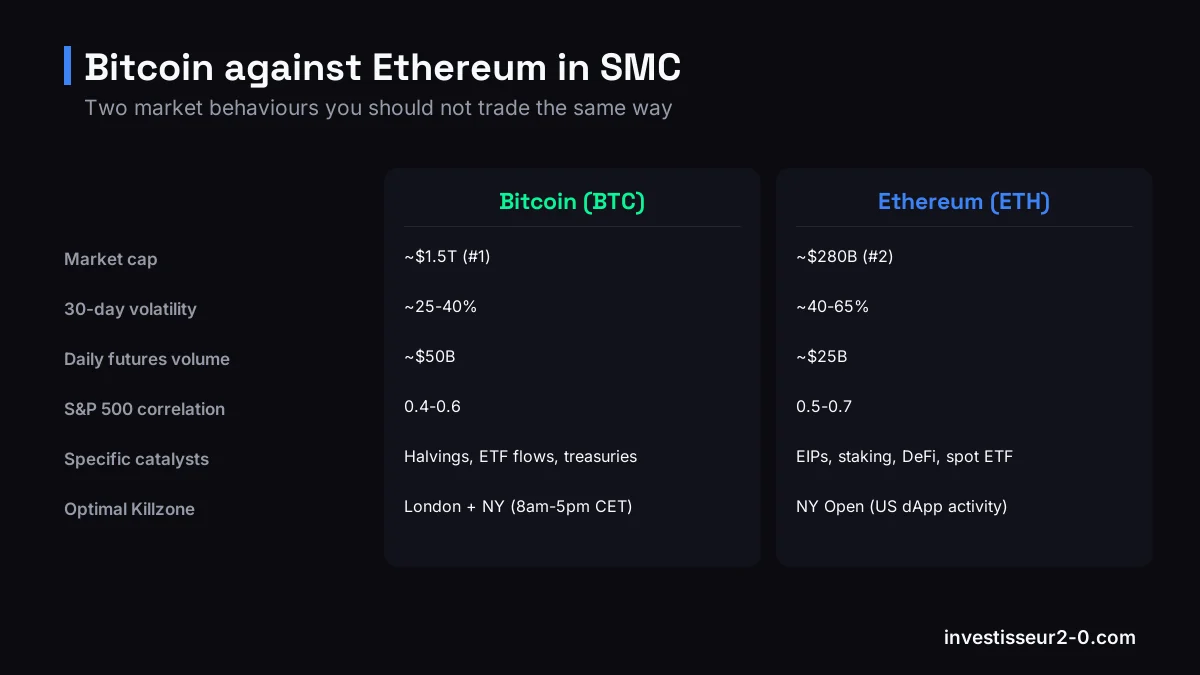
TL;DR: differences in 60 seconds
- Volatility: ETH ~30-50% more volatile than BTC. Wider ranges, more violent sweeps.
- Lead-lag: BTC leads ~70% of sessions. ETH leads during altseasons and DeFi/staking catalysts.
- Liquidity: BTC > ETH on spot and futures volume. SMC setups more reliable on BTC.
- ETH/BTC ratio: best barometer of risk-on/off sentiment in crypto.
- Adapted SMC setup: BTC on D1/H4, ETH on H4/H1 with extra confluence required.
Detailed comparison table
| Criterion | Bitcoin (BTC) | Ethereum (ETH) |
|---|---|---|
| Market cap | ~$1.5T (#1) | ~$280B (#2) |
| 30-day volatility | ~25-40% | ~40-65% |
| Daily futures volume | ~$50B | ~$25B |
| S&P 500 correlation | 0.4-0.6 | 0.5-0.7 |
| Specific catalysts | Halvings, ETF flows, treasuries | EIPs, staking, DeFi, spot ETF |
| Optimal Killzone | London + NY (8am-5pm CET) | NY Open (US dApp activity) |
| Best SMC timeframe | D1 → H4 → H1 | H4 → H1 → M15 |
| Order Block reliability | High (75-80% retest) | Moderate (60-70% retest) |
The head-to-head at a glance
The ETH/BTC ratio: the crypto barometer
The ETH/BTC ratio is the most powerful indicator to navigate between both assets. It measures how much Bitcoin is needed to buy 1 Ether. When the ratio rises, ETH outperforms BTC (possible altseason signal). When it falls, capital concentrates on BTC (risk-off or consolidation).
SMC setups on ETH/BTC
- BSL sweep + bullish CHoCH: imminent altseason signal. Capital rotation toward ETH and alts.
- SSL sweep + bearish CHoCH: start of risk-off. Capital flees back to BTC.
- Wide range without BOS: lateral market, take individual BTC or ETH setups based on their own structures.
Our BTC daily analyses archive and ETH daily analyses let you track this comparative behavior in real-time.
How to adapt your SMC strategy per asset
Bitcoin: standard methodology
- Identify macro Wyckoff phase on W1/D1 (accumulation, markup, distribution, markdown).
- On D1: spot unmitigated Order Blocks and liquidity zones.
- On H4: confirm bias via recent BOS.
- On H1: precise entry in OB + FVG in Discount zone.
- Stop below/above OB with ATR×1.5 buffer. Minimum R/R 1:3.
Ethereum: adapted methodology
Same steps but with mandatory extra confluences:
- ETH/BTC ratio confirmation: don't trade ETH long if ETH/BTC breaks SSL on D1.
- NY Killzone confluence: prefer entries 2pm-5pm CET (US dApps + Coinbase flows).
- Wider ATR buffer: ATR×2 minimum (higher volatility).
- Minimum R/R 1:4: compensates for more frequent false signals.
Frequently asked questions
Do Bitcoin and Ethereum trade the same way under SMC?
No. Bitcoin has lower extreme volatility and clearer institutional manipulation phases (sharper liquidity sweeps). Ethereum is more volatile, more correlated with altcoins and reacts heavily to DeFi/staking flows. SMC-wise: BTC Order Blocks are usually more reliable on higher timeframes (W1, D1); ETH setups require more confluence to avoid false signals due to volatility.
Should I diversify between BTC and ETH or focus on one pair?
For an SMC beginner: focus on Bitcoin first. More liquidity, clearer market structure, more abundant educational resources. Once the methodology is mastered (typically 6-12 months), expanding to Ethereum captures setups where ETH leads BTC (usually at the start of bull runs or during institutional rotations).
Does Bitcoin always lead the market or can Ethereum diverge?
BTC leads most of the time (~70% of sessions). But ETH can diverge on specific catalysts: ETF approvals, hard forks, DeFi/staking narratives, institutional moves on ETH spot. These divergences are opportunities for SMC traders who detect the disconnection via the ETH/BTC ratio.
How to trade the BTC/ETH correlation in SMC?
Watch the ETH/BTC ratio on Daily timeframe. When it breaks a bullish liquidity zone (BSL) with BOS confirmation, it's often the signal of an altseason starting. Conversely, a bearish BOS on ETH/BTC typically precedes corrections across the entire alts market. This ratio is the most reliable barometer of crypto risk-on/risk-off sentiment.
Which crypto pair is best to learn SMC?
Bitcoin on H4 or Daily timeframe. Reasons: max liquidity, observable institutional behavior (ETF flows, MicroStrategy-style public treasuries), clear market structure, less aberrant manipulation. Once Bitcoin is mastered, expand to Ethereum then to major altcoins (SOL, AVAX, BNB).
Go further
- 📊 BTC daily analyses archive
- 📊 ETH daily analyses archive
- 📊 SOL daily analyses archive
- 📘 SMC pillar guide (10,000 words)
- 🤖 AI SMC Analyzer (free)